
Pulp Fiction, 1909 · page 149 of 227
The Argosy for May — page 149: what you’re looking at
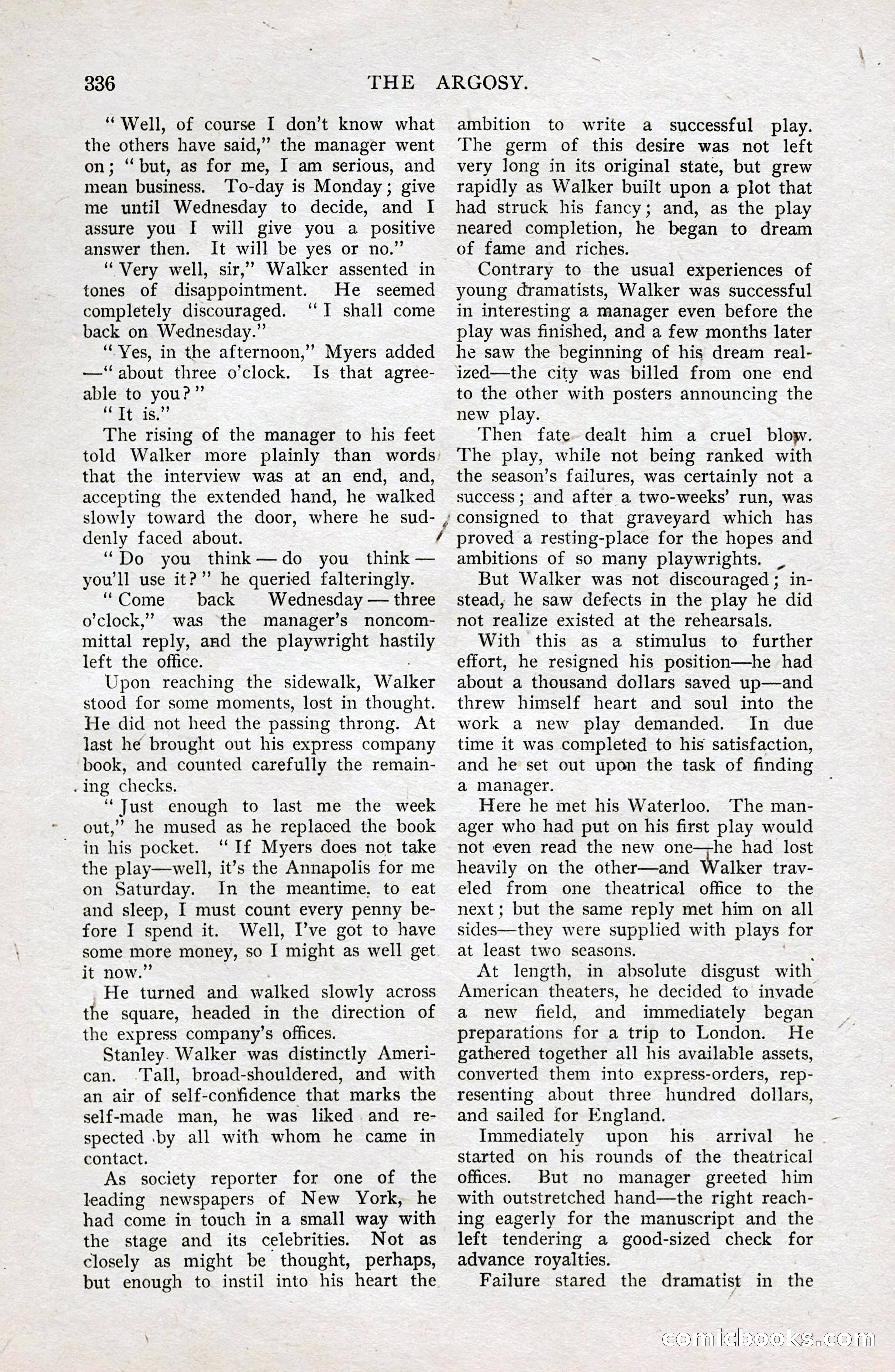
A restored page from Pulp Fiction, 1909. Page through the whole issue in the reader above.
📄 Transcribed text from this page (OCR, searchable)
Machine-transcribed from the original scan — historical spelling and the odd misread are preserved.
336 “Well, of course I don’t know what the others have said,” the manager went on; ‘but, as for me, I am serious, and mean business. To-day is Monday; give me until Wednesday to decide, and I assure you I will give you a positive answer then. It will be yes or no.” ‘Very well, sir,’’ Walker assented in tones of disappointment. He seemed completely discouraged. ‘I shall come back on Wednesday.” ‘Yes, in the afternoon,’’ Myers added —‘“about three o’clock. Is that agree- able to you?”’ paktass~ The rising of the manager to his feet told Walker more plainly than words that the interview was at an end, and, accepting the extended hand, he walked slowly toward the door, where he sud- denly faced about. “Do you think—do you think — you'll use it?” he queried falteringly. “Come back Wednesday — three o'clock,” was the manager’s noncom- mittal reply, and the playwright hastily left the office. Upon reaching the sidewalk, Walker stood for some moments, lost in thought. He did not heed the passing throng. At last he brought out his express company book, and counted carefully the remain- . ing checks. ‘Just enough to last me the week out,’ he mused as he replaced the book in his pocket. ‘If Myers does not take the play—well, it’s the Annapolis for me on Saturday. In the meantime. to eat and sleep, I must count every penny be- fore I spend it. Well, I’ve got to have some more money, so I might as well get it now.” 7 He turned and walked slowly across the square, headed in the direction of the express company’s offices. Stanley. Walker was distinctly Ameri- can. Tall, broad-shouldered, and with an air of self-confidence that marks the self-made man, he was liked and re- spected .by all with whom he came in contact. As society reporter for one of the leading newspapers of New York, he had come in touch in a small way with the stage and its celebrities. Not as closely as might be thought, perhaps, but enough to instil into his heart the é / THE ARGOSY. ambition to write a successful play. The germ of this desire was not left very long in its original state, but grew rapidly as Walker built upon a plot that had struck his fancy; and, as the play neared completion, he began to dream of fame and riches. Contrary to the usual experiences of young dramatists, Walker was successful in interesting a manager even before the play was finished, and a few months later he saw the beginning of his dream real- ized—the city was billed from one end to the other with posters announcing the new play. Then fate dealt him a cruel blow. The play, while not being ranked with the season’s failures, was certainly not a success; and after a two-weeks’ run, was ‘consigned to that graveyard which has proved a resting-place for the hopes and ambitions of so many playwrights. But Walker was not discouraged ; in- stead, he saw defects in the play he did not realize existed at the rehearsals. With this as a stimulus to further effort, he resigned his position—he had about a thousand dollars saved up—and threw himself heart and soul into the work a new play demanded. In due time it was completed to his satisfaction, and he set out upon the task of finding a manager. Here he met his Waterloo. The man- ager who had put on his first play would not even read the new one—-he had lost heavily on the other—and Walker trav- eled from one theatrical office to the next; but the same reply met him on all sides—they were supplied with plays for at least two seasons. At length, in absolute disgust with American theaters, he decided to invade a new field, and immediately began preparations for a trip to London. He gathered together all his available assets, converted them into express-orders, rep- resenting about three hundred dollars, and sailed for England. Immediately upon his arrival he started on his rounds of the theatrical offices. But no manager greeted him with outstretched hand—the right reach- ing eagerly for the manuscript and the left tendering a good-sized check for advance royalties. Failure stared the dramatist in the MICLOOOKS (C©)