
Pulp Fiction, 1909 · page 130 of 227
The Argosy for May — page 130: what you’re looking at
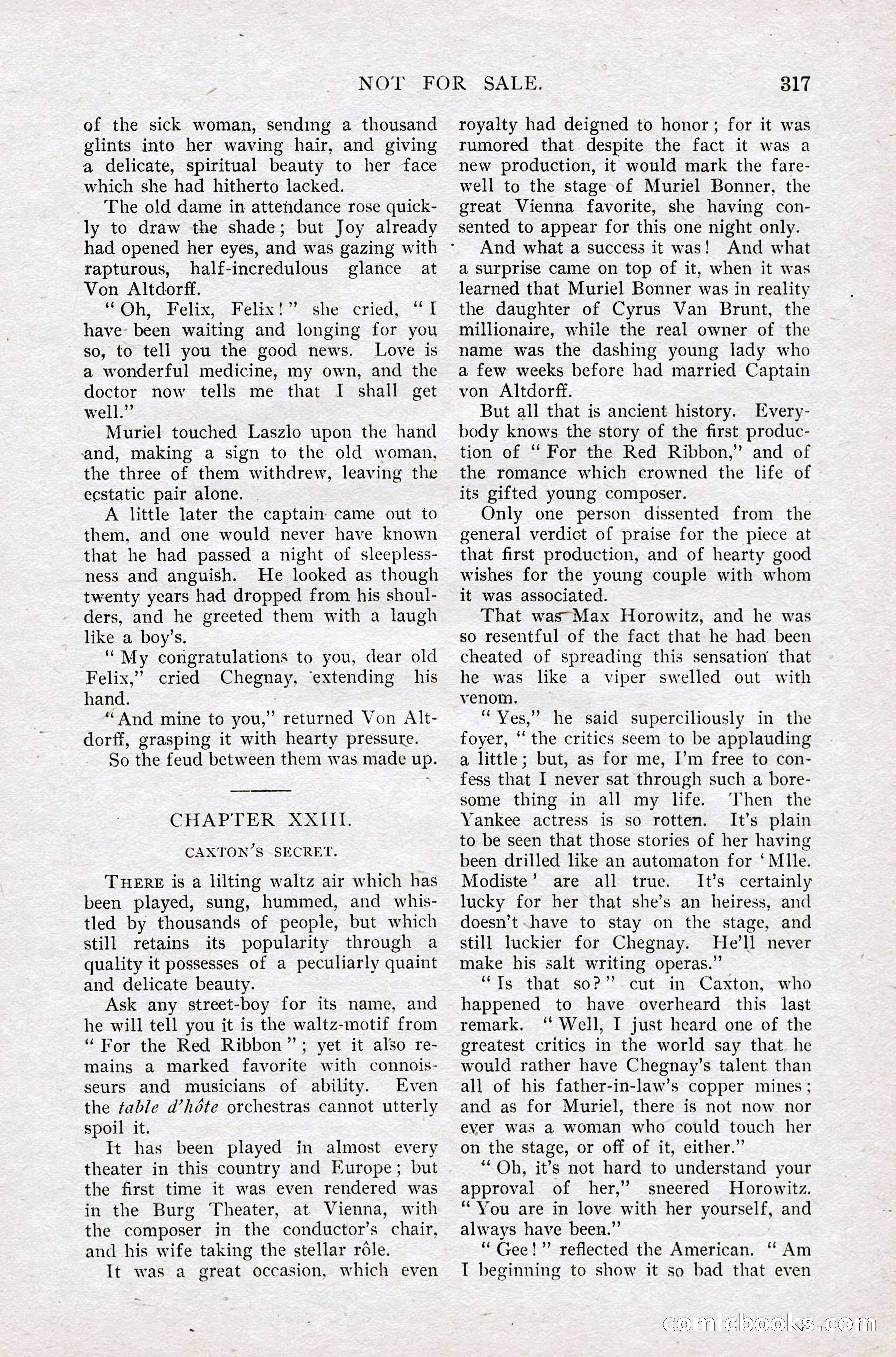
A restored page from Pulp Fiction, 1909. Page through the whole issue in the reader above.
📄 Transcribed text from this page (OCR, searchable)
Machine-transcribed from the original scan — historical spelling and the odd misread are preserved.
NOT FOR SALE. of the sick woman, sending a thousand glints into her waving hair, and giving a delicate, spiritual beauty to her face which she had hitherto lacked. The old dame in attehdance rose quick- ly to draw the shade; but Joy already had opened her eyes, and was gazing with ° rapturous, half-incredulous glance at Von Altdorff. “Oh, Felix, Felix!” she cried, “I have been waiting and longing for you so, to tell you the good news. Love is a wonderful medicine, my own, and the doctor now tells me that I shall get well.” Muriel touched Laszlo upon the hand and, making a sign to the old woman, the three of them withdrew, leaving the ecstatic pair alone. A little later the captain came out to them, and one would never have known that he had passed a night of sleepless- ness and anguish. He looked as though twenty years had dropped from his shoul- ders, and he greeted them with a laugh like a boy’s. ‘My congratulations to you, dear old Felix,” cried Chegnay, ‘extending his hand. “And mine to you,” returned Von Alt- dorff, grasping it with hearty pressure. So the feud between them was made up. 22 ee CHAPTER XNIII. CAXTON’S SECRET. THERE is a lilting waltz air which has been played, sung, hummed, and whis- tled by thousands of people, but which still retains its popularity through a quality it possesses of a peculiarly quaint and delicate beauty. Ask any street-boy for its name, and he will tell you it is the waltz-motif from “For the Red Ribbon”; yet it also re- mains a marked favorite with connois- seurs and musicians of ability. Even the table a’hdte orchestras cannot utterly spoil it. It has been played in almost every theater in this country and Europe; but the first time it was even rendered was in the Burg Theater, at Vienna, with the composer in the conductor’s chair, and his wife taking the stellar role. It was a great occasion, which even 317 royalty had deigned to honor; for it was rumored that. despite the fact it was a new production, it would mark the fare- well to the stage of Muriel Bonner, the great Vienna favorite, she having con- sented to appear for this one night only. And what a success it was! And what a surprise came on top of it, when it was learned that Muriel Bonner was in reality the daughter of Cyrus Van Brunt, the millionaire, while the real owner of the name was the dashing young lady who a few weeks before had married Captain von Altdorff. But all that is ancient history. Every- body knows the story of the first produc- tion of ‘ For the Red Ribbon,” and of the romance which crowned the life of its gifted young composer. Only one person dissented from the general verdict of praise for the piece at that first production, and of hearty good wishes for the young couple with whom it was associated. That was>Max Horowitz, and he was so resentful of the fact that he had been cheated of spreading this sensation that he was like a viper swelled out with venom. “Yes,” he said superciliously in the foyer, ‘ the critics seem to be applauding a little; but, as for me, I’m free to con- fess that I never sat through such a bore- some thing in all my life. ‘Then the Yankee actress is so rotten. It’s plain to be seen that those stories of her having been drilled like an automaton for ‘Mlle. Modiste’ are all true. It’s certainly lucky for her that she’s an heiress, and doesn’t have to stay on the stage, and still luckier for Chegnay. He'll never make his salt writing operas.” “Ts that so?” cut in Caxton, who happened to have overheard this last remark. ‘ Well, I just heard one of the greatest critics in the world say that. he would rather have Chegnay’s talent than all of his father-in-law’s copper mines ; and as for Muriel, there is not now nor ever was a woman who could touch her on the stage, or off of it, either.” “Oh, it’s not hard to understand your approval of her,” sneered Horowitz. You are in love with her yourself, and always have been.” ‘““Gee!”’ reflected the American. “ Am I beginning to show it so bad that even MICLOOOKS (C@