
Pulp Fiction, 1909 · page 119 of 227
The Argosy for May — page 119: what you’re looking at
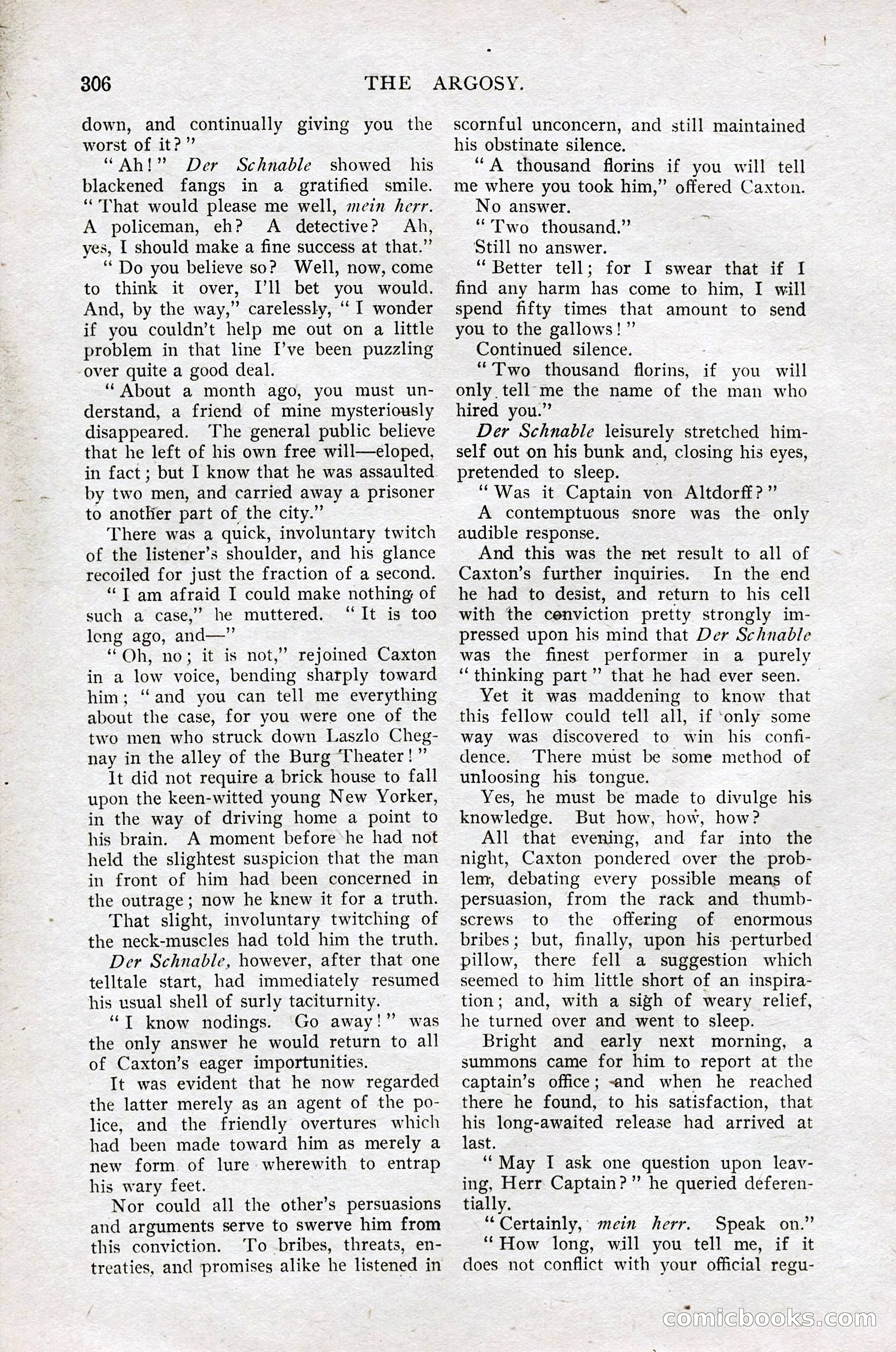
A restored page from Pulp Fiction, 1909. Page through the whole issue in the reader above.
📄 Transcribed text from this page (OCR, searchable)
Machine-transcribed from the original scan — historical spelling and the odd misread are preserved.
306 down, and continually giving you the worst of it?” “Ah!” Der Schnable showed his blackened fangs in a gratified smile. ‘That would please me well, mein herr. A policeman, eh? A detective? Ah, yes, [ should make a fine success at that.” ‘Do you believe so? Well, now, come to think it over, I'll bet you would. And, by the way,” carelessly, “ I wonder if you couldn’t help me out on a little problem in that line I’ve been puzzling over quite a good deal. “About a month ago, you must un- derstand, a friend of mine mysteriously disappeared. The general public believe that he left of his own free will—eloped, in fact; but I know that he was assaulted by two men, and carried away a prisoner to another part of the city.” There was a quick, involuntary twitch of the listener’s shoulder, and his glance recoiled for just the fraction of a second. ‘“T am afraid I could make nothing of such a case,” he muttered. “It is too leng ago, and—”’ “Oh, no; it is not,” rejoined Caxton in a low voice, bending sharply toward him; “and you can tell me everything about the case, for you were one of the two men who struck down Laszlo Cheg- nay in the alley of the Burg Theater!” It did not require a brick house to fall upon the keen-witted young New Yorker, in the way of driving home a point to his brain. A moment before he had not held the slightest suspicion that the man in front of him had been concerned in the outrage; now he knew it for a truth. That slight, involuntary twitching of the neck-muscles had told him the truth. Der Schnable, however, after that one telltale start, had immediately resumed his usual shell of surly taciturnity. “T know nodings. Go away!” was the only answer he would return to all of Caxton’s eager importunities. It was evident that he now regarded the latter merely as an agent of the po- lice, and the friendly overtures which had been made toward him as merely a new form. of lure wherewith to entrap his wary feet. Nor could all the other’s persuasions and arguments serve to swerve him from this conviction. To bribes, threats, en- treaties, and promises alike he listened in THE ARGOSY. scornful unconcern, and still maintained his obstinate silence. ‘A thousand florins if you will tell me where you took him,” offered Caxton. No answer. “Two thousand.” Still no answer. ‘Better tell; for I swear that if I find any harm has come to him, I will spend fifty times that amount to send you to the gallows!” Continued silence. “Two thousand florins, if you will only tell me the name of the man who hired you.” Der Schnable leisurely stretched him- self out on his bunk and, closing his eyes, pretended to sleep. ‘Was it Captain von Altdorff?’”’ A contemptuous snore was the only audible response. And this was the net result to all of Caxton’s further inquiries. In the end he had to desist, and return to his cell with the cenviction pretty strongly im- pressed upon his mind that Der Schnable was the finest performer in a purely “thinking part ’’ that he had ever seen. Yet it was maddening to know that this fellow could tell all, if ‘only some way was discovered to win his confi- dence. There must be some method of unloosing his tongue. Yes, he must be made to divulge his knowledge. But how, how, how? All that evening, and far into the night, Caxton pondered over the prob- lem, debating every possible means of persuasion, from the rack and thumb- screws to the offering of enormous bribes; but, finally, upon his perturbed pillow, there fell a suggestion which seemed to him little short of an inspira- tion; and, with a sigh of weary relief, he turned over and went to sleep. Bright and early next morning, a summons came for him to report at the captain’s office; «and when he reached there he found, to his satisfaction, that his long-awaited release had arrived at last. ‘“May I ask one question upon leav- ing, Herr Captain?” he queried deferen- tially. “Certainly, mein herr. Speak on.” “How long, will you tell me, if it does not conflict with your official regu- — MICLOOO© (Cc S (C@