
Pulp Fiction, 1955 · page 75 of 146
Argosy: The Short Story Magazine — page 75: what you’re looking at
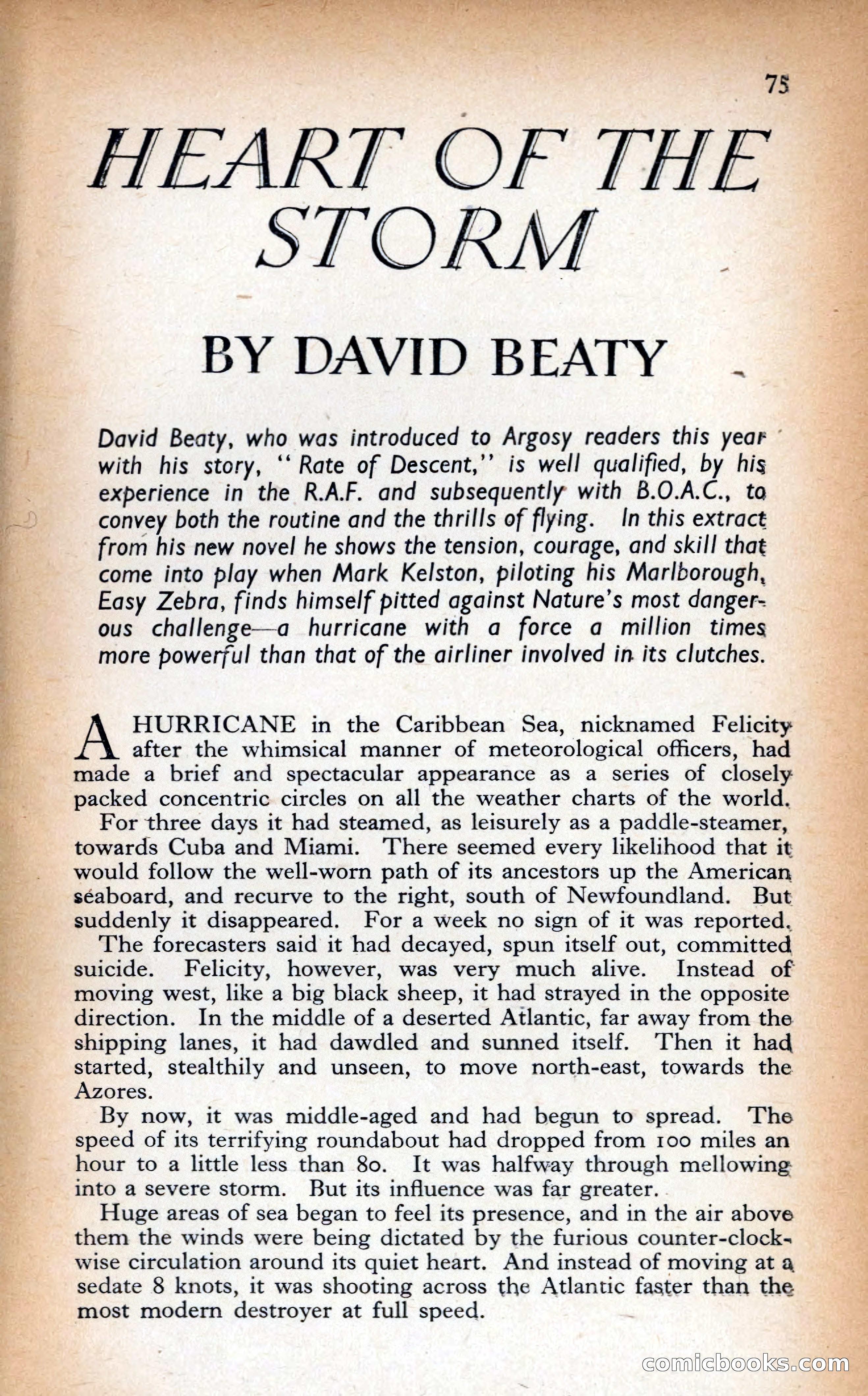
A restored page from Pulp Fiction, 1955. Page through the whole issue in the reader above.
📄 Transcribed text from this page (OCR, searchable)
Machine-transcribed from the original scan — historical spelling and the odd misread are preserved.
» et nae , i . 2 ’ : a ie § é : ne urs a % . ae pa S Pn cs ag i av y's . oe ; Ra ‘ . fee <7 % S,. he - ‘ ee ie ; ‘ Bh. & : J q BY DAVID BEATY 4 David Beaty, who was introduced to Argosy readers this year oe with his story, ‘‘ Rate of Descent,’’ is well qualified, by his aa experience in the R.A.F. and subsequently with B.O.A.C., ta se convey both the routine and the thrills of flying. In this extract re from his new novel he shows the tension, courage, and skill that i come into play when Mark Kelston, piloting his Marlborough, ao Easy Zebra, finds himself pitted against Nature’s most danger- ee ous challenge—a hurricane with a force a million times ia more powerful than that of the airliner involved in its clutches. a HURRICANE in the Caribbean Sea, nicknamed Felicity “3 after the whimsical manner of meteorological officers, had ¢ made a brief and spectacular appearance as a series of closely packed concentric circles on all the weather charts of the world, For three days it had steamed, as leisurely as a paddle-steamer, __ towards Cuba and Miami. ‘There seemed every likelihood that it would follow the well-worn path of its ancestors up the American — séaboard, and recurve to the right, south of Newfoundland. But suddenly it disappeared. For a week no sign of it was reported. _ ‘The forecasters said it had decayed, spun itself out, committed suicide. Felicity, however, was very much alive. Instead of © moving west, like a big black sheep, it had strayed in the opposite a} ‘ direction. In the middle of a deserted Atlantic, faraway fromthe shipping lanes, it had dawdled and sunned itself. Then it had started, stealthily and unseen, to move north-east, towards the Azores. oe By now, it was middle-aged and had begun to spread. The ~ speed of its terrifying roundabout had dropped from 100 miles an hour to a little less than 80. It was halfway through mellowing into a severe storm. But its influence was far greater. . Huge areas of sea began to feel its presence, and in the air above — them the winds were being dictated by the furious counter-clocks ___- wise circulation around its quiet heart. And instead of moving at a ____ sedate 8 knots, it was shooting across the Atlantic faster than the most modern destroyer at full speed. i a ast rs COMIC DOOKSECOm