
Pulp Fiction, 1955 · page 68 of 148
Argosy, September 1955 — page 68: what you’re looking at
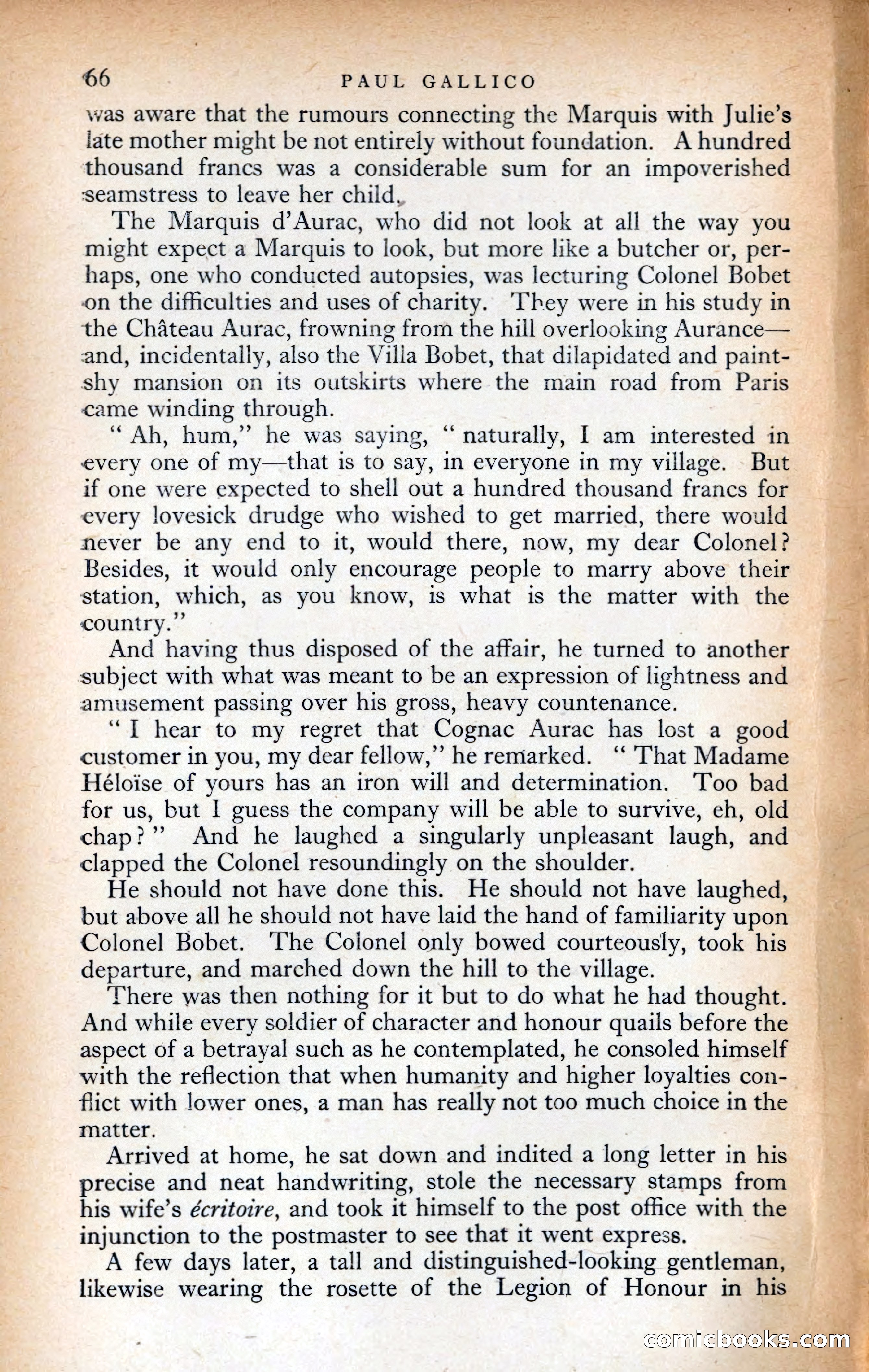
A restored page from Pulp Fiction, 1955. Page through the whole issue in the reader above.
📄 Transcribed text from this page (OCR, searchable)
Machine-transcribed from the original scan — historical spelling and the odd misread are preserved.
i ‘ . a y * ‘ ag [=e oe ah ee tin ot ee _— . hy ee ee ae Oe nw, ade a Ly subject with what was meant to be an expression of lightness and 66 PAUL GALLICO es was aware that the rumours connecting the Marquis with Julie’ s late mother might be not entirely without foundation. A hundred 3 thousand francs was a considerable sum for an impoverished — ‘seamstress to leave her child. The Marquis d’Aurac, who did not look at all the way you~ might expect a Marquis to look, but more like a butcher or, per- haps, one who conducted autopsies, was lecturing Colonel Bobet i: on the difficulties and uses of charity. They were in his studyin the Chateau Aurac, frowning from the hill overlooking Aurance— _ and, incidentally, also the Villa Bobet, that dilapidated and paint- shy mansion on its outskirts where ‘the main road from Paris came winding through. ‘“Ah, hum,” he was saying, “ naturally, I am interested in every one of my—that is to say, in everyone in my village. But. if one were expected to shell out a hundred thousand francs for every lovesick drudge who wished to get married, there would never be any end to it, would there, now, my dear Colonel? Besides, it would only encourage people to marry above their station, which, as you know, is what is the matter with the country.’ And having thus disposed of the affair, he turned to another a \ amusement passing over his gross, heavy countenance. ‘| hear to my regret that Cognac Aurac has lost a good customer in you, my dear fellow,” he remiarked. “‘ That Madame Héloise of yours has an iron will and determination. Too bad ~ for us, but I guess the company will be able to survive, eh, old : chap?” And he laughed a singularly unpleasant laugh, and — clapped the Colonel resoundingly on the shoulder. He should not have done this. He should not have laughed, but above all he should not have laid the hand of familiarity upon Colonel Bobet. The Colonel only bowed courteously, took his departure, and marched down the hill to the village. There was then nothing for it but to do what he had thought. And while every soldier of character and honour quails before the aspect of a betrayal such as he contemplated, he consoled himself with the reflection that when humanity and higher loyalties con- flict with lower ones, a man has really not too much choice in the matter. Arrived at home, he sat down and indited a long letter in his precise and neat handwriting, stole the necessary stamps from _ his wife’s écritoire, and took it himself to the post office with the injunction to the postmaster to see that it went express. a A few days later, a tall and distinguished-looking gentleman, ab likewise wearing the rosette of the Legion of Honour in his — £ comiceeee