
Pulp Fiction, 1955 · page 56 of 148
Argosy, September 1955 — page 56: what you’re looking at
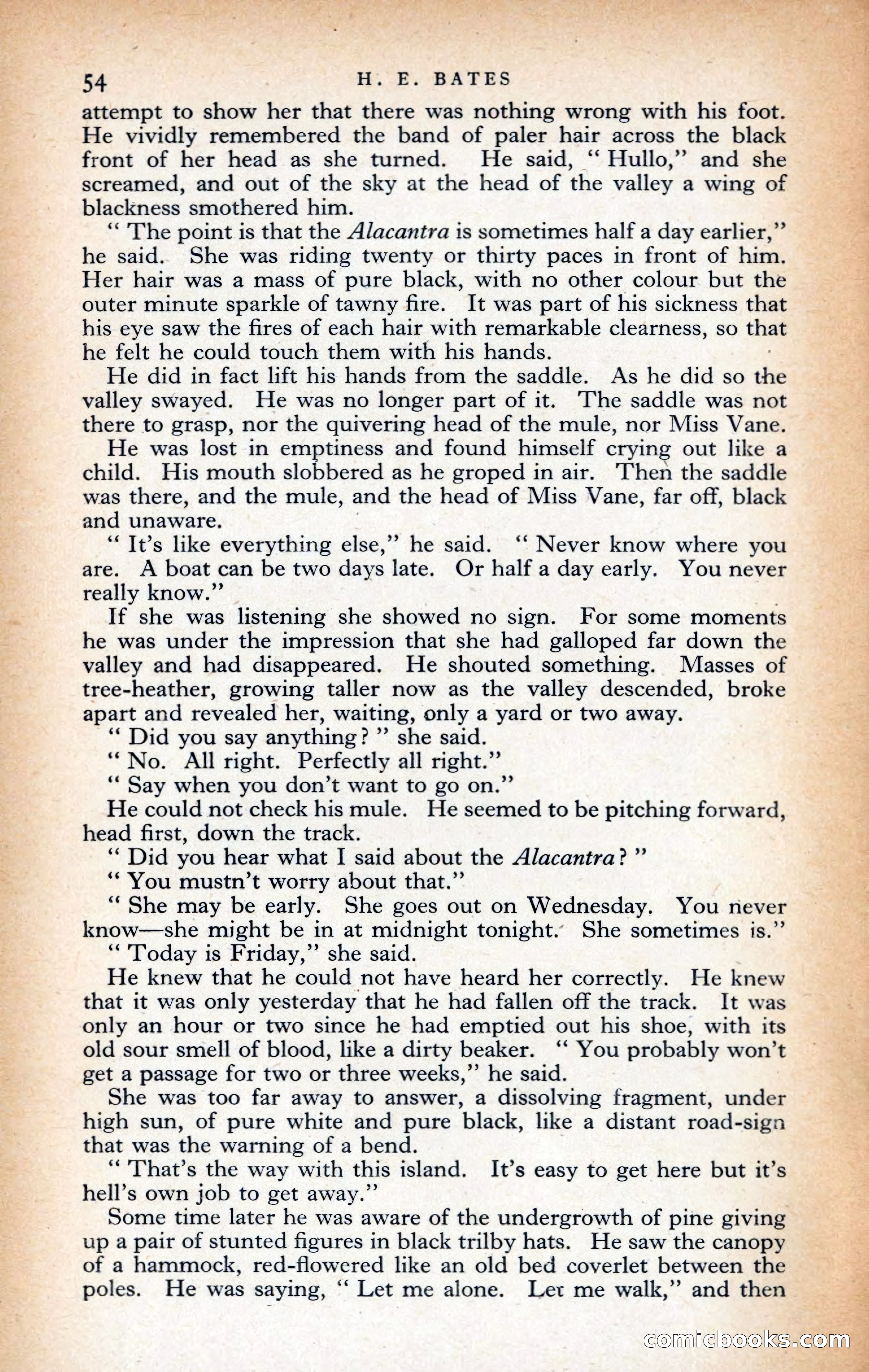
A restored page from Pulp Fiction, 1955. Page through the whole issue in the reader above.
📄 Transcribed text from this page (OCR, searchable)
Machine-transcribed from the original scan — historical spelling and the odd misread are preserved.
ae ee tied ee oY wey Ne Se be | = 54 H. E. BATES attempt to show her that there was nothing wrong with his foot. He vividly remembered the band of paler hair across the black front of her head as she turned. He said, ‘‘ Hullo,’”” and she screamed, and out of the sky at the head of the valley a wing of blackness smothered him. ‘“<’'The point is that the Alacantra is sometimes half a day earlier,” he said. She was riding twenty or thirty paces in front of him. Her hair was a mass of pure black, with no other colour but the outer minute sparkle of tawny fire. It was part of his sickness that his eye saw the fires of each hair with remarkable clearness, so that he felt he could touch them with his hands. He did in fact lift his hands from the saddle. As he did so he valley swayed. He was no longer part of it. The saddle was not there to grasp, nor the quivering head of the mule, nor Miss Vane. He was lost in emptiness and found himself crying out like a child. His mouth slobbered as he groped in air. Then the saddle was there, and the mule, and the head of Miss Vane, far off, black and unaware. “It’s like everything else,” he said. ‘‘ Never know where you are. A boat can be two days late. Or half a day early. You never really know.” If she was listening she showed no sign. For some moments he was under the impression that she had galloped far down the valley and had disappeared. He shouted something. Masses of tree-heather, growing taller now as the valley descended, broke apart and revealed her, waiting, only a yard or two away. ** Did you say anything? ” she said. “No. All right. Perfectly all right.” “Say when you don’t want to go on.” He could not check his mule. He seemed to be pitching forward, head first, down the track. ‘“* Did you hear what I said about the Alacantra?”’ “You mustn’t worry about that.” ““ She may be early. She goes out on Wednesday. You never know—she might be in at midnight tonight. She sometimes is.” “Today is Friday,” she said. He knew that he could not have heard her correctly. He knew that it was only yesterday that he had fallen off the track. It was only an hour or two since he had emptied out his shoe, with its old sour smell of blood, like a dirty beaker. ‘‘ You probably won’t get a passage for two or three weeks,”’ he said. She was too far away to answer, a dissolving fragment, under high sun, of pure white and pure black, like a distant road-sign that was the warning of a bend. ““'That’s the way with this island. It’s easy to get here but it’s hell’s own job to get away.” Some time later he was aware of the undergrowth of pine giving up a pair of stunted figures in black trilby hats. He saw the canopy of a hammock, red-flowered like an old bed coverlet between the poles. He was saying, “‘ Let me alone. Let me walk,” and then commicloolksseornny F ie