
Pulp Fiction, 1955 · page 20 of 148
Argosy, September 1955 — page 20: what you’re looking at
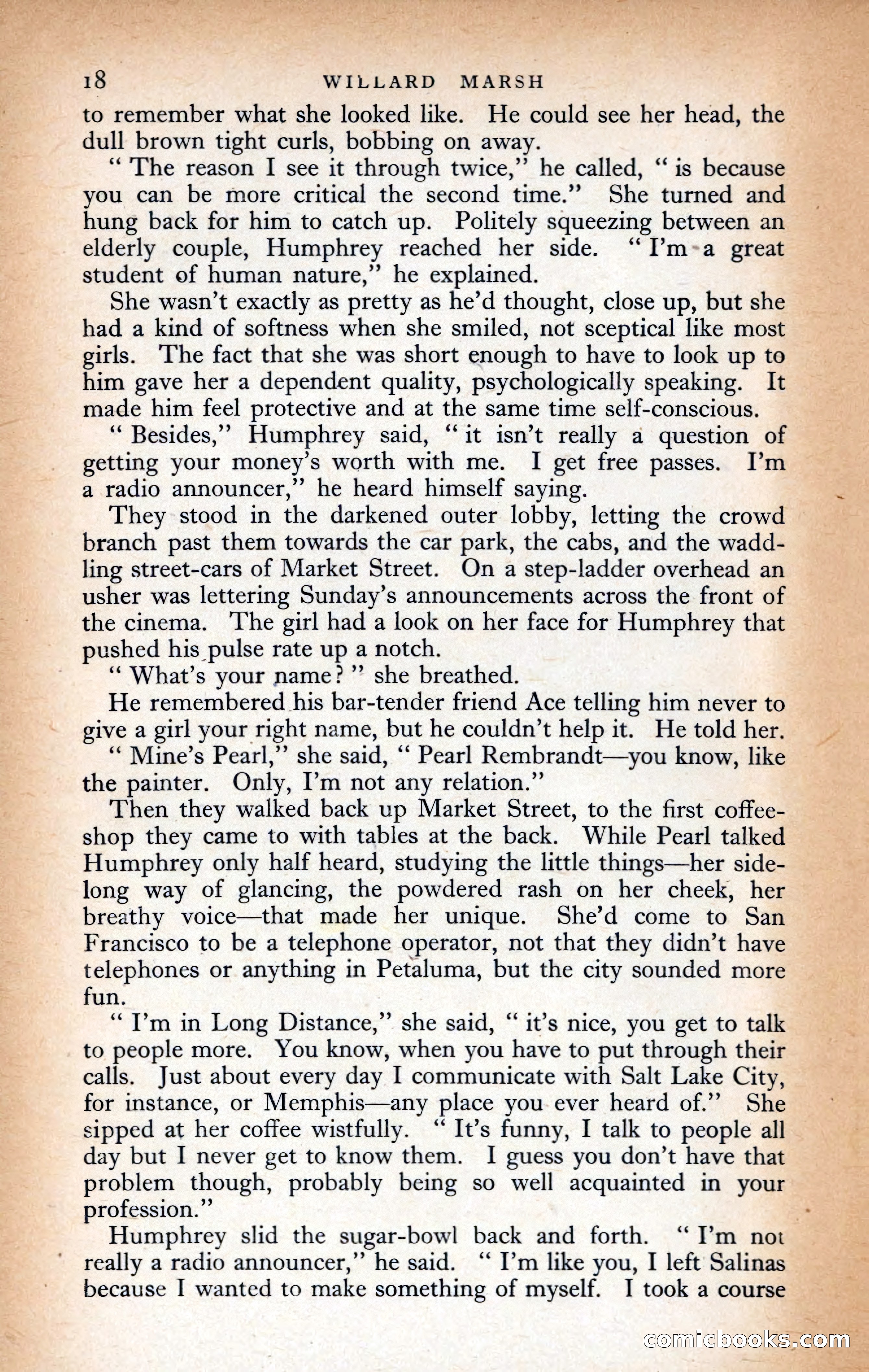
A restored page from Pulp Fiction, 1955. Page through the whole issue in the reader above.
📄 Transcribed text from this page (OCR, searchable)
Machine-transcribed from the original scan — historical spelling and the odd misread are preserved.
¥ , ~ = JG! wy “ “> os = 18 WILLARD MARSH to remember what she looked like. He could see her head, the dull brown tight curls, bobbing on away. “The reason I see it through twice,”’ he called, ‘‘ is because you can be more critical the second time.” She turned and hung back for him to catch up. Politely squeezing between an elderly couple, Humphrey reached her side. “I’m>-a great student of human nature,” he explained. She wasn’t exactly as pretty as he’d thought, close up, but she had a kind of softness when she smiled, not sceptical like most girls. ‘The fact that she was short enough to have to look up to him gave her a dependent quality, psychologically speaking. It made him feel protective and at the same time self-conscious. ‘“‘ Besides,’ Humphrey said, “it isn’t really a question of getting your money’s worth with me. I get free passes. I’m a radio announcer,” he heard himself saying. They stood in the darkened outer lobby, letting the crowd branch past them towards the car park, the cabs, and the wadd- ling street-cars of Market Street. On a step-ladder overhead an usher was lettering Sunday’s announcements across the front of the cinema. The girl had a look on her face for Humphrey that pushed his pulse rate up a notch. ‘“* What’s your name? ”’ she breathed. He remembered his bar-tender friend Ace telling him never to give a girl your right name, but he couldn’t help it. He told her. ‘“‘ Mine’s Pearl,’’ she said, “‘ Pearl Rembrandt—you know, like the painter. Only, I’m not any relation.” Then they walked back up Market Street, to the first coffee- shop they came to with tables at the back. While Pearl talked Humphrey only half heard, studying the little things—her side- long way of glancing, the powdered rash on her cheek, her breathy voice—that made her unique. She’d come to San Francisco to be a telephone operator, not that they didn’t have telephones or anything in Petaluma, but the city sounded more fun. ‘““T’m in Long Distance,” she said, “ it’s nice, you get to talk to people more. You know, when you have to put through their calls. Just about every day I communicate with Salt Lake City, for instance, or Memphis—any place you ever heard of.’’ She sipped at her coffee wistfully. “It’s funny, I talk to people all day but I never get to know them. I guess you don’t have that problem though, probably being so well acquainted in your profession.” Humphrey slid the sugar-bowl back and forth. “I’m not | really a radio announcer,” he said. “ I’m like you, I left Salinas because I wanted to make something of myself. I took a course _~ ee” Ae te thet. (me ry Se +. tt San, ee a St ae Begg oe eee Pi ee ty Sole eg a pees ie Me) of oe , a \ ek ORAL a Ae . ty Ms fy ig tt Pte poe es rT ld be Sal ra PS - ry i Sees * ‘ : ri < ; ude fy "eS e ‘ 7 s ge el r a r. ; i : ae z . ~ ne af » ti ~ 4% —~ Commiciooks-com