
Pulp Fiction, 1955 · page 120 of 148
Argosy, September 1955 — page 120: what you’re looking at
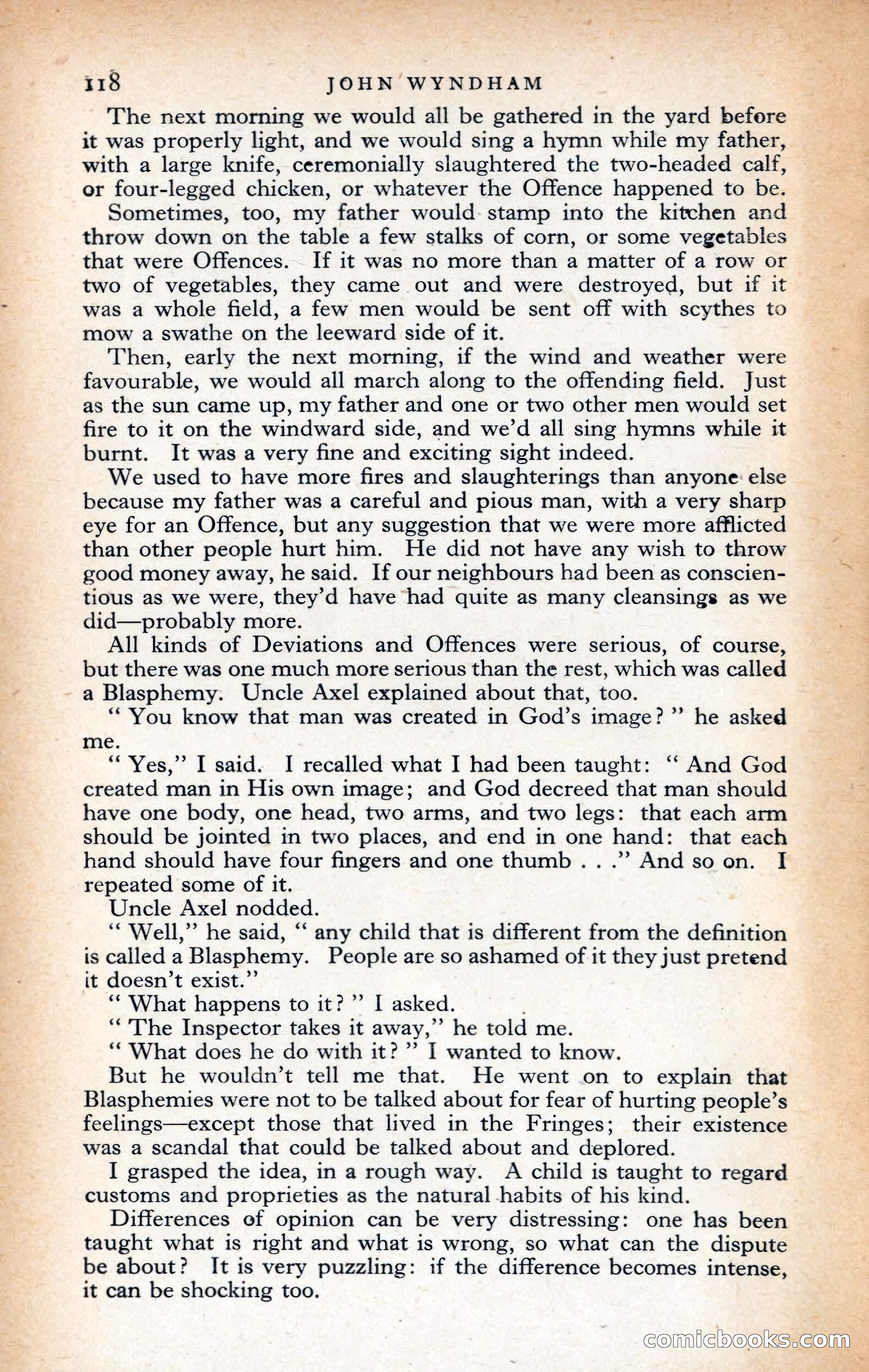
A restored page from Pulp Fiction, 1955. Page through the whole issue in the reader above.
📄 Transcribed text from this page (OCR, searchable)
Machine-transcribed from the original scan — historical spelling and the odd misread are preserved.
118 JOHN WYNDHAM The next morning we would all be gathered in the yard before it was properly light, and we would sing a hymn while my father, with a large knife, ceremonially slaughtered the two-headed calf, or four-legged chicken, or whatever the Offence happened to be. Sometimes, too, my father would stamp into the kitchen and throw down on the table a few stalks of corn, or some vegetables that were Offences. If it was no more than a matter of a row or two of vegetables, they came out and were destroyed, but if it was a whole field, a few men would be sent off with scythes to mow a swathe on the leeward side of it. Then, early the next morning, if the wind and weather were favourable, we would all march along to the offending field. Just as the sun came up, my father and one or two other men would set fire to it on the windward side, and we'd all sing hymns while it burnt. It was a very fine and exciting sight indeed. We used to have more fires and slaughterings than anyone: else because my father was a careful and pious man, with a very sharp eye for an Offence, but any suggestion that we were more afflicted than other people hurt him. He did not have any wish to throw good money away, he said. If our neighbours had been as conscien- tious as we were, they’d have had quite as many cleansings as we did—probably more. All kinds of Deviations and Offences were serious, of course, but there was one much more serious than the rest, which was called a Blasphemy. Uncle Axel explained about that, too. “You know that man was created in God’s image?” he asked me. “Yes,” I said. I recalled what I had been taught: ‘‘ And God created man in His own image; and God decreed that man should have one body, one head, two arms, and two legs: that each arm should be jointed in two places, and end in one hand: that each hand should have four fingers and one thumb...” And soon. I repeated some of it. Uncle Axel nodded. ‘* Well,” he said, “‘ any child that is different from the definition is called a Blasphemy. People are so ashamed of it they just pretend it doesn’t exist.” “What happens to it?”’ I asked. ‘““’'The Inspector takes it away,” he told me. “What does he do with it?’ I wanted to know. But he wouldn’t tell me that. He went on to explain that Blasphemies were not to be talked about for fear of hurting people’s feelings—except those that lived in the Fringes; their existence was a scandal that could be talked about and deplored. I grasped the idea, in a rough way. A child is taught to regard customs and proprieties as the natural habits of his kind. Differences of opinion can be very distressing: one has been taught what is right and what is wrong, so what can the dispute be about? It is very puzzling: if the difference becomes intense, it can be shocking too. eo ee Se 4 ComiclooksSsconn