
Pulp Fiction, 1865 · page 81 of 399
The Argosy — page 81: what you’re looking at
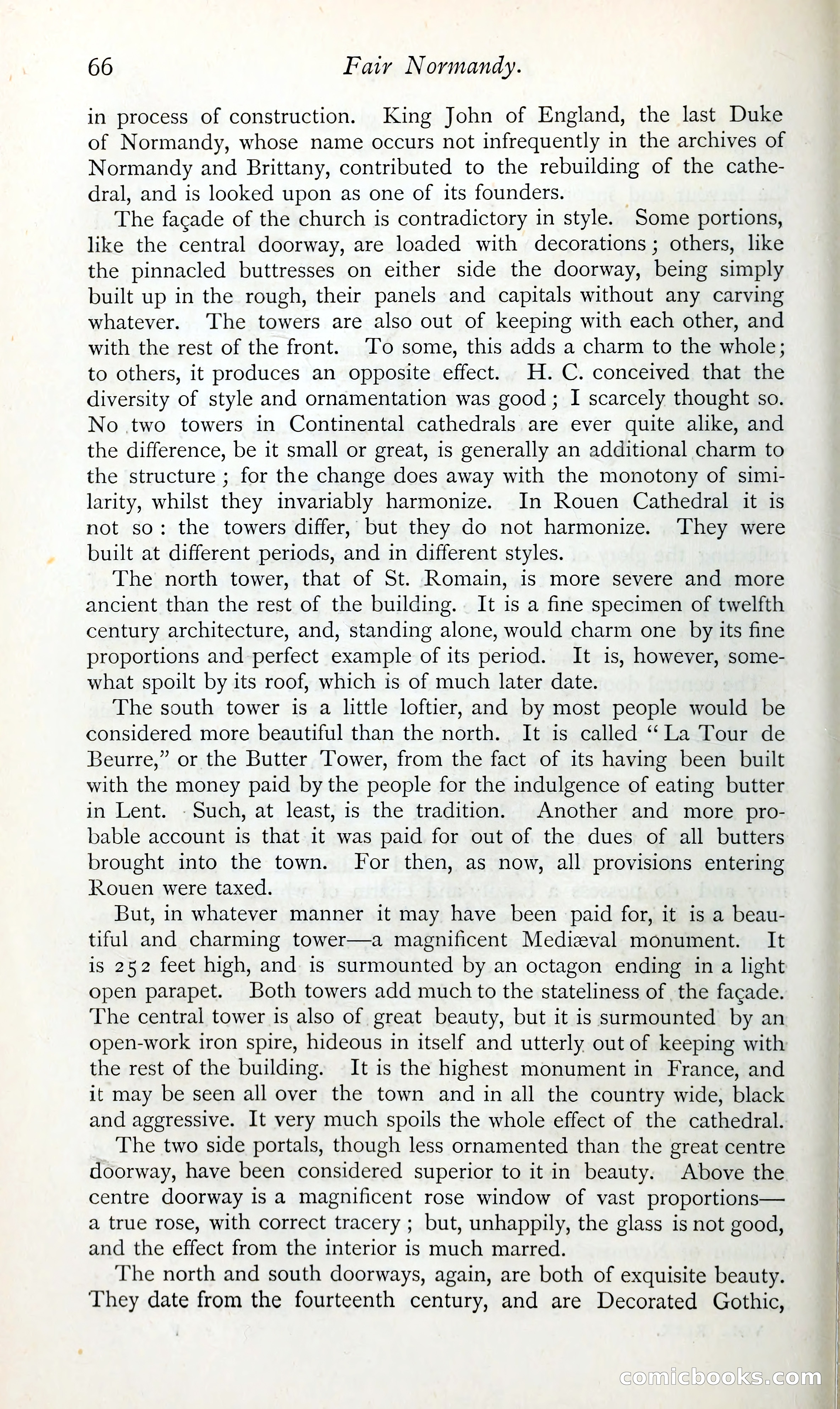
A restored page from Pulp Fiction, 1865. Page through the whole issue in the reader above.
📄 Transcribed text from this page (OCR, searchable)
Machine-transcribed from the original scan — historical spelling and the odd misread are preserved.
66 Fair Normandy. in process of construction. King John of England, the last Duke of Normandy, whose name occurs not infrequently in the archives of Normandy and Brittany, contributed to the rebuilding of the cathe- dral, and is looked upon as one of its founders. The facade of the church is contradictory in style. Some portions, like the central doorway, are loaded with decorations ; others, like the pinnacled buttresses on either side the doorway, being simply built up in the rough, their panels and capitals without any carving whatever. ‘The towers are also out of keeping with each other, and with the rest of the front. ‘To some, this adds a charm to the whole; to others, it produces an opposite effect. H.C. conceived that the diversity of style and ornamentation was good; I scarcely thought so. No .two towers in Continental cathedrals are ever quite alike, and the difference, be it small or great, is generally an additional charm to the structure ; for the change does away with the monotony of simi- larity, whilst they invariably harmonize. In Rouen Cathedral it is not so: the towers differ, but they do not harmonize. ‘They were built at different periods, and in different styles. The north tower, that of St. Romain, 1s more severe and more ancient than the rest of the building. It is a fine specimen of twelfth century architecture, and, standing alone, would charm one by its fine proportions and perfect example of its period. It is, however, some- what spoilt by its roof, which is of much later date. The south tower is a little loftier, and by most people would be considered more beautiful than the north. It is called “La Tour de Beurre,” or the Butter Tower, from the fact of its having been built with the money paid by the people for the indulgence of eating butter in Lent. - Such, at least, is the tradition. Another and more pro- bable account is that it was paid for out of the dues of all butters brought into the town. For then, as now, all provisions entering Rouen were taxed. But, in whatever manner it may have been paid for, it is a beau- tiful and charming tower—a magnificent Medizeval monument. It is 252 feet high, and is surmounted by an octagon ending in a light open parapet. Both towers add much to the stateliness of the facade. The central tower is also of great beauty, but it is surmounted by an open-work iron spire, hideous in itself and utterly out of keeping with the rest of the building. It is the highest monument in France, and it may be seen all over the town and in all the country wide, black and aggressive. It very much spoils the whole effect of the cathedral. The two side portals, though less ornamented than the great centre doorway, have been considered superior to it in beauty. Above the centre doorway is a magnificent rose window of vast proportions— a true rose, with correct tracery ; but, unhappily, the glass is not good, and the effect from the interior is much marred. The north and south doorways, again, are both of exquisite beauty. They date from the fourteenth century, and are Decorated Gothic, E€om () 1 )(0)(0)| KS (EC) m