
Pulp Fiction, 1865 · page 71 of 399
The Argosy — page 71: what you’re looking at
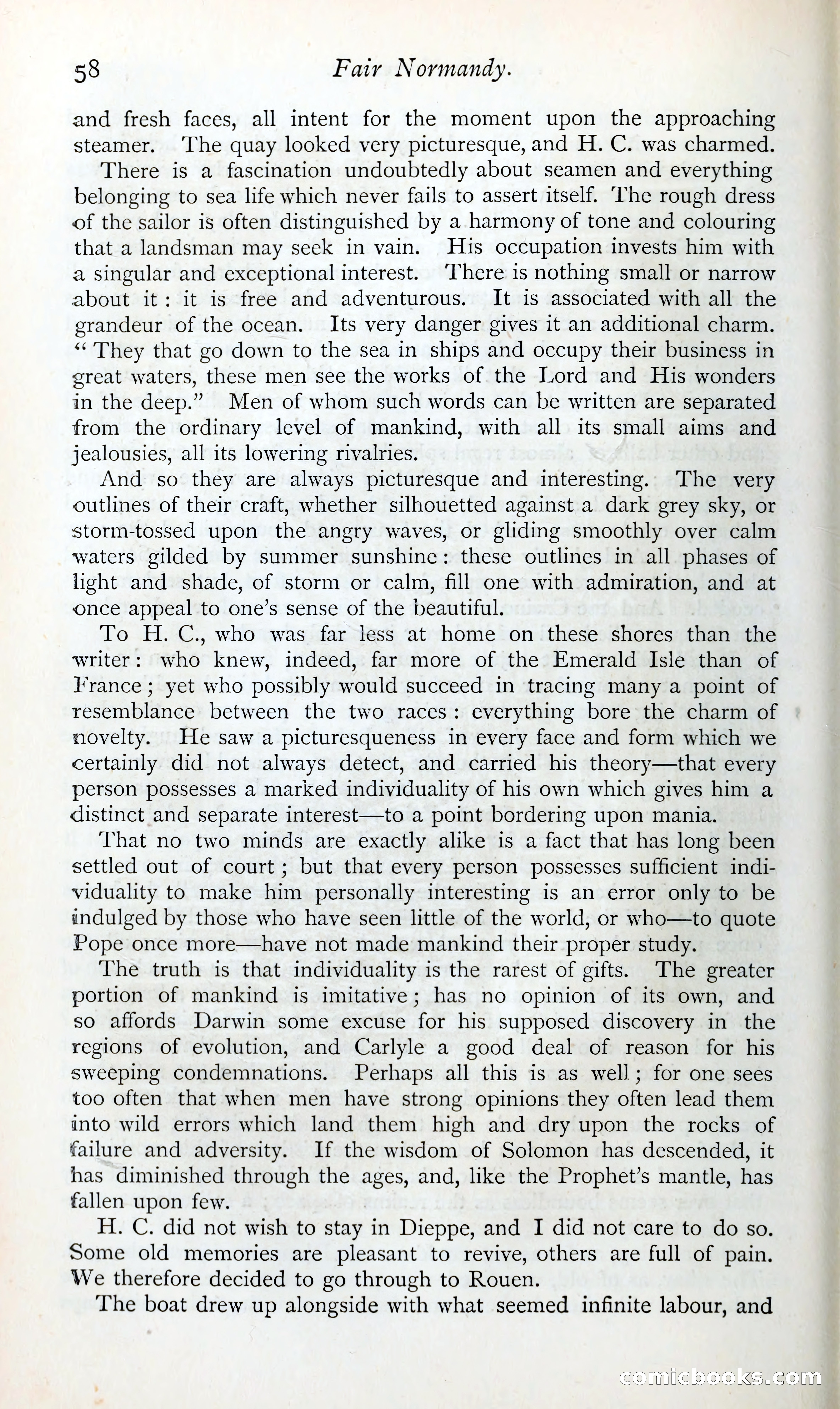
A restored page from Pulp Fiction, 1865. Page through the whole issue in the reader above.
📄 Transcribed text from this page (OCR, searchable)
Machine-transcribed from the original scan — historical spelling and the odd misread are preserved.
58 Far Normandy. and fresh faces, all intent for the moment upon the approaching steamer. ‘The quay looked very picturesque, and H.C. was charmed. There is a fascination undoubtedly about seamen and everything belonging to sea life which never fails to assert itself. ‘The rough dress of the sailor is often distinguished by a harmony of tone and colouring that a landsman may seek in vain. His occupation invests him with a singular and exceptional interest. ‘There is nothing small or narrow about it: it is free and adventurous. It is associated with all the grandeur of the ocean. Its very danger gives it an additional charm. “They that go down to the sea in ships and occupy their business in great waters, these men see the works of the Lord and His wonders in the deep.” Men of whom such words can be written are separated from the ordinary level of mankind, with all its small aims and jealousies, all its lowering rivalries. And so they are always picturesque and interesting. The very outlines of their craft, whether silhouetted against a dark grey sky, or storm-tossed upon the angry waves, or gliding smoothly over calm waters gilded by summer sunshine: these outlines in all phases of light and shade, of storm or calm, fill one with admiration, and at once appeal to one’s sense of the beautiful. To H.C., who was far less at home on these shores than the writer: who knew, indeed, far more of the Emerald Isle than of France ; yet who possibly would succeed in tracing many a point of resemblance between the two races: everything bore the charm of novelty. He saw a picturesqueness in every face and form which we certainly did not always detect, and carried his theory—that every person possesses a marked individuality of his own which gives him a distinct and separate interest—to a point bordering upon mania. That no two minds are exactly alike is a fact that has long been settled out of court ; but that every person possesses sufficient indi- viduality to make him personally interesting is an error only to be indulged by those who have seen little of the world, or who—to quote Pope once more—have not made mankind their proper study. The truth is that individuality is the rarest of gifts. The greater portion of mankind is imitative; has no opinion of its own, and so affords Darwin some excuse for his supposed discovery in the regions of evolution, and Carlyle a good deal of reason for his sweeping condemnations. Perhaps all this is as well; for one sees too often that when men have strong opinions they often lead them into wild errors which land them high and dry upon the rocks of failure and adversity. If the wisdom of Solomon has descended, it has diminished through the ages, and, like the Prophet’s mantle, has fallen upon few. H. C. did not wish to stay in Dieppe, and I did not care to do so. Some old memories are pleasant to revive, others are full of pain. We therefore decided to go through to Rouen. The boat drew up alongside with what seemed infinite labour, and e€om a 1 0)\)0)| KS,,(E(0)