
Pulp Fiction, 1865 · page 66 of 399
The Argosy — page 66: what you’re looking at
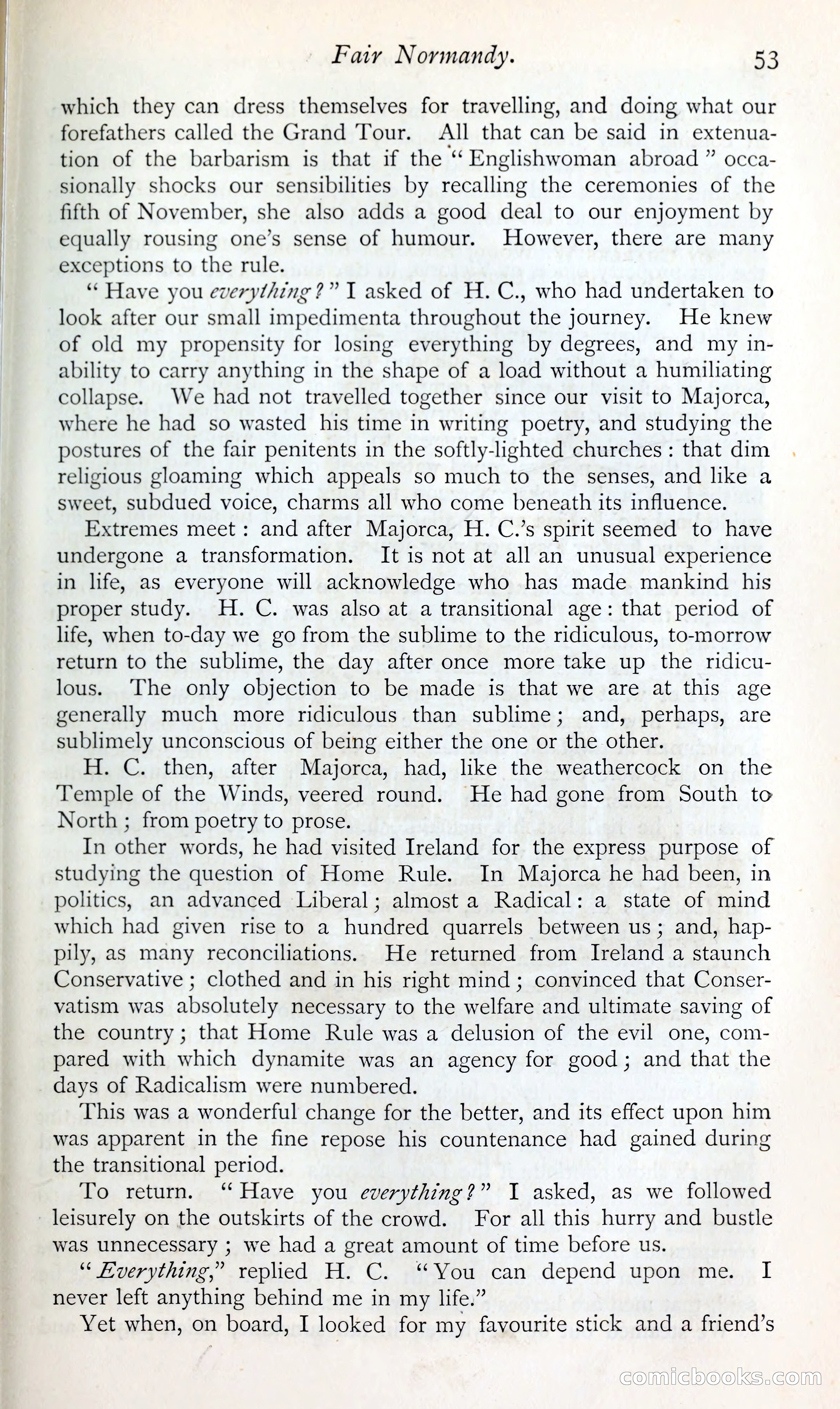
A restored page from Pulp Fiction, 1865. Page through the whole issue in the reader above.
📄 Transcribed text from this page (OCR, searchable)
Machine-transcribed from the original scan — historical spelling and the odd misread are preserved.
Far Normandy. 53 which they can dress themselves for travelling, and doing what our forefathers called the Grand Tour. All that can be said in extenua- tion of the barbarism is that if the “‘ Englishwoman abroad ” occa- sionally shocks our sensibilities by recalling the ceremonies of the fifth of November, she also adds a good deal to our enjoyment by equally rousing one’s sense of humour. However, there are many exceptions to the rule. ‘“ Have you everything?” I asked of H.C., who had undertaken to look after our small impedimenta throughout the journey. He knew of old my propensity for losing everything by degrees, and my in- ability to carry anything in the shape of a load without a humiliating collapse. We had not travelled together since our visit to Majorca, where he had so wasted his time in writing poetry, and studying the postures of the fair penitents in the softly-lighted churches: that dim religious gloaming which appeals so much to the senses, and like a sweet, subdued voice, charms all who come beneath its influence. Extremes meet: and after Majorca, H. C.’s spirit seemed to have undergone a transformation. It is not at all an unusual experience in life, as everyone will acknowledge who has made mankind his proper study. H.C. was also at a transitional age: that period of life, when to-day we go from the sublime to the ridiculous, to-morrow return to the sublime, the day after once more take up the ridicu- lous. The only objection to be made is that we are at this age generally much more ridiculous than sublime; and, perhaps, are sublimely unconscious of being either the one or the other. H. C. then, after Majorca, had, like the weathercock on the Temple of the Winds, veered round. He had gone from South to North ; from poetry to prose. In other words, he had visited Ireland for the express purpose of studying the question of Home Rule. In Majorca he had been, in politics, an advanced Liberal; almost a Radical: a state of mind which had given rise to a hundred quarrels between us; and, hap- pily, as many reconciliations. He returned from Ireland a staunch Conservative ; clothed and in his right mind; convinced that Conser- vatism was absolutely necessary to the welfare and ultimate saving of the country ; that Home Rule was a delusion of the evil one, com- pared with which dynamite was an agency for good; and that the days of Radicalism were numbered. This was a wonderful change for the better, and its effect upon him was apparent in the fine repose his countenance had gained during the transitional period. To return. ‘“ Have you everything?” J asked, as we followed leisurely on the outskirts of the crowd. For all this hurry and bustle was unnecessary ; we had a great amount of time before us. nao yume. .replied EL. ©, *-You can’ depend uponsrme..,,.. I never left anything behind me in my life.” Yet when, on board, I looked for my favourite stick and a friend’s Gomiilcaooksaco im