
Pulp Fiction, 1865 · page 400 of 399
The Argosy — page 400: what you’re looking at
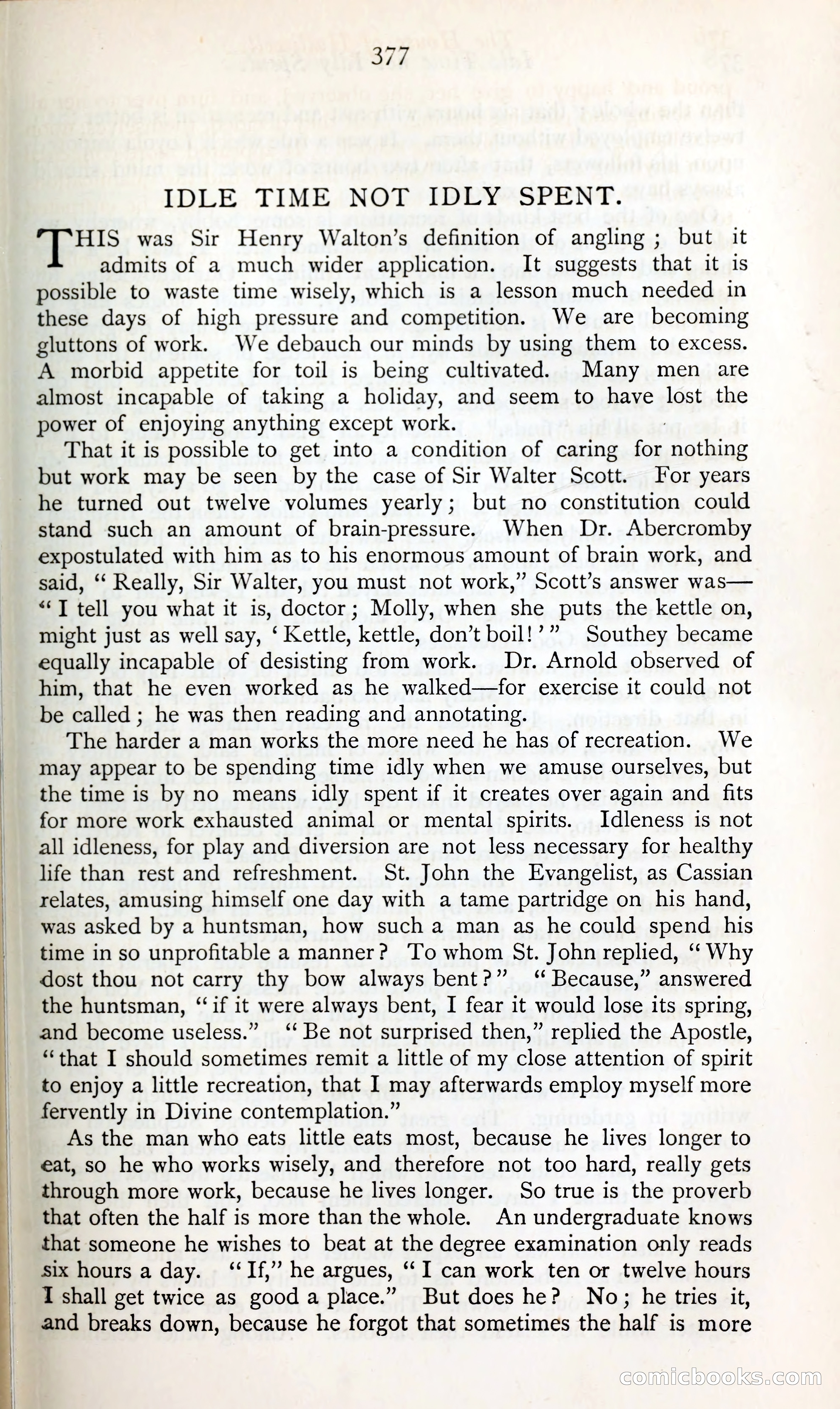
A restored page from Pulp Fiction, 1865. Page through the whole issue in the reader above.
📄 Transcribed text from this page (OCR, searchable)
Machine-transcribed from the original scan — historical spelling and the odd misread are preserved.
377 IDLE TIME NOT IDLY SPENT. Sao was Sir Henry Walton’s definition of angling ; but it admits of a much wider application. It suggests that it is possible to waste time wisely, which is a lesson much needed in these days of high pressure and competition. We are becoming gluttons of work. We debauch our minds by using them to excess. A morbid appetite for toil is being cultivated. Many men are almost incapable of taking a holiday, and seem to have lost the power of enjoying anything except work. : That it is possible to get into a condition of caring for nothing but work may be seen by the case of Sir Walter Scott. or years he turned out twelve volumes yearly; but no constitution could stand such an amount of brain-pressure. When Dr. Abercromby expostulated with him as to his enormous amount of brain work, and said, “‘ Really, Sir Walter, you must not work,” Scott’s answer was— “T tell you what it is, doctor; Molly, when she puts the kettle on, might just as well say, ‘ Kettle, kettle, don’t boil!’” Southey became equally incapable of desisting from work. Dr. Arnold observed of him, that he even worked as he walked—for exercise it could not be called ; he was then reading and annotating. The harder a man works the more need he has of recreation. We may appear to be spending time idly when we amuse ourselves, but the time is by no means idly spent if it creates over again and fits for more work exhausted animal or mental spirits. Idleness is not all idleness, for play and diversion are not less necessary for healthy life than rest and refreshment. St. John the Evangelist, as Cassian relates, amusing himself one day with a tame partridge on his hand, was asked by a huntsman, how such a man as he could spend his time in so unprofitable a manner? ‘To whom St. John replied, ‘‘ Why dost thou not carry thy bow always bent?” ‘“ Because,” answered the huntsman, ‘‘if it were always bent, I fear it would lose its spring, and become useless.” ‘‘ Be not surprised then,” replied the Apostle, “that I should sometimes remit a little of my close attention of spirit to enjoy a little recreation, that I may afterwards employ myself more fervently in Divine contemplation.” As the man who eats little eats most, because he lives longer to eat, so he who works wisely, and therefore not too hard, really gets through more work, because he lives longer. So true is the proverb that often the half is more than the whole. An undergraduate knows that someone he wishes to beat at the degree examination only reads six hours a day. “If,” he argues, “‘I can work ten or twelve hours T shall get twice as good a place.” But does he? No; he tries it, and breaks down, because he forgot that sometimes the half is more GomiilGaooks (©)