
Pulp Fiction, 1865 · page 396 of 399
The Argosy — page 396: what you’re looking at
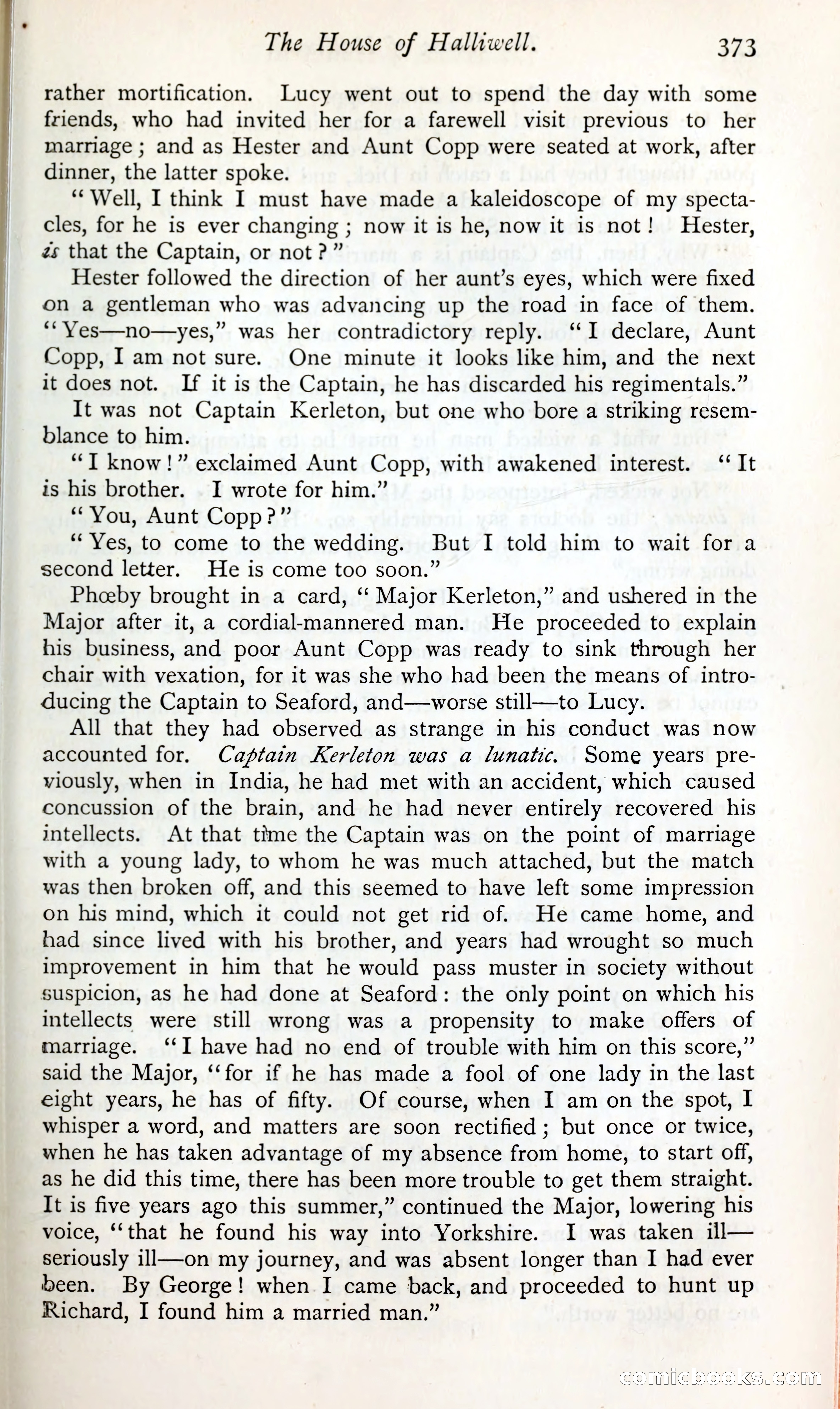
A restored page from Pulp Fiction, 1865. Page through the whole issue in the reader above.
📄 Transcribed text from this page (OCR, searchable)
Machine-transcribed from the original scan — historical spelling and the odd misread are preserved.
The House of Halliwell. 373 rather mortification. Lucy went out to spend the day with some friends, who had invited her for a farewell visit previous to her marriage ; and as Hester and Aunt Copp were seated at work, after dinner, the latter spoke. “Well, I think I must have made a kaleidoscope of my specta- cles, for he is ever changing ; now it is he, now it is not! Hester, 2s that the Captain, or not ?” Hester followed the direction of her aunt’s eyes, which were fixed on a gentleman who was advancing up the road in face of them. ‘“ Yes—no—yes,” was her contradictory reply. “I declare, Aunt Copp, Iam not sure. One minute it looks like him, and the next it does not. If it is the Captain, he has discarded his regimentals.” It was not Captain Kerleton, but one who bore a striking resem- blance to him. “T know!” exclaimed Aunt Copp, with awakened interest. “It is his brother. I wrote for him.” “You, Aunt Copp?” “Yes, to come to the wedding. But I told him to wait for a second letter. He is come too soon.” Phoeby brought in a card, ‘‘ Major Kerleton,” and ushered in the Major after it, a cordial-mannered man. He proceeded to explain his business, and poor Aunt Copp was ready to sink through her chair with vexation, for it was she who had been the means of intro- ducing the Captain to Seaford, and—worse still—to Lucy. All that they had observed as strange in his conduct was now accounted for. Captain Kerleton was a lunatic. Some years pre- viously, when in India, he had met with an accident, which caused concussion of the brain, and he had never entirely recovered his intellects. At that time the Captain was on the point of marriage with a young lady, to whom he was much attached, but the match was then broken off, and this seemed to have left some impression on his mind, which it could not get rid of. He came home, and had since lived with his brother, and years had wrought so much improvement in him that he would pass muster in society without suspicion, as he had done at Seaford: the only point on which his intellects were still wrong was a propensity to make offers of marriage. ‘‘I have had no end of trouble with him on this score,” said the Major, ‘‘for if he has made a fool of one lady in the last eight years, he has of fifty. Of course, when I am on the spot, I whisper a word, and matters are soon rectified; but once or twice, when he has taken advantage of my absence from home, to start off, as he did this time, there has been more trouble to get them straight. It is five years ago this summer,” continued the Major, lowering his voice, ‘‘that he found his way into Yorkshire. I was taken ill— seriously ill—on my journey, and was absent longer than I had ever been. By George! when I came back, and proceeded to hunt up Richard, I found him a married man.” COMM ) NOOKS (SO)