
Pulp Fiction, 1865 · page 377 of 399
The Argosy — page 377: what you’re looking at
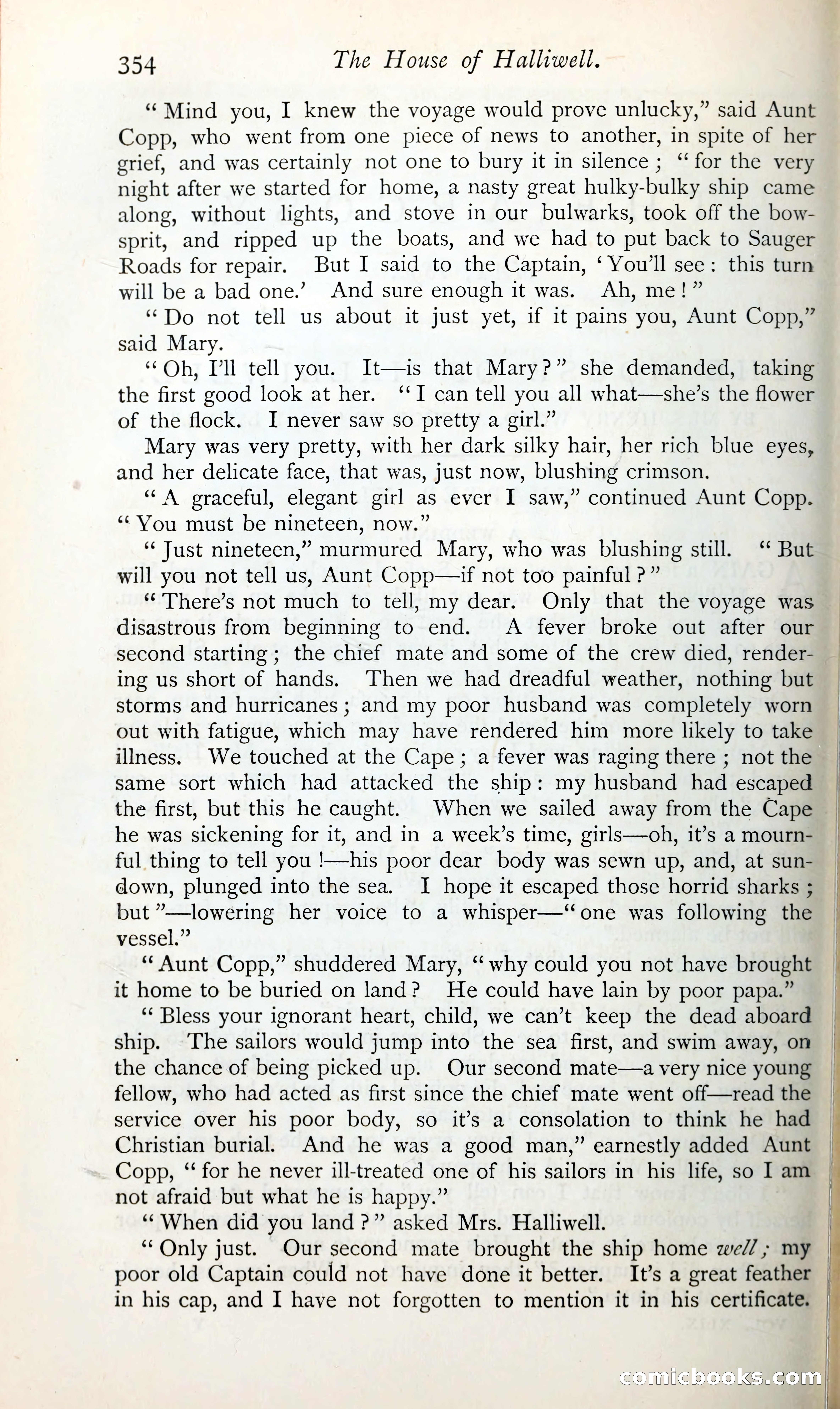
A restored page from Pulp Fiction, 1865. Page through the whole issue in the reader above.
📄 Transcribed text from this page (OCR, searchable)
Machine-transcribed from the original scan — historical spelling and the odd misread are preserved.
354 The House of Halliwell. “Mind you, I knew the voyage would prove unlucky,” said Aunt Copp, who went from one piece of news to another, in spite of her grief, and was certainly not one to bury it in silence; “for the very night after we started for home, a nasty great hulky-bulky ship came along, without lights, and stove in our bulwarks, took off the bow- sprit, and ripped up the boats, and we had to put back to Sauger Roads for repair. But I said to the Captain, ‘ You'll see: this turn will be a bad one.’ And sure enough it was. Ah, me!” “Do not tell us about it just yet, if 1t pains you, Aunt Copp,” said Mary. “Oh, Dll tell you. It—is that Mary?” she demanded, taking the first good look at her. ‘‘I can tell you all what—she’s the flower of the flock. I never saw so pretty a girl.” Mary was very pretty, with her dark silky hair, her rich blue eyes, and her delicate face, that was, just now, blushing crimson. “A graceful, elegant girl as ever I saw,” continued Aunt Copp. ‘¢ You must be nineteen, now.” ‘Just nineteen,” murmured Mary, who was blushing still. ‘‘ But will you not tell us, Aunt Copp—if not too painful P” ‘There’s not much to tell, my dear. Only that the voyage was disastrous from beginning to end. A fever broke out after our — second starting; the chief mate and some of the crew died, render- — ing us short of hands. Then we had dreadful weather, nothing but storms and hurricanes; and my poor husband was completely worn | out with fatigue, which may have rendered him more likely to take — illness. We touched at the Cape; a fever was raging there ; not the — same sort which had attacked the ship: my husband had escaped the first, but this he caught. When we sailed away from the Cape he was sickening for it, and in a week’s time, girls—oh, it’s a mourn- ful thing to tell you !—his poor dear body was sewn up, and, at sun- — down, plunged into the sea. I hope it escaped those horrid sharks ; but ”—lowering her voice to a whisper—‘‘one was following the vessel.” ‘* Aunt Copp,” shuddered Mary, “why could you not have brought it home to be buried on land? He could have lain by poor papa.” ‘Bless your ignorant heart, child, we can’t keep the dead aboard ship. The sailors would jump into the sea first, and swim away, on | the chance of being picked up. Our second mate—a very nice young fellow, who had acted as first since the chief mate went off—read the service over his poor body, so it’s a consolation to think he had — Christian burial. And he was a good man,” earnestly added Aunt — Copp, ‘‘ for he never ill-treated one of his sailors in his life, so I am not afraid but what he is happy.” | ‘When did you land ?” asked Mrs. Halliwell. | ‘Only just. Our second mate brought the ship home zed/ ; my | poor old Captain could not have done it better. It’s a great feather in his cap, and I have not forgotten to mention it in his certificate. Gomicbooks.com