
Pulp Fiction, 1865 · page 370 of 399
The Argosy — page 370: what you’re looking at
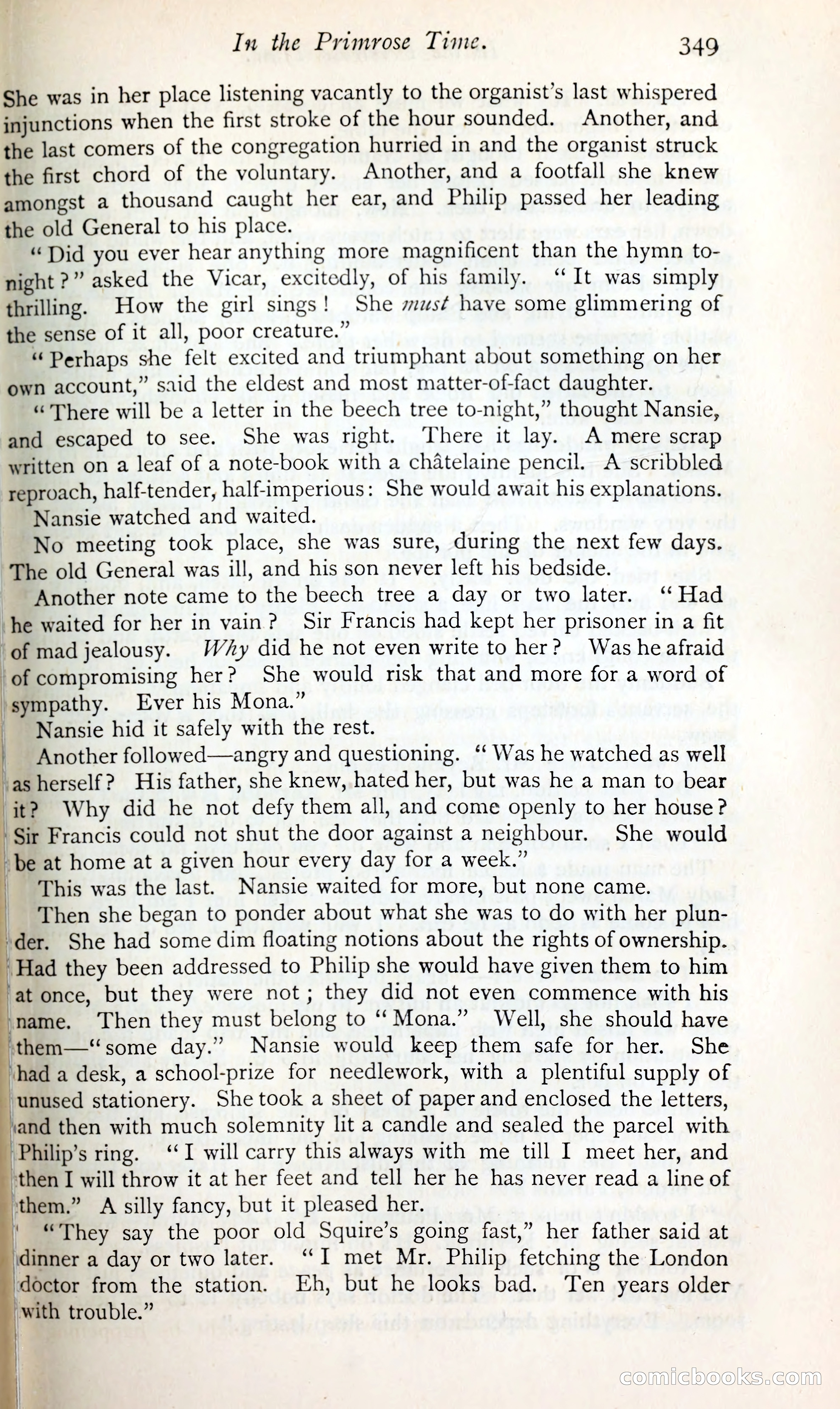
A restored page from Pulp Fiction, 1865. Page through the whole issue in the reader above.
📄 Transcribed text from this page (OCR, searchable)
Machine-transcribed from the original scan — historical spelling and the odd misread are preserved.
In the Primrose Time. 349 She was in her place listening vacantly to the organist’s last whispered injunctions when the first stroke of the hour sounded. Another, and the last comers of the congregation hurried in and the organist struck the first chord of the voluntary. Another, and a footfall she knew amongst a thousand caught her ear, and Philip passed her leading the old General to his place. “Did you ever hear anything more magnificent than the hymn to- night ?” asked the Vicar, excitedly, of his family. “It was simply thrilling. How the girl sings! She must have some glimmering of the sense of it all, poor creature.” « Perhaps she felt excited and triumphant about something on her own account,” said the eldest and most matter-of-fact daughter. “ There will be a letter in the beech tree to-night,” thought Nansie, and escaped to see. She was right. There it lay. A mere scrap written on a leaf of a note-book with a chatelaine pencil. A scribbled reproach, half-tender, halfimperious: She would await his explanations. -Nansie watched and waited. No meeting took place, she was sure, during the next few days. The old General was ill, and his son never left his bedside. Another note came to the beech tree a day or two later. ‘‘ Had he waited for her in vain? Sir Francis had kept her prisoner in a fit ‘of madjealousy. Why did he not even write to her? Was he afraid ‘of compromising her? She would risk that and more for a word of ‘sympathy. Ever his Mona.” Nansie hid it safely with the rest. _ Another followed—angry and questioning. ‘‘ Was he watched as well as herself? His father, she knew, hated her, but was he a man to bear it? Why did he not defy them all, and come openly to her house? Sir Francis could not shut the door against a neighbour. She would be at home at a given hour every day for a week.” This was the last. Nansie waited for more, but none came. Then she began to ponder about what she was to do with her plun- ‘der. She had some dim floating notions about the rights of ownership. ‘Had they been addressed to Philip she would have given them to him ‘at once, but they were not; they did not even commence with his sname. Then they must belong to “Mona.” Well, she should have them—some day.” Nansie would keep them safe for her. She vhad a desk, a school-prize for needlework, with a plentiful supply of ‘unused stationery. She took a sheet of paper and enclosed the letters, yand then with much solemnity lit a candle and sealed the parcel with ‘Philip’s ring. ‘I will carry this always with me till I meet her, and then I will throw it at her feet and tell her he has never read a line of them.” A silly fancy, but it pleased her. ‘ “They say the poor old Squire’s going fast,” her father said at idinner a day or two later. “I met Mr. Philip fetching the London ‘doctor from the station. Eh, but he looks bad. Ten years older “with trouble.” ad ——— —— — a ——— CORlNELMOO© SS) im