
Pulp Fiction, 1865 · page 366 of 399
The Argosy — page 366: what you’re looking at
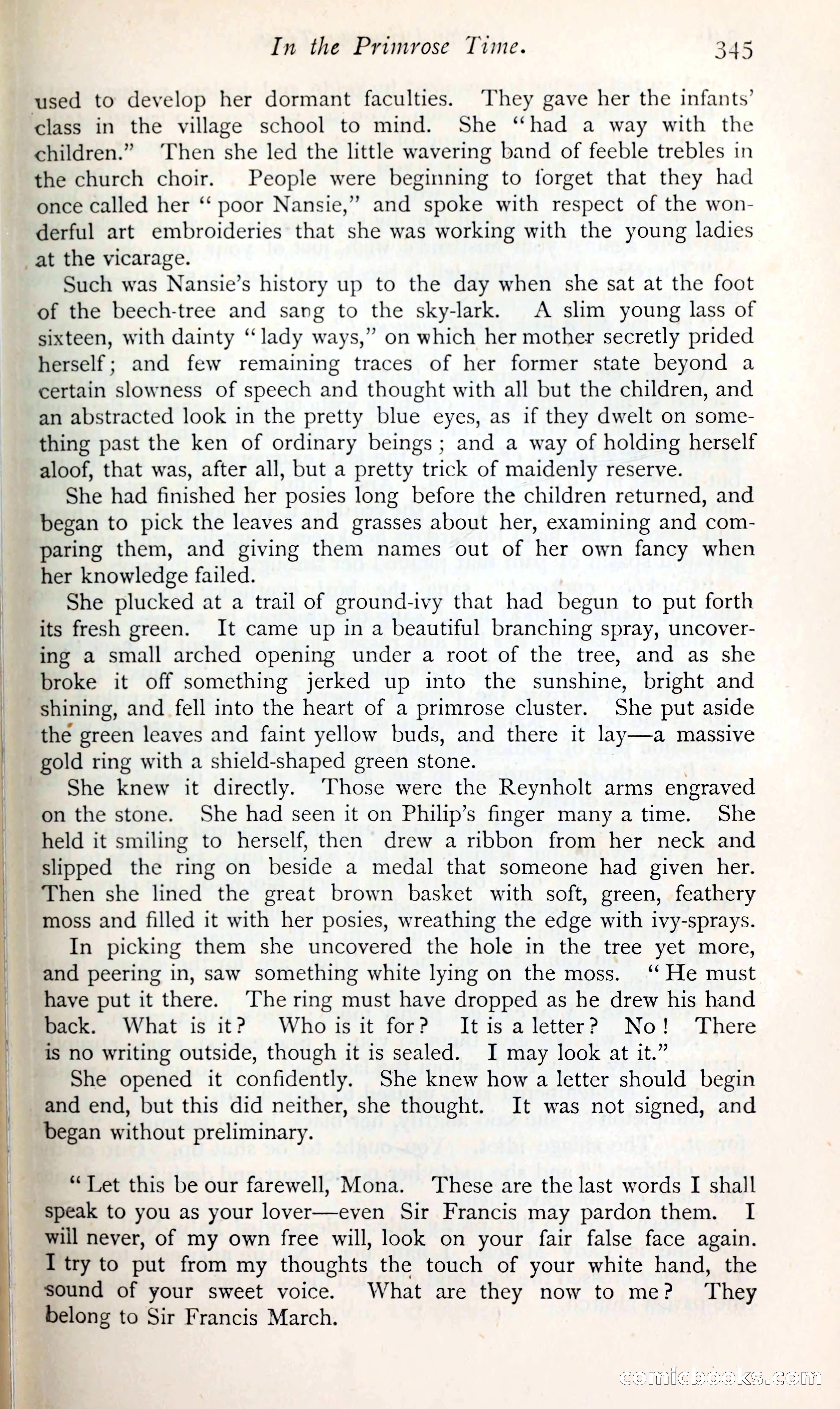
A restored page from Pulp Fiction, 1865. Page through the whole issue in the reader above.
📄 Transcribed text from this page (OCR, searchable)
Machine-transcribed from the original scan — historical spelling and the odd misread are preserved.
In the Primrose Time. 345 used to develop her dormant faculties. They gave her the infants’ class in the village school to mind. She ‘had a way with the children.” ‘Then she led the little wavering band of feeble trebles in the church choir. People were beginning to forget that they had once called her “‘ poor Nansie,” and spoke with respect of the won- derful art embroideries that she was working with the young ladies _at the vicarage. Such was Nansie’s history up to the day when she sat at the foot of the beech-tree and sang to the sky-lark. A slim young lass of sixteen, with dainty “lady ways,” on which her mother secretly prided herself; and few remaining traces of her former state beyond a certain slowness of speech and thought with all but the children, and an abstracted look in the pretty blue eyes, as if they dwelt on some- thing past the ken of ordinary beings ; and a way of holding herself aloof, that was, after all, but a pretty trick of maidenly reserve. She had finished her posies long before the children returned, and began to pick the leaves and grasses about her, examining and com- paring them, and giving them names out of her own fancy when her knowledge failed. She plucked at a trail of ground-ivy that had begun to put forth its fresh green. It came up in a beautiful branching spray, uncover- ing a small arched opening under a root of the tree, and as she broke it off something jerked up into the sunshine, bright and shining, and fell into the heart of a primrose cluster. She put aside the green leaves and faint yellow buds, and there it lay—a massive gold ring with a shield-shaped green stone. She knew it directly. Those were the Reynholt arms engraved on the stone. She had seen it on Philip’s finger many a time. She held it smiling to herself, then drew a ribbon from her neck and slipped the ring on beside a medal that someone had given her. Then she lined the great brown basket with soft, green, feathery moss and filled it with her posies, wreathing the edge with ivy-sprays. In picking them she uncovered the hole in the tree yet more, and peering in, saw something white lying on the moss. ‘‘ He must have put it there. ‘The ring must have dropped as he drew his hand Dack. What is it? Whoisit for? Itisaletter? No! There is no writing outside, though it is sealed. I may look at it.” She opened it confidently. She knew how a letter should begin _and end, but this did neither, she thought. It was not signed, and began without preliminary. “Let this be our farewell, Mona. These are the last words I shall speak to you as your lover—even Sir Francis may pardon them. I will never, of my own free will, look on your fair false face again. T try to put from my thoughts the touch of your white hand, the sound of your sweet voice. What are they now to me? They belong to Sir Francis March. CoOnniclooolkks im