
Pulp Fiction, 1865 · page 308 of 399
The Argosy — page 308: what you’re looking at
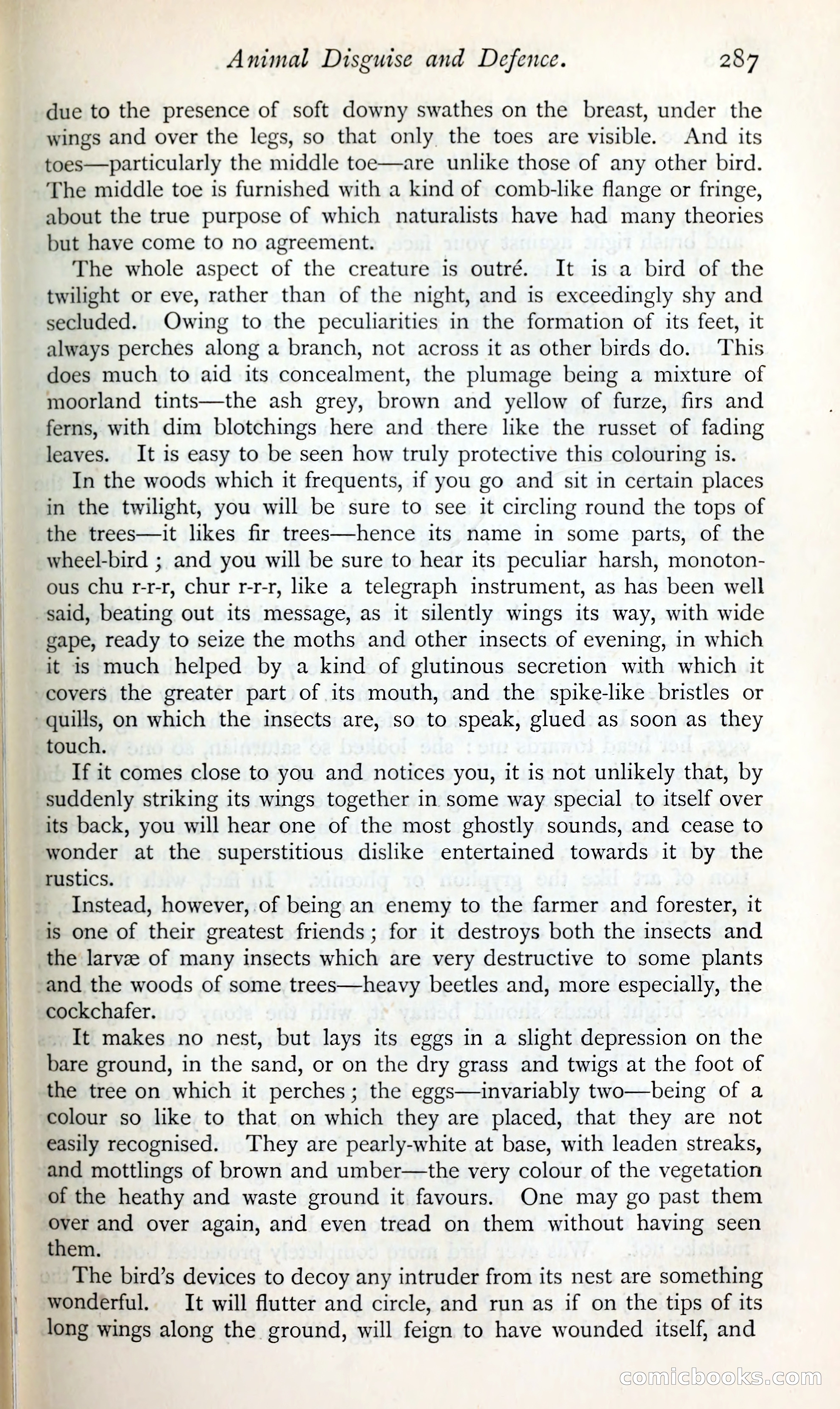
A restored page from Pulp Fiction, 1865. Page through the whole issue in the reader above.
📄 Transcribed text from this page (OCR, searchable)
Machine-transcribed from the original scan — historical spelling and the odd misread are preserved.
Ammal Disguise and Defence. 287 due to the presence of soft downy swathes on the breast, under the wings and over the legs, so that only the toes are visible. And its toes—particularly the middle toe—are unlike those of any other bird. The middle toe is furnished with a kind of comb-like flange or fringe, about the true purpose of which naturalists have had many theories but have come to no agreement. The whole aspect of the creature is outré. It is a bird of the twilight or eve, rather than of the night, and is exceedingly shy and secluded. Owing to the peculiarities in the formation of its feet, it always perches along a branch, not across it as other birds do. ‘This does much to aid its concealment, the plumage being a mixture of moorland tints—the ash grey, brown and yellow of furze, firs and ferns, with dim blotchings here and there like the russet of fading leaves. It is easy to be seen how truly protective this colouring is. In the woods which it frequents, if you go and sit in certain places in the twilight, you will be sure to see it circling round the tops of the trees—it likes fir trees—hence its name in some parts, of the wheel-bird ; and you will be sure to hear its peculiar harsh, monoton- ous chu r-r-r, chur r-r-r, like a telegraph instrument, as has been well said, beating out its message, as it silently wings its way, with wide gape, ready to seize the moths and other insects of evening, in which it is much helped by a kind of glutinous secretion with which it covers the greater part of its mouth, and the spike-like bristles or quills, on which the insects are, so to speak, glued as soon as they touch. If it comes close to you and notices you, it is not unlikely that, by suddenly striking its wings together in some way special to itself over its back, you will hear one of the most ghostly sounds, and cease to wonder at the superstitious dislike entertained towards it by the rustics. Instead, however, of being an enemy to the farmer and forester, it is one of their greatest friends; for it destroys both the insects and the larvee of many insects which are very destructive to some plants -and the woods of some trees—heavy beetles and, more especially, the cockchafer. It makes no nest, but lays its eggs in a slight depression on the bare ground, in the sand, or on the dry grass and twigs at the foot of the tree on which it perches; the eggs—invariably two—being of a colour so like to that on which they are placed, that they are not easily recognised. They are pearly-white at base, with leaden streaks, and mottlings of brown and umber—the very colour of the vegetation of the heathy and waste ground it favours. One may go past them Over and over again, and even tread on them without having seen them. The bird’s devices to decoy any intruder from its nest are something wonderful. It will flutter and circle, and run as if on the tips of its long wings along the ground, will feign to have wounded itself, and GomiilGcaooks (©) an