
Pulp Fiction, 1865 · page 306 of 399
The Argosy — page 306: what you’re looking at
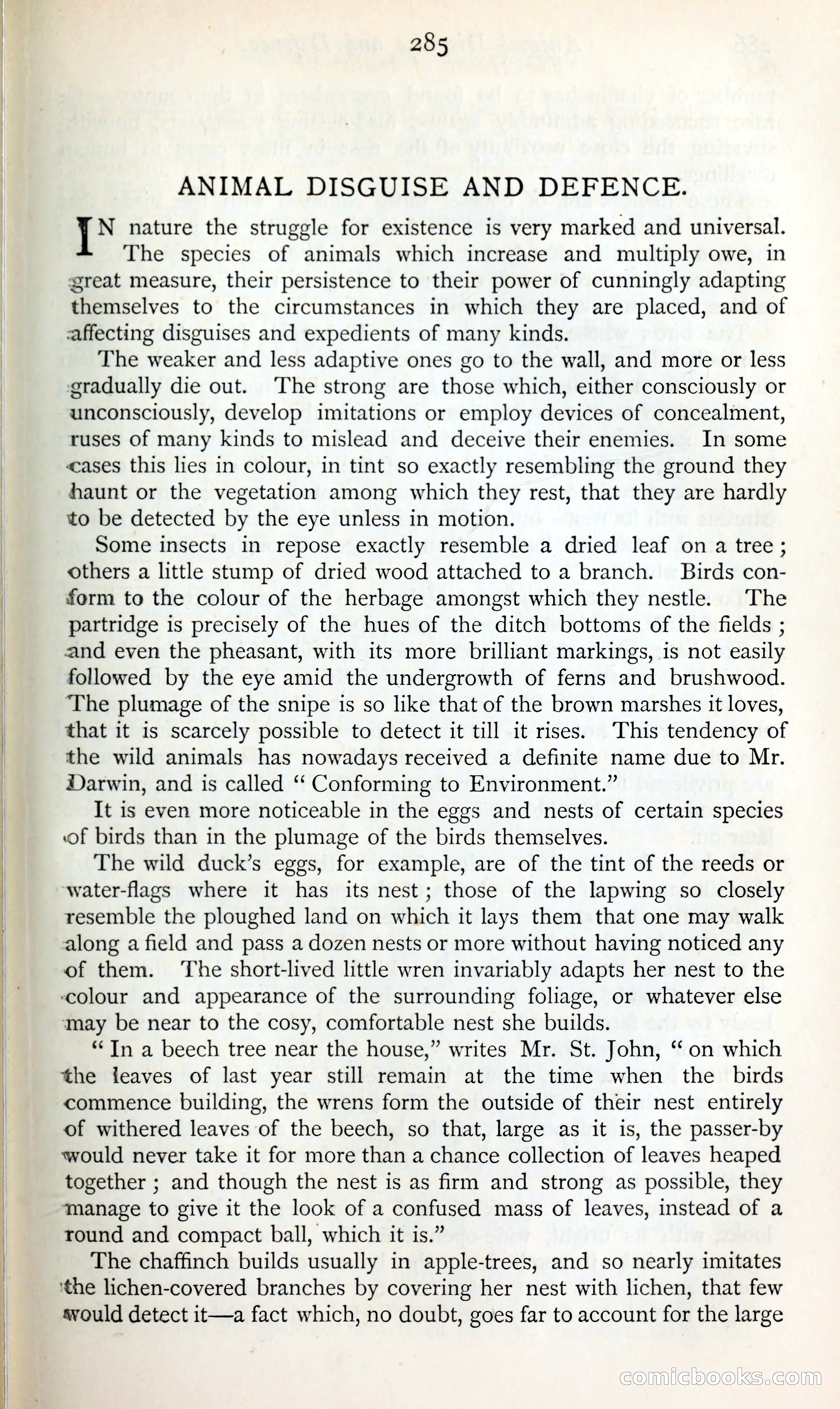
A restored page from Pulp Fiction, 1865. Page through the whole issue in the reader above.
📄 Transcribed text from this page (OCR, searchable)
Machine-transcribed from the original scan — historical spelling and the odd misread are preserved.
285 ANIMAL DISGUISE AND DEFENCE. 1% nature the struggle for existence is very marked and universal. The species of animals which increase and multiply owe, in great measure, their persistence to their power of cunningly adapting themselves to the circumstances in which they are placed, and of affecting disguises and expedients of many kinds. The weaker and less adaptive ones go to the wall, and more or less gradually die out. ‘The strong are those which, either consciously or unconsciously, develop imitations or employ devices of concealment, ruses of many kinds to mislead and deceive their enemies. In some cases this lies in colour, in tint so exactly resembling the ground they haunt or the vegetation among which they rest, that they are hardly to be detected by the eye unless in motion. Some insects in repose exactly resemble a dried leaf on a tree; others a little stump of dried wood attached to a branch. Birds con- form to the colour of the herbage amongst which they nestle. The partridge is precisely of the hues of the ditch bottoms of the fields ; and even the pheasant, with its more brilliant markings, is not easily followed by the eye amid the undergrowth of ferns and brushwood. ‘The plumage of the snipe is so like that of the brown marshes it loves, that it is scarcely possible to detect it till it rises. This tendency of the wild animals has nowadays received a definite name due to Mr. Darwin, and is called “‘ Conforming to Environment.” It is even more noticeable in the eggs and nests of certain species of birds than in the plumage of the birds themselves. The wild duck’s eggs, for example, are of the tint of the reeds or water-flags where it has its nest; those of the lapwing so closely resemble the ploughed land on which it lays them that one may walk along a field and pass a dozen nests or more without having noticed any of them. ‘The short-lived little wren invariably adapts her nest to the colour and appearance of the surrounding foliage, or whatever else ‘may be near to the cosy, comfortable nest she builds. “In a beech tree near the house,” writes Mr. St. John, “on which the feaves of last year still remain at the time when the _ birds commence building, the wrens form the outside of their nest entirely of withered leaves of the beech, so that, large as it is, the passer-by would never take it for more than a chance collection of leaves heaped together ; and though the nest is as firm and strong as possible, they Manage to give it the look of a confused mass of leaves, instead of a round and compact ball, which it is.” The chaffinch builds usually in apple-trees, and so nearly imitates ithe lichen-covered branches by covering her nest with lichen, that few svould detect it—a fact which, no doubt, goes far to account for the large COM (-) VHOO|KS,CO im