
Pulp Fiction, 1865 · page 264 of 399
The Argosy — page 264: what you’re looking at
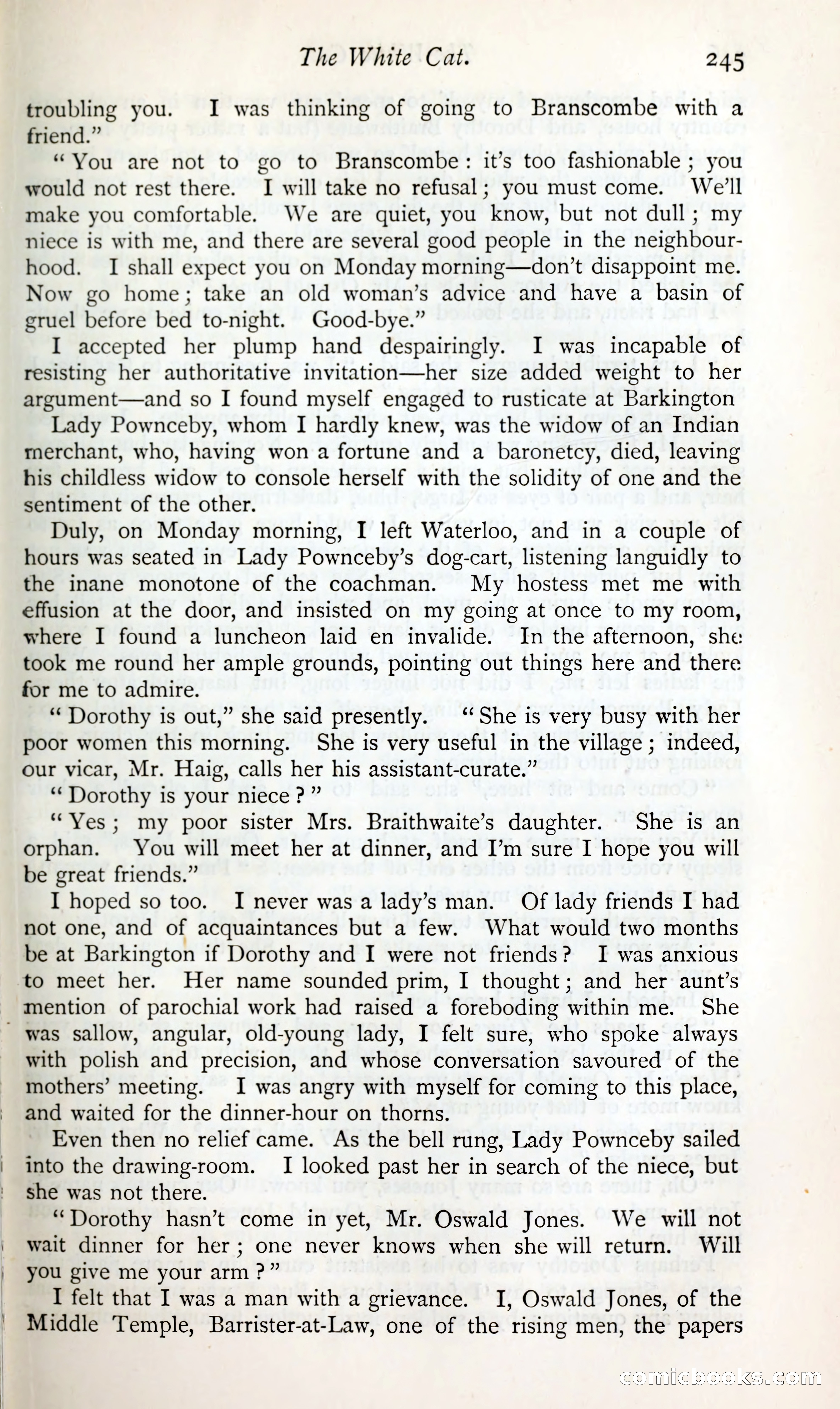
A restored page from Pulp Fiction, 1865. Page through the whole issue in the reader above.
📄 Transcribed text from this page (OCR, searchable)
Machine-transcribed from the original scan — historical spelling and the odd misread are preserved.
} | The White Cat. 245 troubling you. I was thinking of going to Branscombe with a friend.” “You are not to go to Branscombe: it’s too fashionable ; you would not rest there. I will take no refusal; you must come. We'll make you comfortable. We are quiet, you know, but not dull; my niece is with me, and there are several good people in the neighbour- hood. I shall expect you on Monday morning—don’t disappoint me. Now go home; take an old woman’s advice and have a basin of gruel before bed to-night. Good-bye.” I accepted her plump hand despairingly. I was incapable of resisting her authoritative invitation—her size added weight to her argument—and so I found myself engaged to rusticate at Barkington Lady Pownceby, whom I hardly knew, was the widow of an Indian merchant, who, having won a fortune and a baronetcy, died, leaving his childless widow to console herself with the solidity of one and the sentiment of the other. Duly, on Monday morning, I left Waterloo, and in a couple of hours was seated in Lady Pownceby’s dog-cart, listening languidly to the inane monotone of the coachman. My hostess met me with effusion at the door, and insisted on my going at once to my room, where I found a luncheon laid en invalide. In the afternoon, she: took me round her ample grounds, pointing out things here and there for me to admire. “Dorothy is out,” she said presently. ‘She is very busy with her poor women this morning. She is very useful in the village; indeed, our vicar, Mr. Haig, calls her his assistant-curate.” “Dorothy is your niece ? ” “Yes; my poor sister Mrs. Braithwaite’s daughter. She is an orphan. You will meet her at dinner, and I’m sure I hope you will be great friends.” I hoped so too. I never was a lady’s man. Of lady friends I had not one, and of acquaintances but a few. What would two months be at Barkington if Dorothy and I were not friends? I was anxious to meet her. Her name sounded prim, I thought; and her aunt’s mention of parochial work had raised a foreboding within me. She was sallow, angular, old-young lady, I felt sure, who spoke always with polish and precision, and whose conversation savoured of the mothers’ meeting. I was angry with myself for coming to this place, and waited for the dinner-hour on thorns. Even then no relief came. As the bell rung, Lady Pownceby sailed into the drawing-room. I looked past her in search of the niece, but she was not there. “Dorothy hasn’t come in yet, Mr. Oswald Jones. We will not wait dinner for her; one never knows when she will return. Will you give me your arm ?” I felt that I was a man with a grievance. I, Oswald Jones, of the Middle Temple, Barrister-at-Law, one of the rising men, the papers CORINELOO© SS) (©) am