
Pulp Fiction, 1865 · page 254 of 399
The Argosy — page 254: what you’re looking at
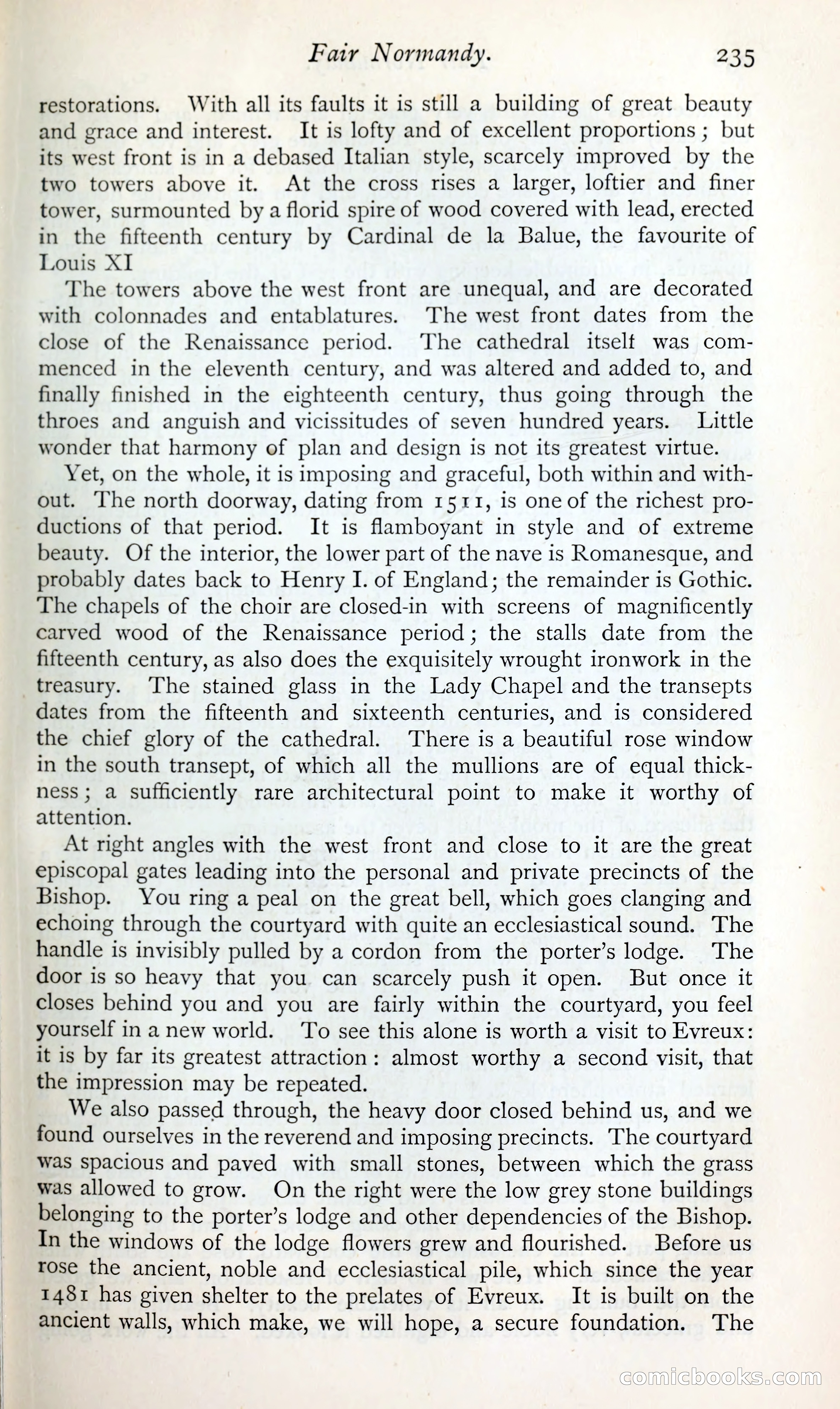
A restored page from Pulp Fiction, 1865. Page through the whole issue in the reader above.
📄 Transcribed text from this page (OCR, searchable)
Machine-transcribed from the original scan — historical spelling and the odd misread are preserved.
Fair Normandy. 235 restorations. With all its faults it is still a building of great beauty and grace and interest. It is lofty and of excellent proportions ; but its west front is in a debased Italian style, scarcely improved by the two towers above it. At the cross rises a larger, loftier and finer tower, surmounted by a florid spire of wood covered with lead, erected in the fifteenth century by Cardinal de la Balue, the favourite of Louis XI The towers above the west front are unequal, and are decorated with colonnades and entablatures. The west front dates from the close of the Renaissance period. ‘The cathedral itself was com- menced in the eleventh century, and was altered and added to, and finally finished in the eighteenth century, thus going through the throes and anguish and vicissitudes of seven hundred years. Little wonder that harmony of plan and design is not its greatest virtue. Yet, on the whole, it is imposing and graceful, both within and with- out. ‘The north doorway, dating from 1511, is oneof the richest pro- ductions of that period. It is flamboyant in style and of extreme beauty. Of the interior, the lower part of the nave is Romanesque, and probably dates back to Henry I. of England; the remainder is Gothic. The chapels of the choir are closed-in with screens of magnificently carved wood of the Renaissance period; the stalls date from the fifteenth century, as also does the exquisitely wrought ironwork in the treasury. The stained glass in the Lady Chapel and the transepts dates from the fifteenth and sixteenth centuries, and is considered the chief glory of the cathedral. There is a beautiful rose window in the south transept, of which all the mullions are of equal thick- ness; a sufficiently rare architectural point to make it worthy of attention. At right angles with the west front and close to it are the great episcopal gates leading into the personal and private precincts of the Bishop. You ring a peal on the great bell, which goes clanging and echoing through the courtyard with quite an ecclesiastical sound. The handle is invisibly pulled by a cordon from the porter’s lodge. The door is so heavy that you can scarcely push it open. But once it closes behind you and you are fairly within the courtyard, you feel yourself inanew world. To see this alone is worth a visit to Evreux: it is by far its greatest attraction: almost worthy a second visit, that the impression may be repeated. We also passed through, the heavy door closed behind us, and we found ourselves in the reverend and imposing precincts. The courtyard was spacious and paved with small stones, between which the grass was allowed to grow. On the right were the low grey stone buildings belonging to the porter’s lodge and other dependencies of the Bishop. In the windows of the lodge flowers grew and flourished. Before us rose the ancient, noble and ecclesiastical pile, which since the year 1481 has given shelter to the prelates of Evreux. It is built on the ancient walls, which make, we will hope, a secure foundation. The CoOnniclooolkKs (S©) im