
Pulp Fiction, 1865 · page 219 of 399
The Argosy — page 219: what you’re looking at
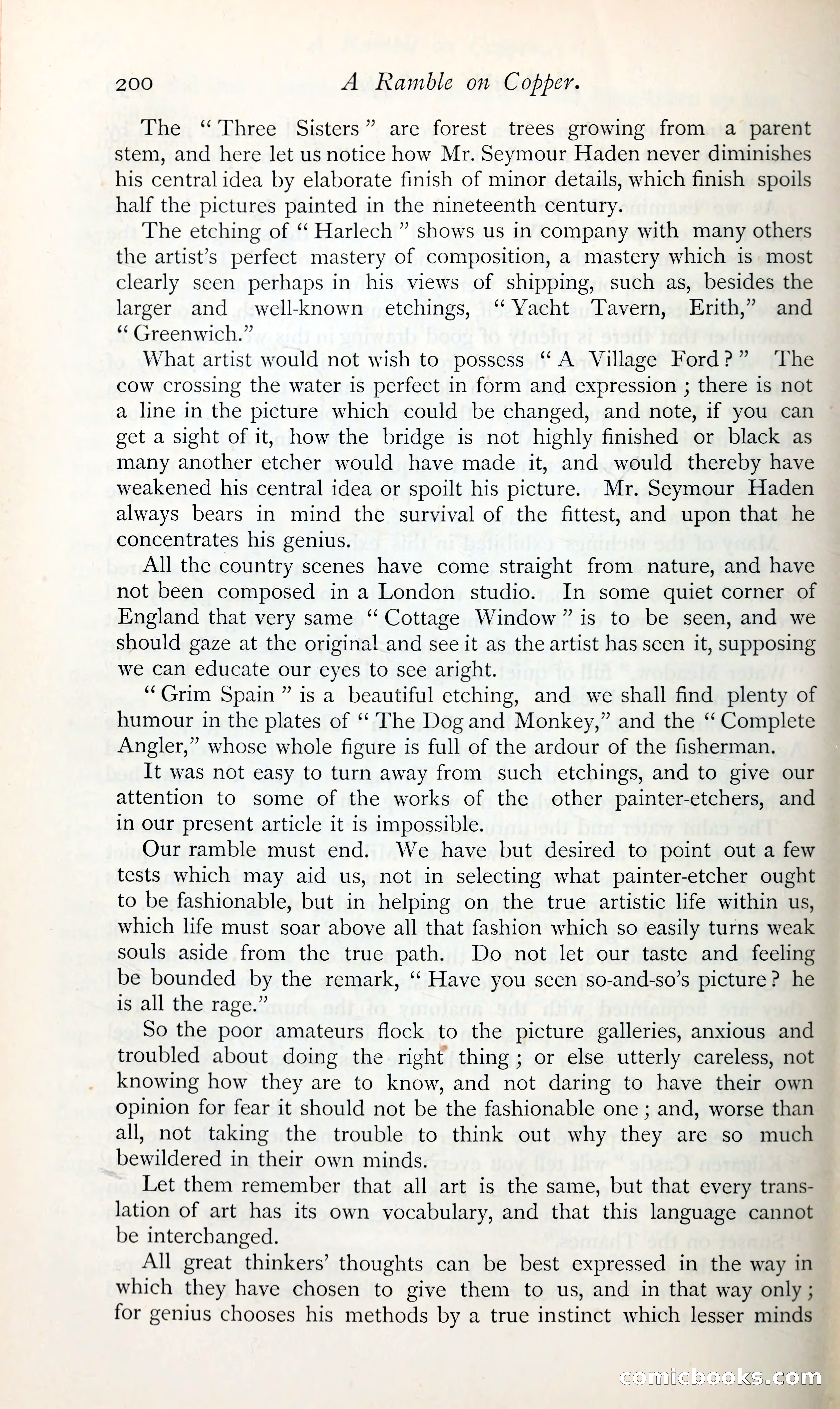
A restored page from Pulp Fiction, 1865. Page through the whole issue in the reader above.
📄 Transcribed text from this page (OCR, searchable)
Machine-transcribed from the original scan — historical spelling and the odd misread are preserved.
200 A Ramble on Copper. The ‘Three Sisters” are forest trees growing from a parent stem, and here let us notice how Mr. Seymour Haden never diminishes his centralidea by elaborate finish of minor details, which finish spoils half the pictures painted in the nineteenth century. The etching of ‘‘ Harlech ” shows us in company with many others the artist’s perfect mastery of composition, a mastery which is most clearly seen perhaps in his views of shipping, such as, besides the larger and _ well-known etchings, ‘‘ Yacht ‘Tavern, Enrth,” and ‘“* Greenwich.” What artist would not wish to possess “fA Village Ford?” ‘The cow crossing the water is perfect in form and expression ; there is not a line in the picture which could be changed, and note, if you can get a sight of it, how the bridge is not highly finished or black as many another etcher would have made it, and would thereby have weakened his central idea or spoilt his picture. Mr. Seymour Haden always bears in mind the survival of the fittest, and upon that he concentrates his genius. All the country scenes have come straight from nature, and have not been composed in a London studio. In some quiet corner of England that very same ‘‘ Cottage Window” is to be seen, and we should gaze at the original and see it as the artist has seen it, supposing we can educate our eyes to see aright. “Grim Spain” is a beautiful etching, and we shall find plenty of humour in the plates of ‘‘ The Dog and Monkey,” and the ‘‘ Complete Angler,” whose whole figure is full of the ardour of the fisherman. It was not easy to turn away from such etchings, and to give our attention to some of the works of the other painter-etchers, and in our present article it is impossible. Our ramble must end. We have but desired to point out a few tests which may aid us, not in selecting what painter-etcher ought to be fashionable, but in helping on the true artistic life within us, which life must soar above all that fashion which so easily turns weak souls aside from the true path. Do not let our taste and feeling be bounded by the remark, ‘‘ Have you seen so-and-so’s picture? he is all the rage.” So the poor amateurs flock to the picture galleries, anxious and troubled about doing the right thing; or else utterly careless, not knowing how they are to know, and not daring to have their own opinion for fear it should not be the fashionable one ; and, worse than all, not taking the trouble to think out why they are so much bewildered in their own minds. Let them remember that all art is the same, but that every trans- lation of art has its own vocabulary, and that this language cannot be interchanged. All great thinkers’ thoughts can be best expressed in the way in which they have chosen to give them to us, and in that way only; for genius chooses his methods by a true instinct which lesser minds €om ! a» \ soOoksS-com