
Pulp Fiction, 1865 · page 207 of 399
The Argosy — page 207: what you’re looking at
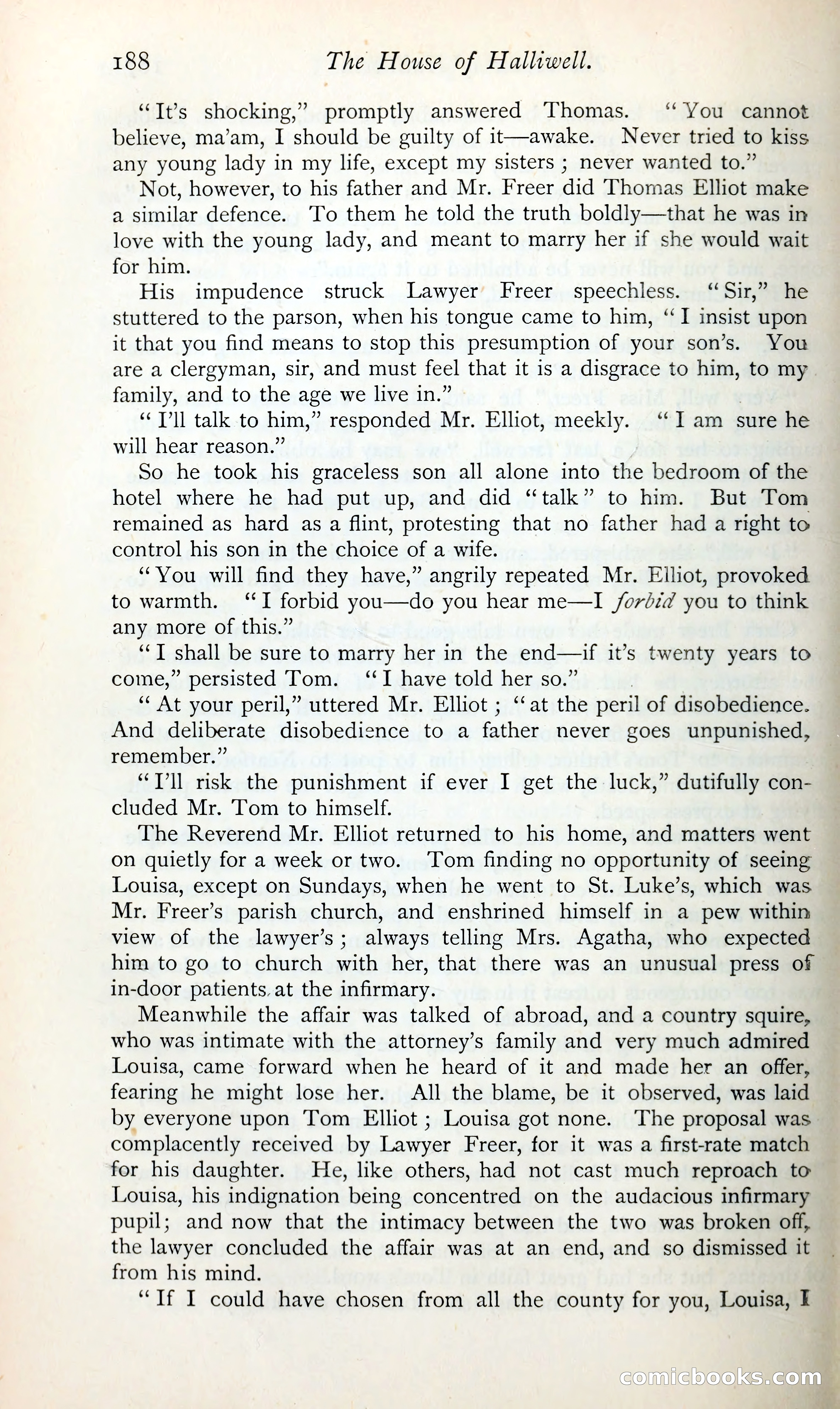
A restored page from Pulp Fiction, 1865. Page through the whole issue in the reader above.
📄 Transcribed text from this page (OCR, searchable)
Machine-transcribed from the original scan — historical spelling and the odd misread are preserved.
188 The House of Halliwell. ‘“Tt’s shocking,” promptly answered Thomas. ‘‘ You cannot believe, ma’am, I should be guilty of it—awake. Never tried to kiss any young lady in my life, except my sisters ; never wanted to.” Not, however, to his father and Mr. Freer did Thomas Elliot make a similar defence. ‘To them he told the truth boldly—that he was in love with the young lady, and meant to marry her if she would wait for him. His impudence struck Lawyer’ Freer speechless. “Sir,” he stuttered to the parson, when his tongue came to him, ‘‘I insist upon it that you find means to stop this presumption of your son’s. You are a clergyman, sir, and must feel that it is a disgrace to him, to my family, and to the age we live in.” | “ T’ll talk to him,” responded Mr. Elliot, meekly. “I am sure he will hear reason.” So he took his graceless son all alone into the bedroom of the hotel where he had put up, and did “talk” to him. But Tom remained as hard as a flint, protesting that no father had a right to control his son in the choice of a wife. “You will find they have,” angrily repeated Mr. Elliot, provoked to warmth. “TI forbid you—do you hear me—I /ordzd you to think any more of this.” ‘“‘T shall be sure to marry her in the end—f it’s twenty years to come,” persisted Tom. ‘“‘I have told her so.” | ‘At your peril,” uttered Mr. Elliot ; ‘‘at the peril of disobedience. And deliberate disobedience to a father never goes unpunished, remember.” “Tl risk the punishment if ever I get the luck,” dutifully con- cluded Mr. Tom to himself. The Reverend Mr. Elliot returned to his home, and matters went on quietly for a week or two. ‘Tom finding no opportunity of seeing Louisa, except on Sundays, when he went to St. Luke’s, which was Mr. Freer’s parish church, and enshrined himself in a pew within view of the lawyer’s; always telling Mrs. Agatha, who expected him to go to church with her, that there was an unusual press of in-door patients. at the infirmary. Meanwhile the affair was talked of abroad, and a country squire, who was intimate with the attorney’s family and very much admired Louisa, came forward when he heard of it and made her an offer, fearing he might lose her. All the blame, be it observed, was laid by everyone upon Tom Elliot ; Louisa got none. ‘The proposal was complacently received by Lawyer Freer, for it was a first-rate match for his daughter. He, like others, had not cast much reproach to Louisa, his indignation being concentred on the audacious infirmary pupil; and now that the intimacy between the two was broken off, the lawyer concluded the affair was at an end, and so dismissed it from his mind. “If I could have chosen from all the county for you, Louisa, I EONMIE OOO KSarerey a)