
Pulp Fiction, 1865 · page 180 of 399
The Argosy — page 180: what you’re looking at
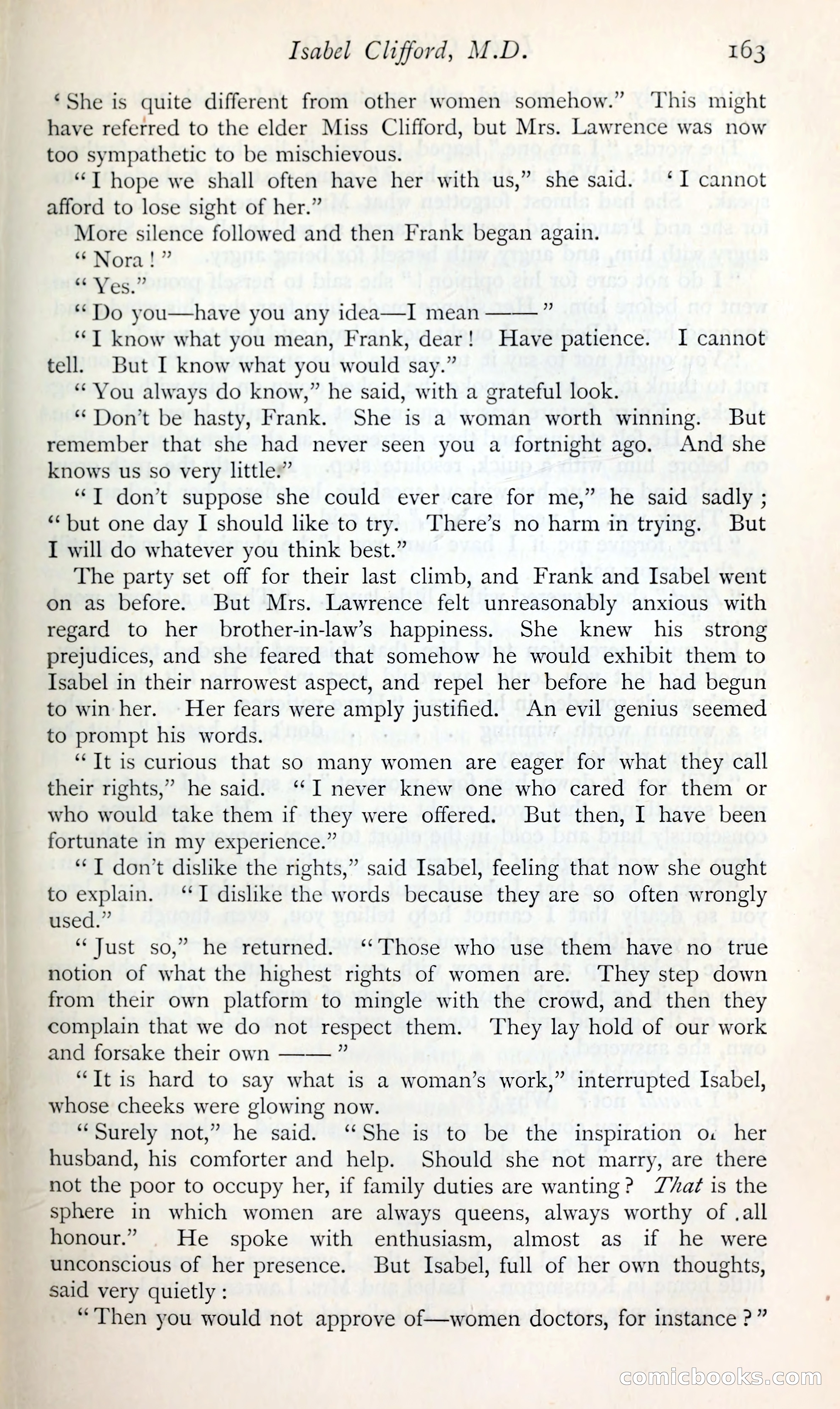
A restored page from Pulp Fiction, 1865. Page through the whole issue in the reader above.
📄 Transcribed text from this page (OCR, searchable)
Machine-transcribed from the original scan — historical spelling and the odd misread are preserved.
Isabel Clifford, M.D. 163 ‘She is quite different from other women somehow.” ‘This might have referred to the elder Miss Clifford, but Mrs. Lawrence was now too sympathetic to be mischievous. “T hope we shall often have her with us,” she said. ‘I cannot afford to lose sight of her.” More silence followed and then Frank began again. eaNora |.” Yes.” “Do you—have you any idea—I mean —— ‘‘T know what you mean, Frank, dear! Have patience. I cannot tell. But I know what you would say.” “You always do know,” he said, with a grateful look. “ Don’t be hasty, Frank. She is a woman worth winning. But remember that she had never seen you a fortnight ago. And she knows us so very little.” ““T don’t suppose she could ever care for me,” he said sadly ; *“but one day I should like to try. There’s no harm in trying. But I will do whatever you think best.” The party set off for their last climb, and Frank and Isabel went on as before. But Mrs. Lawrence felt unreasonably anxious with regard to her brother-in-law’s happiness. She knew his strong prejudices, and she feared that somehow he would exhibit them to Isabel in their narrowest aspect, and repel her before he had begun to win her. Her fears were amply justified. An evil genius seemed to prompt his words. “Tt is curious that so many women are eager for what they call their rights,” he said. ‘‘I never knew one who cared for them or who would take them if they were offered. But then, I have been fortunate In my experience.” ‘““T don’t dislike the rights,” said Isabel, feeling that now she ought to explain. “I dislike the words because they are so often wrongly used.” “Just so,” he returned. ‘‘Those who use them have no true notion of what the highest rights of women are. ‘They step down from their own platform to mingle with the crowd, and then they complain that we do not respect them. ‘They lay hold of our work and forsake their own —— ” “Tt is hard to say what is a woman’s work,” interrupted Isabel, whose cheeks were glowing now. “Surely not,” he said. “She is to be the inspiration o«¢ her husband, his comforter and help. Should she not marry, are there not the poor to occupy her, if family duties are wanting? TZvat is the sphere in which women are always queens, always worthy of .all honour.” He spoke with enthusiasm, almost as if he were unconscious of her presence. But Isabel, full of her own thoughts, said very quietly : “Then you would not approve of—women doctors, for instance ? ” ) COnNICLOOKS (S©) im