
Pulp Fiction, 1865 · page 165 of 399
The Argosy — page 165: what you’re looking at
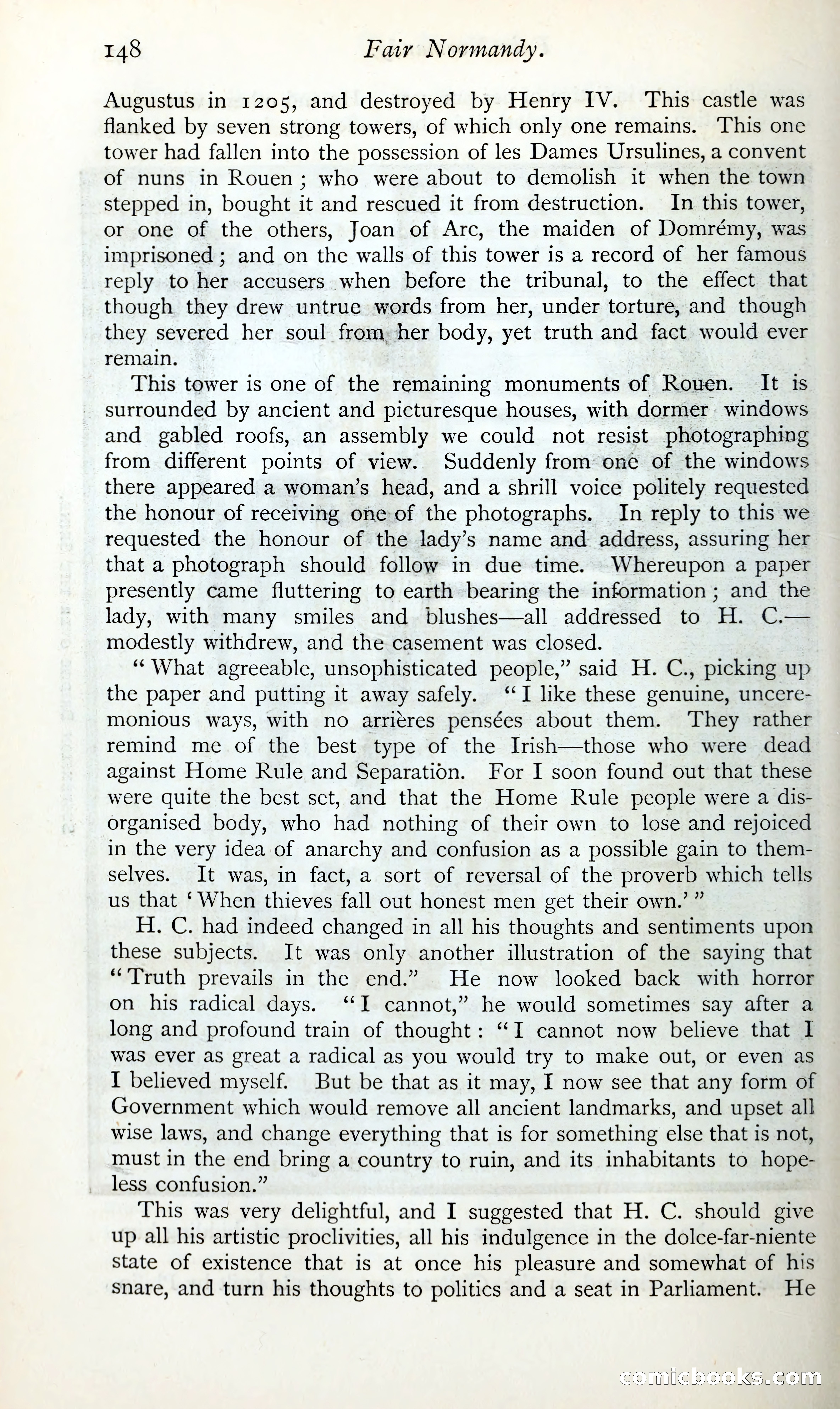
A restored page from Pulp Fiction, 1865. Page through the whole issue in the reader above.
📄 Transcribed text from this page (OCR, searchable)
Machine-transcribed from the original scan — historical spelling and the odd misread are preserved.
148 Far Normandy. Augustus in 1205, and destroyed by Henry IV. ‘This castle was flanked by seven strong towers, of which only one remains. ‘This one tower had fallen into the possession of les Dames Ursulines, a convent of nuns in Rouen; who were about to demolish it when the town stepped in, bought it and rescued it from destruction. In this tower, or one of the others, Joan of Arc, the maiden of Domremy, was imprisoned ; and on the walls of this tower is a record of her famous reply to her accusers when before the tribunal, to the effect that though they drew untrue words from her, under torture, and though they severed her soul from, her body, yet truth and fact would ever remain. This tower is one of the remaining monuments of Rouen. It is surrounded by ancient and picturesque houses, with dormer windows and gabled roofs, an assembly we could not resist photographing from different points of view. Suddenly from one of the windows there appeared a woman’s head, and a shrill voice politely requested the honour of receiving one of the photographs. In reply to this we requested the honour of the lady’s name and address, assuring her that a photograph should follow in due time. Whereupon a paper presently came fluttering to earth bearing the information ; and the lady, with many smiles and blushes—all addressed to H. C.— modestly withdrew, and the casement was closed. ‘““What agreeable, unsophisticated people,” said H. C., picking up the paper and putting it away safely. ‘I like these genuine, uncere- monious ways, with no arrieres pensées about them. They rather remind me of the best type of the Irish—those who were dead against Home Rule and Separation. For I soon found out that these were quite the best set, and that the Home Rule people were a dis- organised body, who had nothing of their own to lose and rejoiced in the very idea of anarchy and confusion as a possible gain to them- selves. It was, in fact, a sort of reversal of the proverb which tells us that ‘When thieves fall out honest men get their own.’ ” H. C. had indeed changed in all his thoughts and sentiments upon these subjects. It was only another illustration of the saying that “Truth prevails in the end.” He now looked back with horror on his radical days. “I cannot,” he would sometimes say after a long and profound train of thought: ‘I cannot now believe that I was ever as great a radical as you would try to make out, or even as I believed myself. But be that as it may, I now see that any form of Government which would remove all ancient landmarks, and upset all wise laws, and change everything that is for something else that is not, must in the end bring a country to ruin, and its inhabitants to hope- less confusion.” This was very delightful, and I suggested that H. C. should give up all his artistic proclivities, all his indulgence in the dolce-far-niente state of existence that is at once his pleasure and somewhat of his snare, and turn his thoughts to politics and a seat in Parliament. He Gomilcbooks.com | an \