
Pulp Fiction, 1865 · page 163 of 399
The Argosy — page 163: what you’re looking at
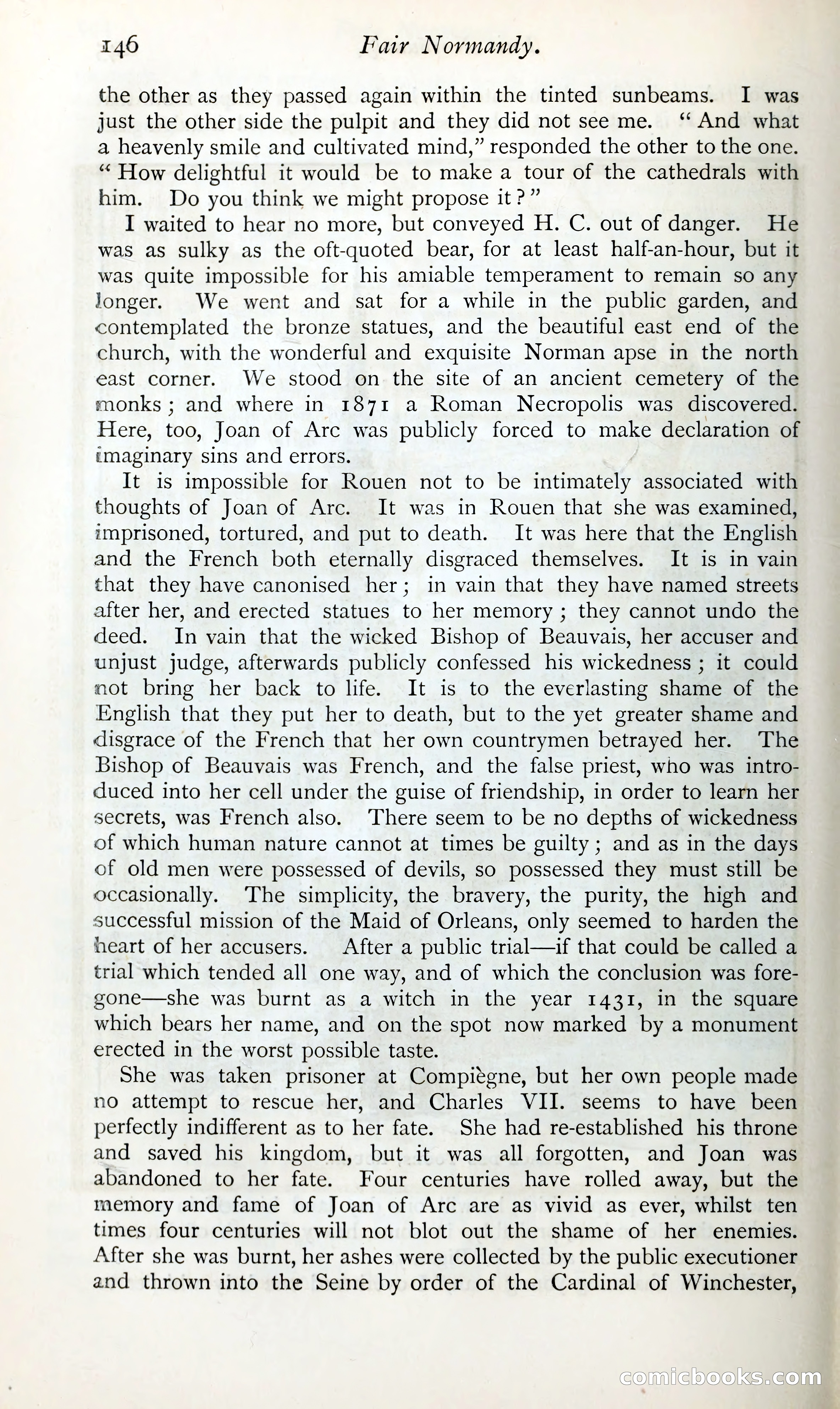
A restored page from Pulp Fiction, 1865. Page through the whole issue in the reader above.
📄 Transcribed text from this page (OCR, searchable)
Machine-transcribed from the original scan — historical spelling and the odd misread are preserved.
146 Far Normandy. the other as they passed again within the tinted sunbeams. I was just the other side the pulpit and they did not see me. ‘‘ And what a heavenly smile and cultivated mind,” responded the other to the one. “ How delightful it would be to make a tour of the cathedrals with him. Do you think we might propose it?” I waited to hear no more, but conveyed H. C. out of danger. He was as sulky as the oft-quoted bear, for at least half-an-hour, but it was quite impossible for his amiable temperament to remain so any Jonger. We went and sat for a while in the public garden, and contemplated the bronze statues, and the beautiful east end of the church, with the wonderful and exquisite Norman apse in the north east corner. We stood on the site of an ancient cemetery of the monks ; and where in 1871 a Roman Necropolis was discovered. Here, too, Joan of Arc was publicly forced to make declaration of imaginary sins and errors. It is impossible for Rouen not to be intimately associated with thoughts of Joan of Arc. It was in Rouen that she was examined, imprisoned, tortured, and put to death. It was here that the English and the French both eternally disgraced themselves. It is in vain that they have canonised her; in vain that they have named streets after her, and erected statues to her memory ; they cannot undo the deed. In vain that the wicked Bishop of Beauvais, her accuser and unjust judge, afterwards publicly confessed his wickedness ; it could mot bring her back to life. It is to the everlasting shame of the English that they put her to death, but to the yet greater shame and disgrace of the French that her own countrymen betrayed her. ‘The Bishop of Beauvais was French, and the false priest, who was intro- duced into her cell under the guise of friendship, in order to learn her secrets, was French also. ‘There seem to be no depths of wickedness of which human nature cannot at times be guilty; and as in the days of old men were possessed of devils, so possessed they must still be occasionally. ‘The simplicity, the bravery, the purity, the high and successful mission of the Maid of Orleans, only seemed to harden the heart of her accusers. After a public trial—if that could be called a trial which tended all one way, and of which the conclusion was fore- gone—she was burnt as a witch in the year 1431, in the square which bears her name, and on the spot now marked by a monument erected in the worst possible taste. She was taken prisoner at Compiégne, but her own people made no attempt to rescue her, and Charles VII. seems to have been perfectly indifferent as to her fate. She had re-established his throne and saved his kingdom, but it was all forgotten, and Joan was abandoned to her fate. Four centuries have rolled away, but the raemory and fame of Joan of Arc are as vivid as ever, whilst ten times four centuries will not blot out the shame of her enemies. After she was burnt, her ashes were collected by the public executioner and thrown into the Seine by order of the Cardinal of Winchester, GomiilGcbooks co (-) m