
Pulp Fiction, 1865 · page 155 of 399
The Argosy — page 155: what you’re looking at
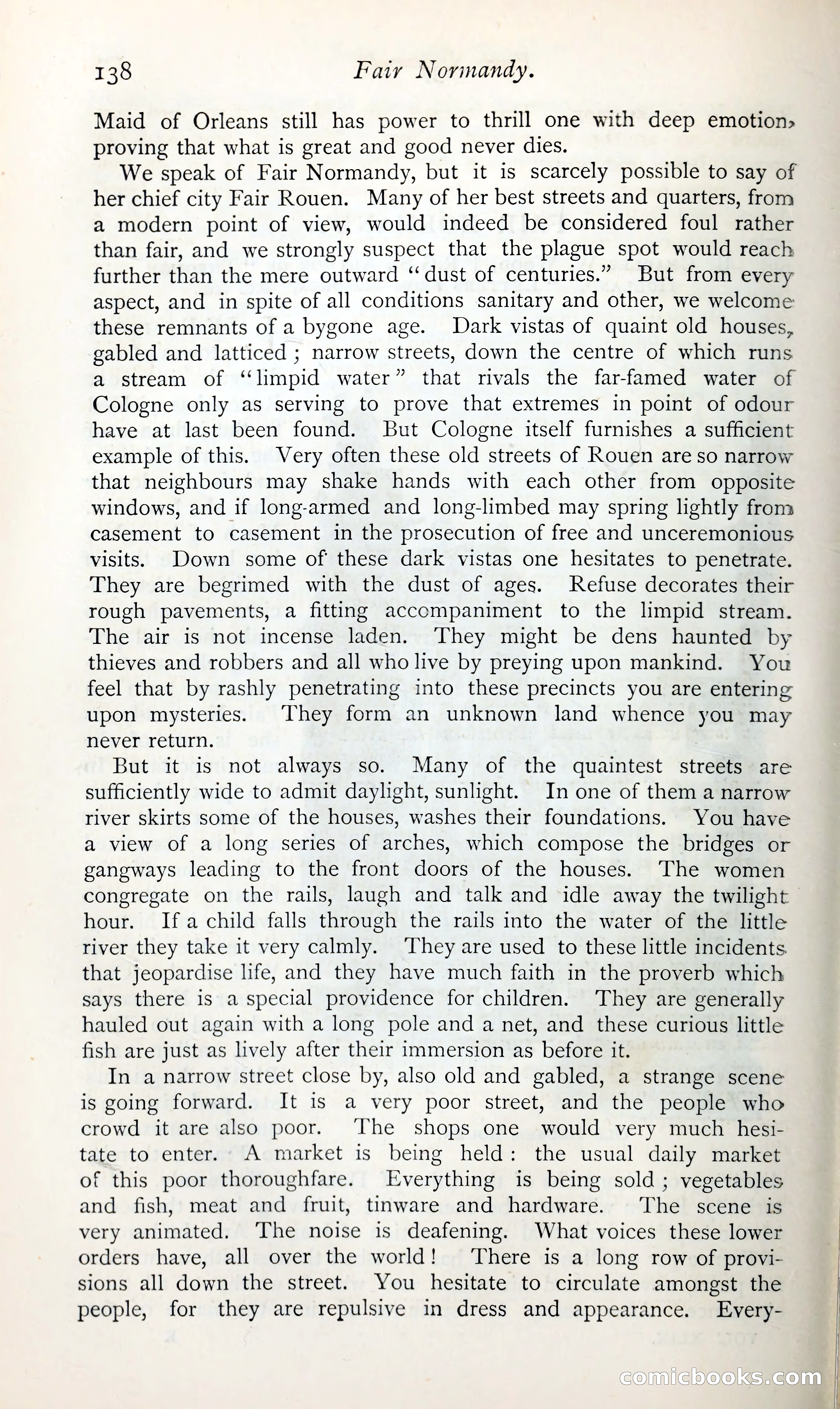
A restored page from Pulp Fiction, 1865. Page through the whole issue in the reader above.
📄 Transcribed text from this page (OCR, searchable)
Machine-transcribed from the original scan — historical spelling and the odd misread are preserved.
138 Faiv Normandy. Maid of Orleans still has power to thrill one with deep emotion» proving that what is great and good never dies. We speak of Fair Normandy, but it is scarcely possible to say of her chief city Fair Rouen. Many of her best streets and quarters, from a modern point of view, would indeed be considered foul rather than fair, and we strongly suspect that the plague spot would reach further than the mere outward ‘dust of centuries.” But from every aspect, and in spite of all conditions sanitary and other, we welcome these remnants of a bygone age. Dark vistas of quaint old houses, gabled and latticed ; narrow streets, down the centre of which runs a stream of “‘limpid water” that rivals the far-famed water of Cologne only as serving to prove that extremes in point of odour have at last been found. But Cologne itself furnishes a sufficient example of this. Very often these old streets of Rouen are so narrow that neighbours may shake hands with each other from opposite windows, and if long-armed and long-limbed may spring lightly from casement to casement in the prosecution of free and unceremonious visits. Down some of these dark vistas one hesitates to penetrate. They are begrimed with the dust of ages. Refuse decorates their rough pavements, a fitting accompaniment to the hmpid stream. The air is not incense laden. ‘They might be dens haunted by thieves and robbers and all who live by preying upon mankind. You feel that by rashly penetrating into these precincts you are entering upon mysteries. They form an unknown land whence you may never return. But it is not always so. Many of the quaintest streets are sufficiently wide to admit daylight, sunlight. In one of them a narrow river skirts some of the houses, washes their foundations. You have a view of a long series of arches, which compose the bridges or gangways leading to the front doors of the houses. The women congregate on the rails, laugh and talk and idle away the twilight hour. Ifa child falls through the rails into the water of the little river they take it very calmly. ‘They are used to these little incidents. that jeopardise life, and they have much faith in the proverb which says there 1s a special providence for children. ‘They are generally hauled out again with a long pole and a net, and these curious little fish are just as lively after their immersion as before it. In a narrow street close by, also old and gabled, a strange scene is going forward. It is a very poor street, and the people who crowd it are also poor. ‘The shops one would very much hesi- tate to enter. A market is being held: the usual daily market of this poor thoroughfare. Everything is being sold ; vegetables and fish, meat and fruit, tinware and hardware. The scene is very animated. The noise is deafening. What voices these lower orders have, all over the world! ‘There is a long row of provi- sions all down the street. You hesitate to circulate amongst the people, for they are repulsive in dress and appearance. Every- Eomichbooks.co m