
Pulp Fiction, 1865 · page 99 of 399
The Argosy — page 99: what you’re looking at
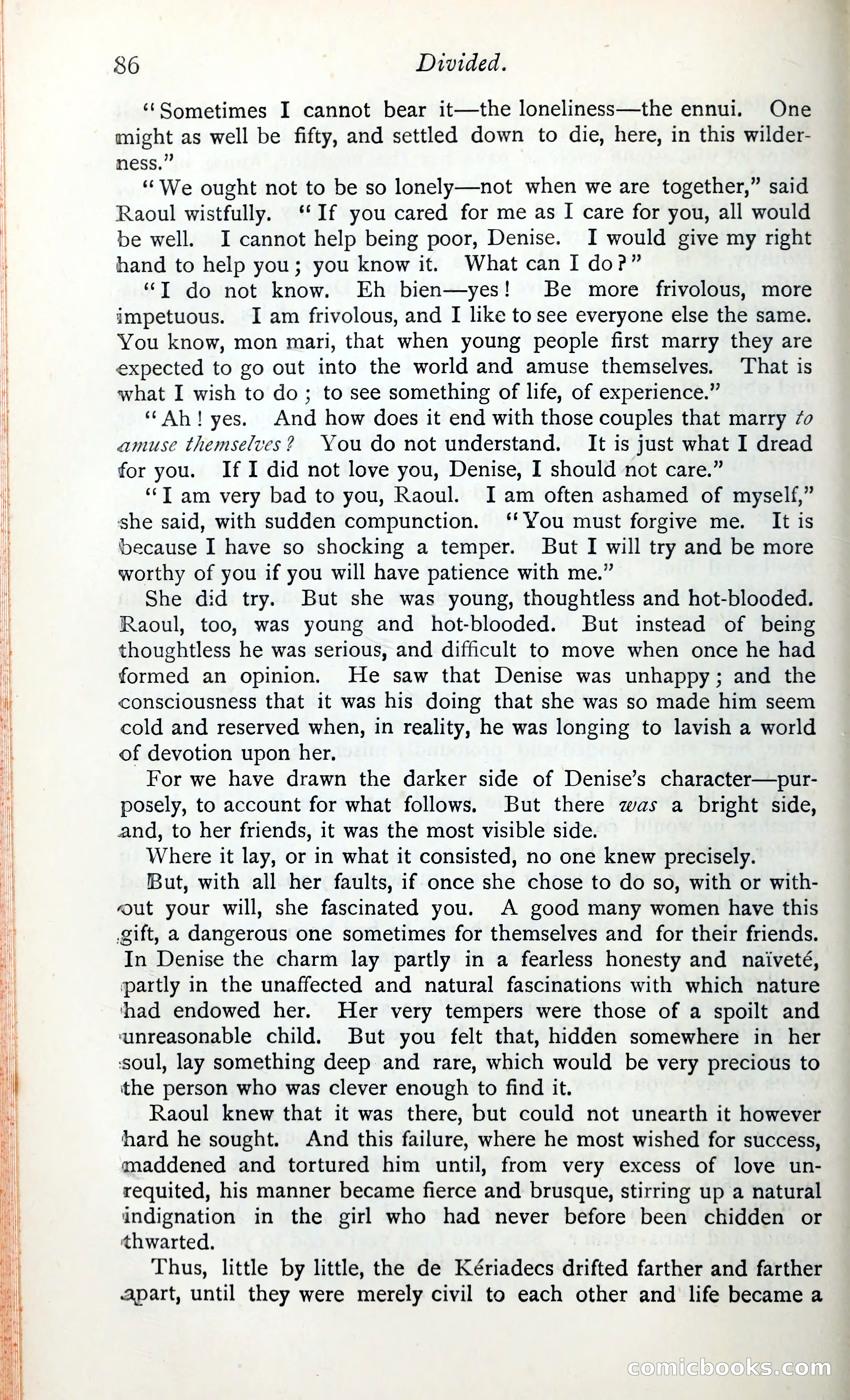
A restored page from Pulp Fiction, 1865. Page through the whole issue in the reader above.
📄 Transcribed text from this page (OCR, searchable)
Machine-transcribed from the original scan — historical spelling and the odd misread are preserved.
80 Divided. ‘‘Sometimes I cannot bear it—the loneliness—the ennui. One might as well be fifty, and settled down to die, here, in this wilder- ness.” ‘“We ought not to be so lonely—not when we are together,” said Raoul wistfully. ‘If you cared for me as I care for you, all would be well. I cannot help being poor, Denise. I would give my right hand to help you; you know it. What can I do?” “T do not know. Eh bien—yes! Be more frivolous, more impetuous. I am frivolous, and I like to see everyone else the same. You know, mon mari, that when young people first marry they are expected to go out into the world and amuse themselves. ‘That is what I wish to do; to see something of life, of experience.” ‘Ah! yes. And how does it end with those couples that marry 7o amuse themselves? You do not understand. It is just what I dread for you. If I did not love you, Denise, I should not care.” ‘Tam very bad to you, Raoul. JI am often ashamed of myself,” she said, with sudden compunction. ‘‘ You must forgive me. It is because I have so shocking a temper. But I will try and be more worthy of you if you will have patience with me.” She did try. But she was young, thoughtless and hot-blooded. Raoul, too, was young and hot-blooded. But instead of being thoughtless he was serious, and difficult to move when once he had formed an opinion. He saw that Denise was unhappy; and the consciousness that it was his doing that she was so made him seem cold and reserved when, in reality, he was longing to lavish a world of devotion upon her. For we have drawn the darker side of Denise’s character—pur- posely, to account for what follows. But there was a bright side, and, to her friends, it was the most visible side. Where it lay, or in what it consisted, no one knew precisely. But, with all her faults, if once she chose to do so, with or with- out your will, she fascinated you. A good many women have this gift, a dangerous one sometimes for themselves and for their friends. In Denise the charm lay partly in a fearless honesty and naiveté, partly in the unaffected and natural fascinations with which nature ‘had endowed her. Her very tempers were those of a spoilt and unreasonable child. But you felt that, hidden somewhere in her soul, lay something deep and rare, which would be very precious to the person who was clever enough to find it. Raoul knew that it was there, but could not unearth it however hard he sought. And this failure, where he most wished for success, maddened and tortured him until, from very excess of love un- requited, his manner became fierce and brusque, stirring up a natural indignation in the girl who had never before been chidden or thwarted. . Thus, little by little, the de Kériadecs drifted farther and farther apart, until they were merely civil to each other and life became a CORNICE OO KS ACO ()