
Pulp Fiction, 1865 · page 84 of 399
The Argosy — page 84: what you’re looking at
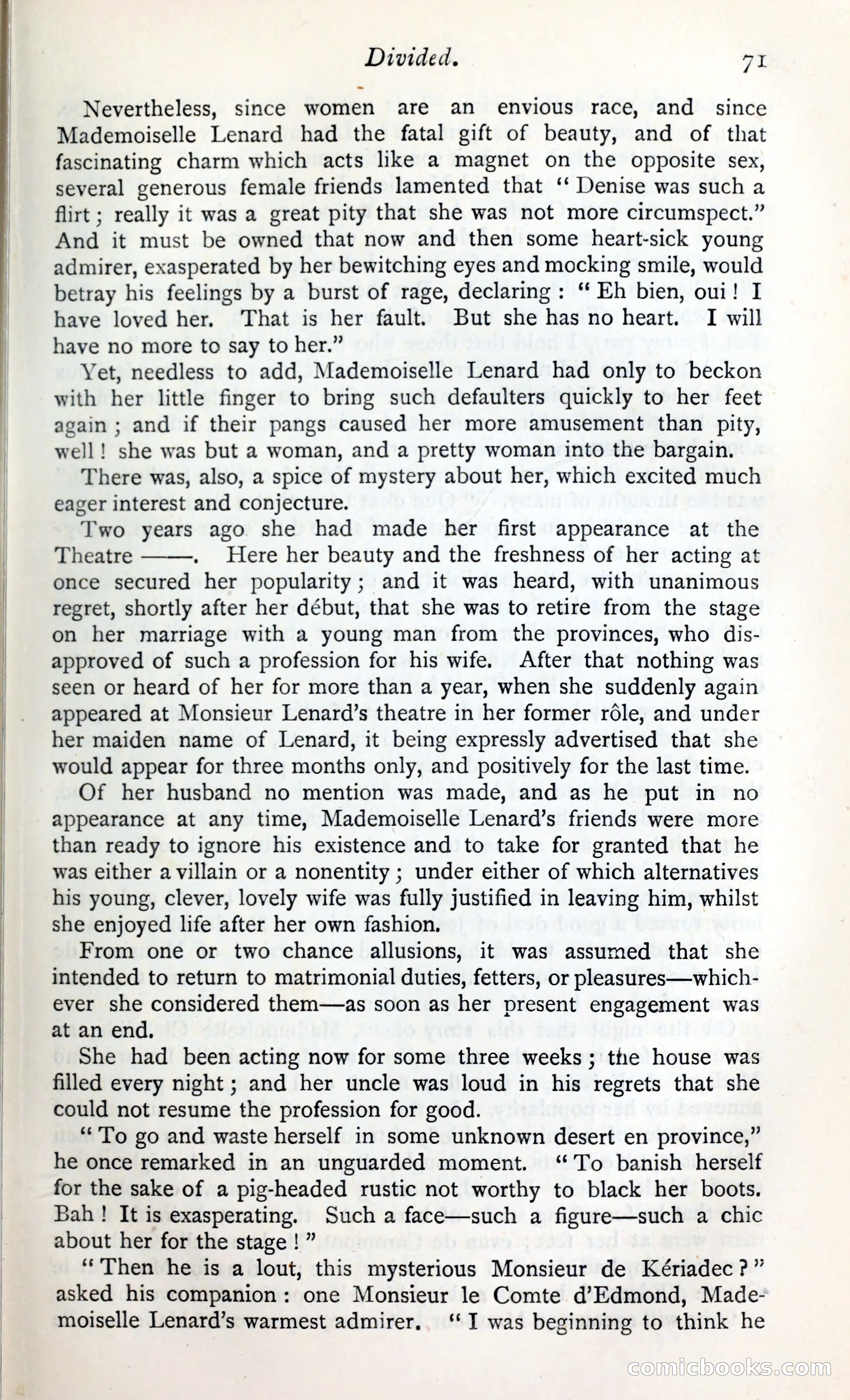
A restored page from Pulp Fiction, 1865. Page through the whole issue in the reader above.
📄 Transcribed text from this page (OCR, searchable)
Machine-transcribed from the original scan — historical spelling and the odd misread are preserved.
Divided. 71 Nevertheless, since women are an envious race, and since Mademoiselle Lenard had the fatal gift of beauty, and of that fascinating charm which acts like a magnet on the opposite sex, several generous female friends lamented that ‘‘ Denise was such a flirt; really it was a great pity that she was not more circumspect.” And it must be owned that now and then some heart-sick young admirer, exasperated by her bewitching eyes and mocking smile, would betray his feelings by a burst of rage, declaring: ‘ Eh bien, oui! I have loved her. ‘That is her fault. But she has no heart. I will have no more to say to her.” Yet, needless to add, Mademoiselle Lenard had only to beckon with her little finger to bring such defaulters quickly to her feet again; and if their pangs caused her more amusement than pity, well! she was but a woman, and a pretty woman into the bargain. There was, also, a spice of mystery about her, which excited much eager interest and conjecture. Two years ago she had made her first appearance at the Theatre Here her beauty and the freshness of her acting at once secured her popularity; and it was heard, with unanimous regret, shortly after her début, that she was to retire from the stage on her marriage with a young man from the provinces, who dis- approved of such a profession for his wife. After that nothing was seen or heard of her for more than a year, when she suddenly again appeared at Monsieur Lenard’s theatre in her former réle, and under her maiden name of Lenard, it being expressly advertised that she would appear for three months only, and positively for the last time. Of her husband no mention was made, and as he put in no appearance at any time, Mademoiselle Lenard’s friends were more than ready to ignore his existence and to take for granted that he was either a villain or a nonentity ; under either of which alternatives his young, clever, lovely wife was fully justified in leaving him, whilst she enjoyed life after her own fashion. From one or two chance allusions, it was assumed that she intended to return to matrimonial duties, fetters, or pleasures—which- ever she considered them—as soon as her present engagement was at an end. She had been acting now for some three weeks; ttie house was filled every night ; and her uncle was loud in his regrets that she could not resume the profession for good. ‘“'To go and waste herself in some unknown desert en province,” he once remarked in an unguarded moment. “To banish herself for the sake of a pig-headed rustic not worthy to black her boots. Bah! It is exasperating. Such a face—such a figure—such a chic about her for the stage ! ” ‘Then he is a lout, this mysterious Monsieur de Kériadec ?” asked his companion: one Monsieur le Comte d’Edmond, Made- moiselle Lenard’s warmest admirer. ‘I was beginning to think he CONnnicloOolKSs (SO) am