
Pulp Fiction, 1865 · page 80 of 399
The Argosy — page 80: what you’re looking at
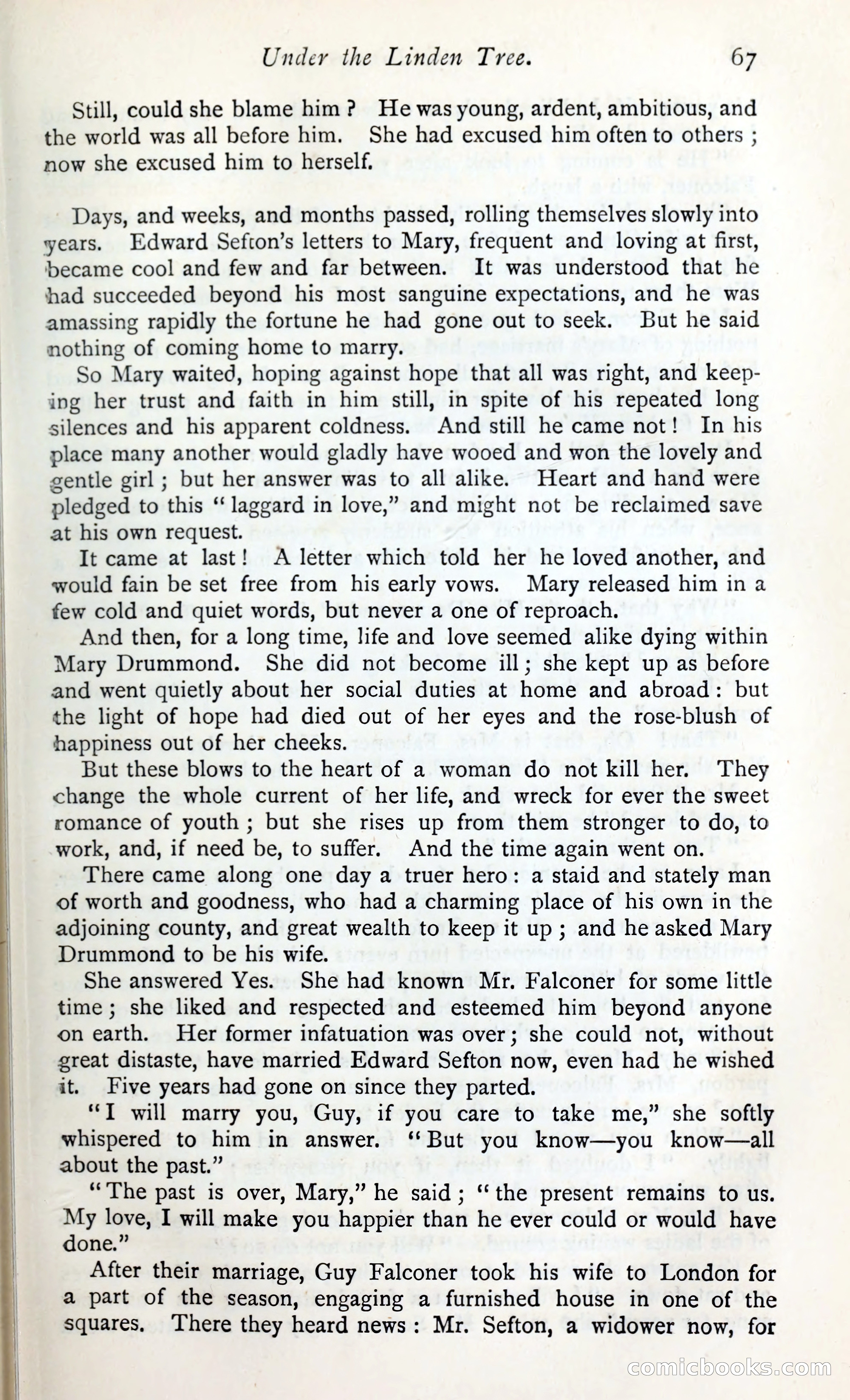
A restored page from Pulp Fiction, 1865. Page through the whole issue in the reader above.
📄 Transcribed text from this page (OCR, searchable)
Machine-transcribed from the original scan — historical spelling and the odd misread are preserved.
Under the Linden Tree. 67 Still, could she blame him? He was young, ardent, ambitious, and the world was all before him. She had excused him often to others ; now she excused him to herself. Days, and weeks, and months passed, rolling themselves slowly into years. Edward Sefton’s letters to Mary, frequent and loving at first, became cool and few and far between. It was understood that he had succeeded beyond his most sanguine expectations, and he was amassing rapidly the fortune he had gone out to seek. But he said nothing of coming home to marry. So Mary waited, hoping against hope that all was right, and keep- ing her trust and faith in him still, in spite of his repeated long silences and his apparent coldness. And still he came not! In his place many another would gladly have wooed and won the lovely and gentle girl ; but her answer was to all alike. Heart and hand were pledged to this ‘‘ laggard in love,” and might not be reclaimed save at his own request. It came at last! A letter which told her he loved another, and would fain be set free from his early vows. Mary released him in a few cold and quiet words, but never a one of reproach. And then, for a long time, life and love seemed alike dying within Mary Drummond. She did not become ill; she kept up as before and went quietly about her social duties at home and abroad: but the light of hope had died out of her eyes and the rose-blush of happiness out of her cheeks. But these blows to the heart of a woman do not kill her. They change the whole current of her life, and wreck for ever the sweet romance of youth; but she rises up from them stronger to do, to work, and, if need be, to suffer. And the time again went on. There came along one day a truer hero: a staid and stately man of worth and goodness, who had a charming place of his own in the adjoining county, and great wealth to keep it up; and he asked Mary Drummond to be his wife. She answered Yes. She had known Mr. Falconer for some little time ; she liked and respected and esteemed him beyond anyone on earth. Her former infatuation was over; she could not, without great distaste, have married Edward Sefton now, even had he wished it. Five years had gone on since they parted. ““T will marry you, Guy, if you care to take me,” she softly whispered to him in answer. ‘‘But you know—you know—all about the past.” ‘The past is over, Mary,” he said; ‘the present remains to us. My love, I will make you happier than he ever could or would have done.” After their marriage, Guy Falconer took his wife to London for a part of the season, engaging a furnished house in one of the squares, There they heard news: Mr. Sefton, a widower now, for ECOMNICMHOOKS.EO An