
Pulp Fiction, 1865 · page 68 of 399
The Argosy — page 68: what you’re looking at
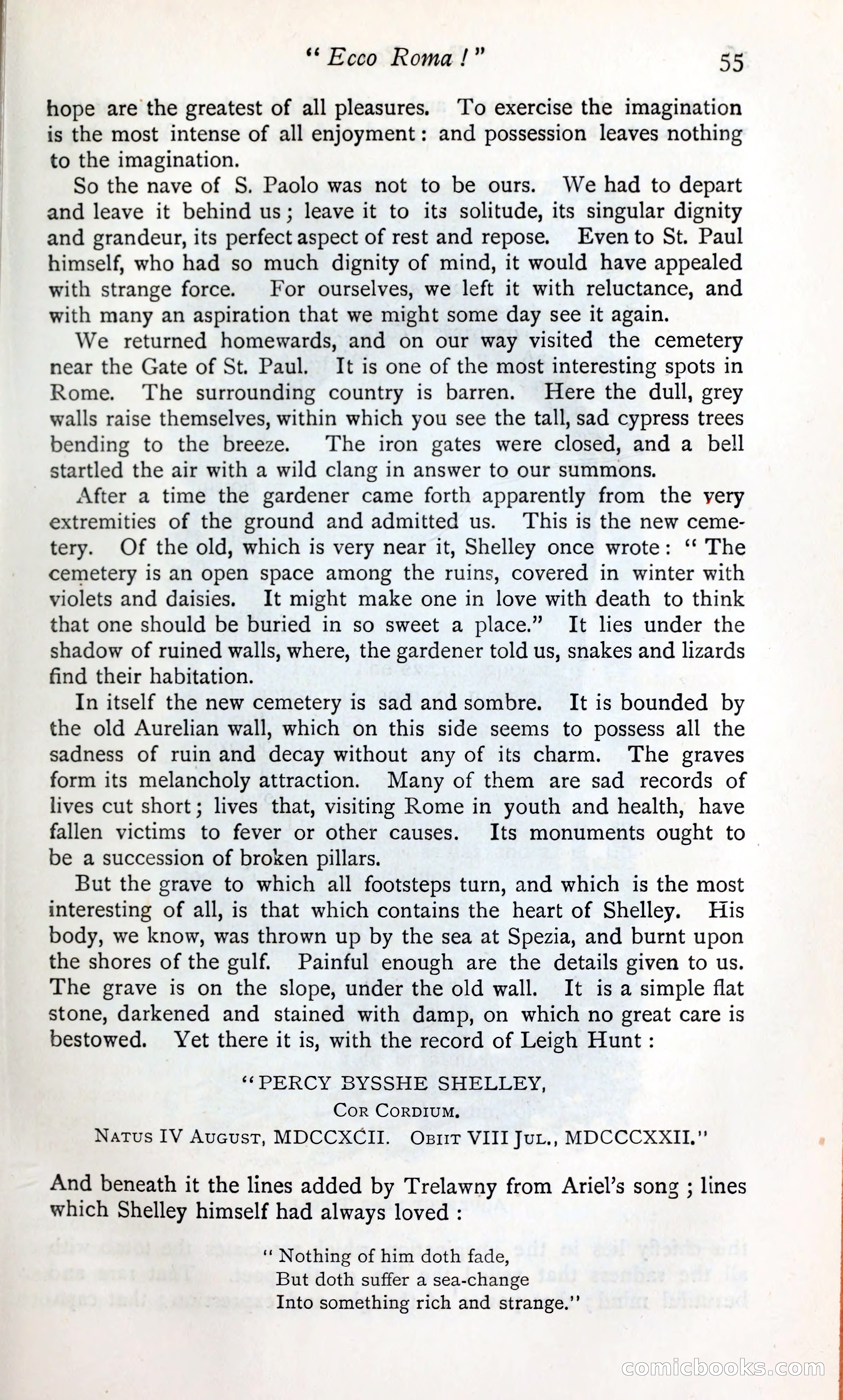
A restored page from Pulp Fiction, 1865. Page through the whole issue in the reader above.
📄 Transcribed text from this page (OCR, searchable)
Machine-transcribed from the original scan — historical spelling and the odd misread are preserved.
‘‘ Ecco Roma!” 55 hope are the greatest of all pleasures. ‘To exercise the imagination is the most intense of all enjoyment: and possession leaves nothing to the imagination. So the nave of S, Paolo was not to be ours. We had to depart and leave it behind us; leave it to its solitude, its singular dignity and grandeur, its perfect aspect of rest and repose. Evento St. Paul himself, who had so much dignity of mind, it would have appealed with strange force. For ourselves, we left it with reluctance, and with many an aspiration that we might some day see it again. We returned homewards, and on our way visited the cemetery near the Gate of St. Paul. It is one of the most interesting spots in Rome. The surrounding country is barren. Here the dull, grey walls raise themselves, within which you see the tall, sad cypress trees bending to the breeze. The iron gates were closed, and a bell startled the air with a wild clang in answer to our summons. After a time the gardener came forth apparently from the yery extremities of the ground and admitted us. This is the new ceme- tery. Of the old, which is very near it, Shelley once wrote: ‘“‘ The cemetery is an open space among the ruins, covered in winter with violets and daisies. It might make one in love with death to think that one should be buried in so sweet a place.” It lies under the shadow of ruined walls, where, the gardener told us, snakes and lizards find their habitation. In itself the new cemetery is sad andsombre. It is bounded by the old Aurelian wall, which on this side seems to possess all the sadness of ruin and decay without any of its charm. The graves form its melancholy attraction. Many of them are sad records of lives cut short; lives that, visiting Rome in youth and health, have fallen victims to fever or other causes. Its monuments ought to be a succession of broken pillars. But the grave to which all footsteps turn, and which is the most interesting of all, is that which contains the heart of Shelley. His body, we know, was thrown up by the sea at Spezia, and burnt upon the shores of the gulf. Painful enough are the details given to us. The grave is on the slope, under the old wall. It is a simple flat stone, darkened and stained with damp, on which no great care is bestowed. Yet there it is, with the record of Leigh Hunt : ‘*PERCY BYSSHE SHELLEY, Cor CORDIUM. Natus IV Aucust, MDCCXCII. Osmt VIII Jut., MDCCCXXII.”’ And beneath it the lines added by Trelawny from Ariel’s song ; lines which Shelley himself had always loved : ‘* Nothing of him doth fade, But doth suffer a sea-change Into something rich and strange.”’ conicaookks (SO) mn