
Pulp Fiction, 1865 · page 61 of 399
The Argosy — page 61: what you’re looking at
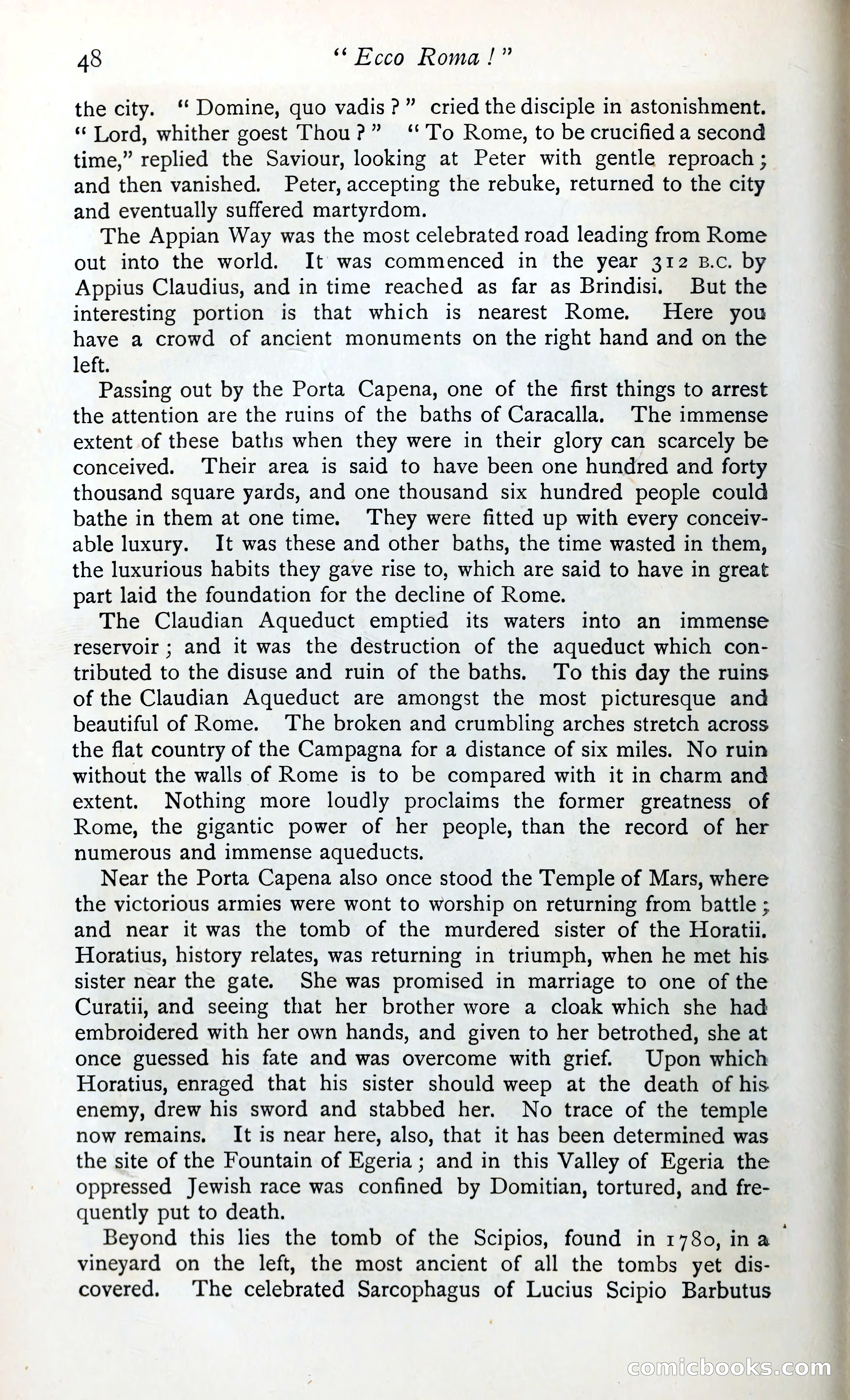
A restored page from Pulp Fiction, 1865. Page through the whole issue in the reader above.
📄 Transcribed text from this page (OCR, searchable)
Machine-transcribed from the original scan — historical spelling and the odd misread are preserved.
48 “Ecco Roma!” the city. ‘‘ Domine, quo vadis?” cried the disciple in astonishment. ‘ Tord, whither goest Thou?” ‘*To Rome, to be crucified a second time,” replied the Saviour, looking at Peter with gentle reproach ; and then vanished. Peter, accepting the rebuke, returned to the city and eventually suffered martyrdom. The Appian Way was the most celebrated road leading from Rome out into the world. It was commenced in the year 312 B.c. by Appius Claudius, and in time reached as far as Brindisi. But the interesting portion is that which is nearest Rome. Here you have a crowd of ancient monuments on the right hand and on the left. Passing out by the Porta Capena, one of the first things to arrest the attention are the ruins of the baths of Caracalla. The immense extent of these baths when they were in their glory can scarcely be conceived. Their area is said to have been one hundred and forty thousand square yards, and one thousand six hundred people could bathe in them at one time. They were fitted up with every conceiv- able luxury. It was these and other baths, the time wasted in them, the luxurious habits they gave rise to, which are said to have in great part laid the foundation for the decline of Rome. The Claudian Aqueduct emptied its waters into an immense reservoir ; and it was the destruction of the aqueduct which con- tributed to the disuse and ruin of the baths. To this day the ruins of the Claudian Aqueduct are amongst the most picturesque and beautiful of Rome. The broken and crumbling arches stretch across the flat country of the Campagna for a distance of six miles. No ruin without the walls of Rome is to be compared with it in charm and extent. Nothing more loudly proclaims the former greatness of Rome, the gigantic power of her people, than the record of her numerous and immense aqueducts. Near the Porta Capena also once stood the Temple of Mars, where the victorious armies were wont to worship on returning from battle ; and near it was the tomb of the murdered sister of the Horatii. Horatius, history relates, was returning in triumph, when he met his. sister near the gate. She was promised in marriage to one of the Curatii, and seeing that her brother wore a cloak which she had embroidered with her own hands, and given to her betrothed, she at once guessed his fate and was overcome with grief. Upon which Horatius, enraged that his sister should weep at the death of his enemy, drew his sword and stabbed her. No trace of the temple now remains. It is near here, also, that it has been determined was the site of the Fountain of Egeria; and in this Valley of Egeria the oppressed Jewish race was confined by Domitian, tortured, and fre- quently put to death. Beyond this lies the tomb of the Scipios, found in 1780, ina vineyard on the left, the most ancient of all the tombs yet dis- covered. The celebrated Sarcophagus of Lucius Scipio Barbutus CONMIGO KS (E(0)