
Pulp Fiction, 1865 · page 236 of 399
The Argosy — page 236: what you’re looking at
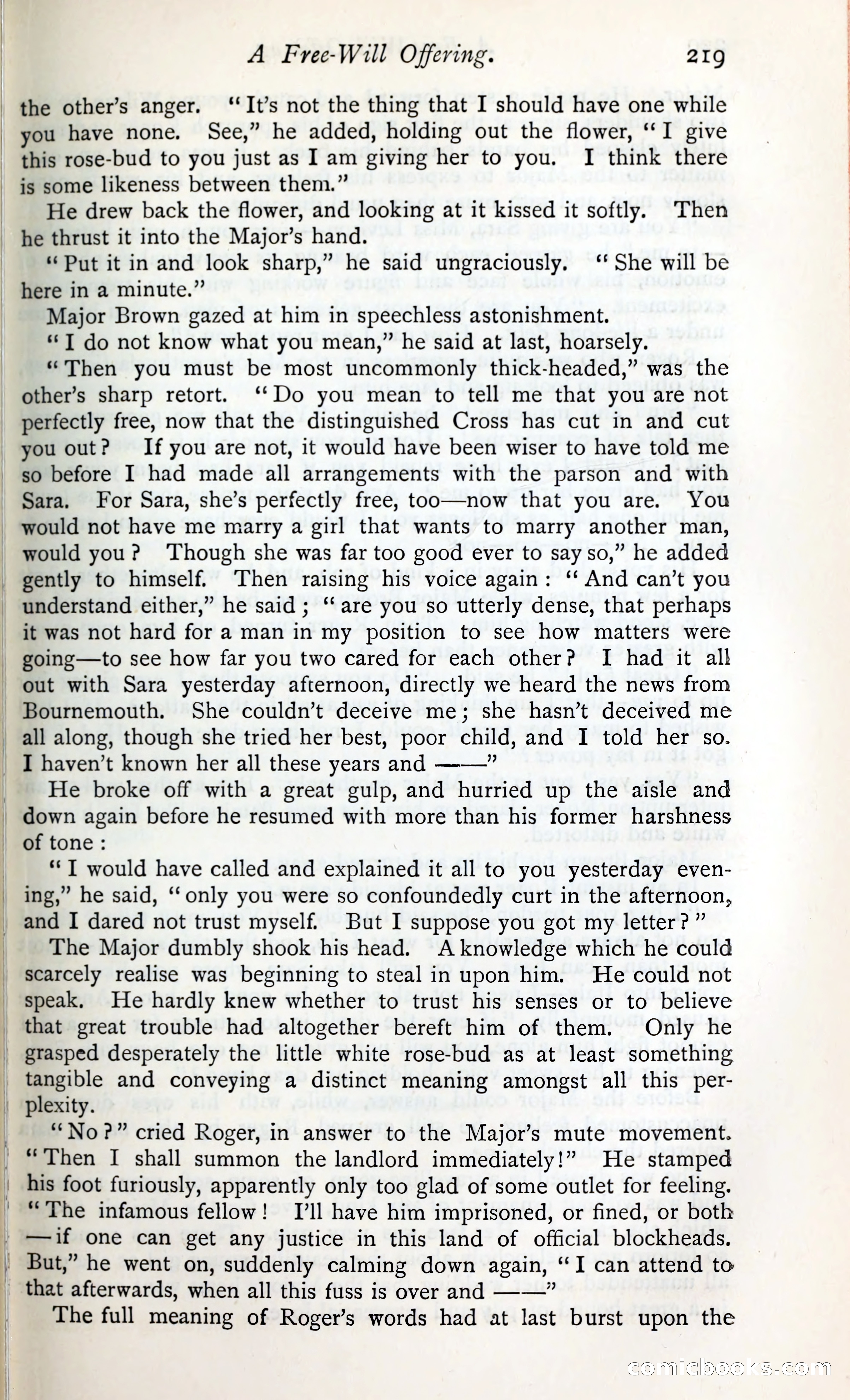
A restored page from Pulp Fiction, 1865. Page through the whole issue in the reader above.
📄 Transcribed text from this page (OCR, searchable)
Machine-transcribed from the original scan — historical spelling and the odd misread are preserved.
— — LE = ————————— OO ——_—_OJ A Free-Will Offering. 219 the other’s anger. ‘‘It’s not the thing that I should have one while you have none. See,” he added, holding out the flower, “I give this rose-bud to you just as I am giving her to you. I think there is some likeness between them.” He drew back the flower, and looking at it kissed it softly. Then he thrust it into the Major’s hand. Put it in and look sharp,” he said ungraciously. ‘‘ She will be here in a minute.” Major Brown gazed at him in speechless astonishment. * TJ do not know what you mean,” he said at last, hoarsely. “Then you must be most uncommonly thick-headed,” was the _ other’s sharp retort. ‘‘Do you mean to tell me that you are not perfectly free, now that the distinguished Cross has cut in and cut you out? If you are not, it would have been wiser to have told me so before I had made all arrangements with the parson and with Sara. For Sara, she’s perfectly free, too—now that you are. You would not have me marry a girl that wants to marry another man, would you? ‘Though she was far too good ever to say so,” he added gently to himself. Then raising his voice again: ‘* And can’t you understand either,” he said; ‘“‘ are you so utterly dense, that perhaps it was not hard for a man in my position to see how matters were going—to see how far you two cared for each other? I had it all out with Sara yesterday afternoon, directly we heard the news from Bournemouth. She couldn’t deceive me; she hasn’t deceived me all along, though she tried her best, poor child, and I told her so. I haven’t known her all these years and ——” He broke off with a great gulp, and hurried up the aisle and _ down again before he resumed with more than his former harshness of tone: *“{ would have called and explained it all to you yesterday even- ing,” he said, “‘ only you were so confoundedly curt in the afternoon, _ and I dared not trust myself. But I suppose you got my letter?” _. The Major dumbly shook his head. A knowledge which he could _ scarcely realise was beginning to stealin upon him. He could not speak. He hardly knew whether to trust his senses or to believe that great trouble had altogether bereft him of them. Only he | grasped desperately the little white rose-bud as at least something _ tangible and conveying a distinct meaning amongst all this per- plexity. “No?” cried Roger, in answer to the Major’s mute movement. _ “Then I shall summon the landlord immediately!” He stamped | his foot furiously, apparently only too glad of some outlet for feeling. ' “The infamous fellow! Ill have him imprisoned, or fined, or both _ —if one can get any justice in this land of official blockheads. _ But,” he went on, suddenly calming down again, “I can attend to _ that afterwards, when all this fuss is over and ——” The full meaning of Roger’s words had at last burst upon the CORNICLIOO