
Pulp Fiction, 1865 · page 230 of 399
The Argosy — page 230: what you’re looking at
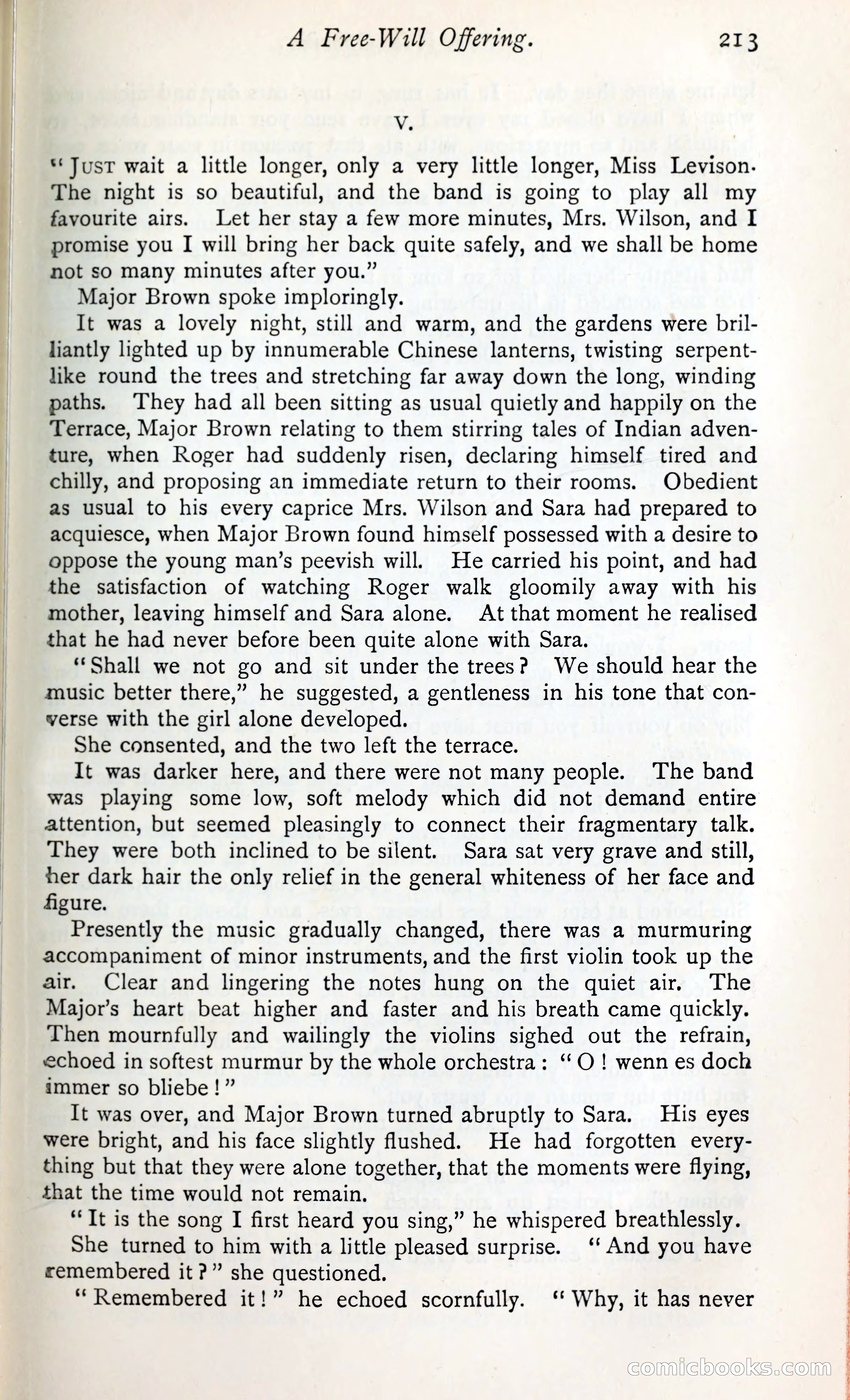
A restored page from Pulp Fiction, 1865. Page through the whole issue in the reader above.
📄 Transcribed text from this page (OCR, searchable)
Machine-transcribed from the original scan — historical spelling and the odd misread are preserved.
A Free-Will Offering. 213 fe *‘ Just wait a little longer, only a very little longer, Miss Levison. The night is so beautiful, and the band is going to play all my favourite airs. Let her stay a few more minutes, Mrs. Wilson, and I promise you I will bring her back quite safely, and we shall be home not so many minutes after you.” Major Brown spoke imploringly. It was a lovely night, still and warm, and the gardens were bril- liantly lighted up by innumerable Chinese lanterns, twisting serpent- like round the trees and stretching far away down the long, winding paths. ‘They had all been sitting as usual quietly and happily on the Terrace, Major Brown relating to them stirring tales of Indian adven- ture, when Roger had suddenly risen, declaring himself tired and chilly, and proposing an immediate return to their rooms. Obedient as usual to his every caprice Mrs. Wilson and Sara had prepared to acquiesce, when Major Brown found himself possessed with a desire to oppose the young man’s peevish will. He carried his point, and had the satisfaction of watching Roger walk gloomily away with his mother, leaving himself and Sara alone. At that moment he realised that he had never before been quite alone with Sara. “Shall we not go and sit under the trees? We should hear the music better there,” he suggested, a gentleness in his tone that con- verse with the girl alone developed. She consented, and the two left the terrace. It was darker here, and there were not many people. The band was playing some low, soft melody which did not demand entire attention, but seemed pleasingly to connect their fragmentary talk. They were both inclined to be silent. Sara sat very grave and still, her dark hair the only relief in the general whiteness of her face and figure. Presently the music gradually changed, there was a murmuring accompaniment of minor instruments, and the first violin took up the air. Clear and lingering the notes hung on the quiet air. The Major’s heart beat higher and faster and his breath came quickly. Then mournfully and wailingly the violins sighed out the refrain, echoed in softest murmur by the whole orchestra: ‘“‘O! wenn es doch immer so bliebe!” It was over, and Major Brown turned abruptly to Sara. His eyes were bright, and his face slightly flushed. He had forgotten every- thing but that they were alone together, that the moments were flying, that the time would not remain. “It is the song I first heard you sing,” he whispered breathlessly. She turned to him with a little pleased surprise. ‘‘ And you have remembered it ?” she questioned. ‘“Kemembered it!” he echoed scornfully. ‘* Why, it has never COnnicloooks (SO) am OS _ — —