
Pulp Fiction, 1865 · page 225 of 399
The Argosy — page 225: what you’re looking at
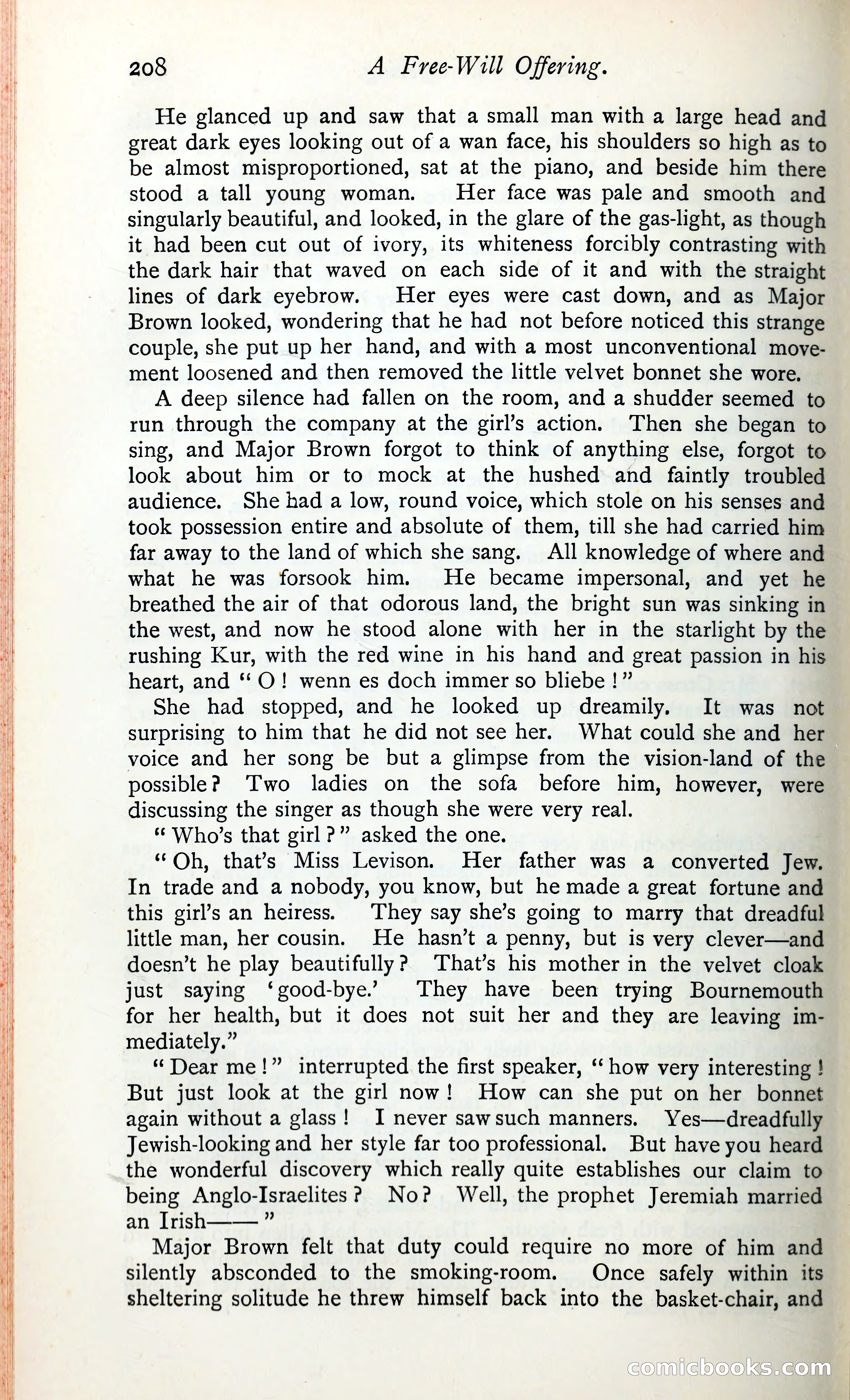
A restored page from Pulp Fiction, 1865. Page through the whole issue in the reader above.
📄 Transcribed text from this page (OCR, searchable)
Machine-transcribed from the original scan — historical spelling and the odd misread are preserved.
—— = —— ss = 3 —- SS a 208 A Free-Will Offering. He glanced up and saw that a small man with a large head and great dark eyes looking out of a wan face, his shoulders so high as to be almost misproportioned, sat at the piano, and beside him there stood a tall young woman. Her face was pale and smooth and singularly beautiful, and looked, in the glare of the gas-light, as though it had been cut out of ivory, its whiteness forcibly contrasting with the dark hair that waved on each side of it and with the straight lines of dark eyebrow. Her eyes were cast down, and as Major Brown looked, wondering that he had not before noticed this strange couple, she put up her hand, and with a most unconventional move- ment loosened and then removed the little velvet bonnet she wore. A deep silence had fallen on the room, and a shudder seemed to run through the company at the girl’s action. Then she began to sing, and Major Brown forgot to think of anything else, forgot to look about him or to mock at the hushed and faintly troubled audience. She had a low, round voice, which stole on his senses and took possession entire and absolute of them, till she had carried him far away to the land of which she sang. All knowledge of where and what he was forsook him. He became impersonal, and yet he breathed the air of that odorous land, the bright sun was sinking in the west, and now he stood alone with her in the starlight by the rushing Kur, with the red wine in his hand and great passion in his heart, and ‘‘O! wenn es doch immer so bliebe !” She had stopped, and he looked up dreamily. It was not surprising to him that he did not see her. What could she and her voice and her song be but a glimpse from the vision-land of the possible? ‘Two ladies on the sofa before him, however, were discussing the singer as though she were very real. Who’s that girl?” asked the one. ‘Oh, that’s Miss Levison. Her father was a converted Jew. In trade and a nobody, you know, but he made a great fortune and this girl’s an heiress. They say she’s going to marry that dreadful little man, her cousin. He hasn’t a penny, but is very clever—and doesn’t he play beautifully? That’s his mother in the velvet cloak just saying ‘good-bye.’ They have been trying Bournemouth for her health, but it does not suit her and they are leaving im- mediately.” “Dear me!” interrupted the first speaker, ‘‘ how very interesting ! But just look at the girl now! How can she put on her bonnet again without a glass! I never sawsuch manners. Yes—dreadfully Jewish-looking and her style far too professional. But have you heard the wonderful discovery which really quite establishes our claim to being Anglo-Israelites? No? Well, the prophet Jeremiah married an Irish—— ” Major Brown felt that duty could require no more of him and silently absconded to the smoking-room. Once safely within its sheltering solitude he threw himself back into the basket-chair, and CORNICE OO Sn eorna