
Pulp Fiction, 1865 · page 222 of 399
The Argosy — page 222: what you’re looking at
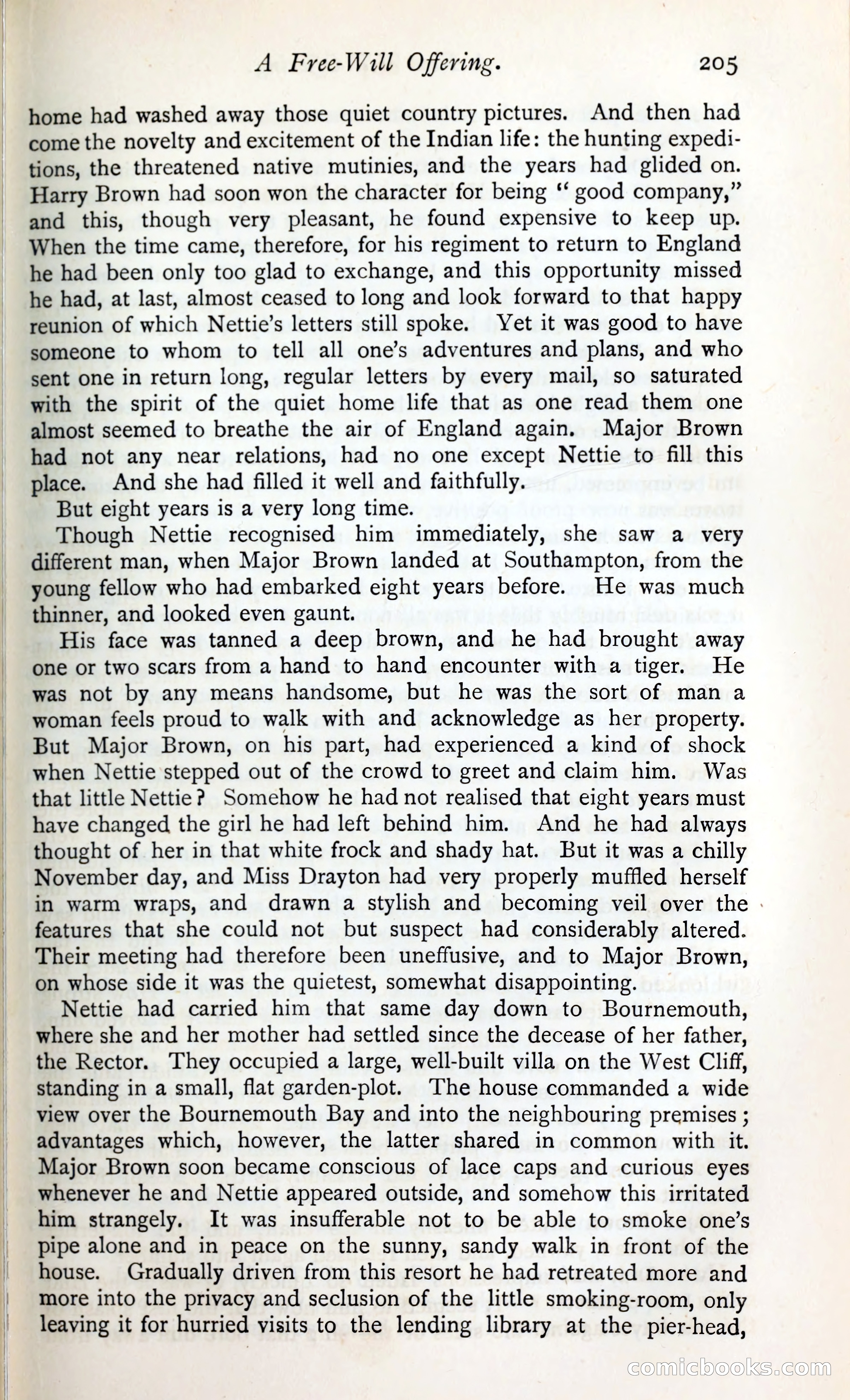
A restored page from Pulp Fiction, 1865. Page through the whole issue in the reader above.
📄 Transcribed text from this page (OCR, searchable)
Machine-transcribed from the original scan — historical spelling and the odd misread are preserved.
——E ~. @ —————————— oe a — —_ - _ ae a — — a A Free-Will Offering. 205 home had washed away those quiet country pictures. And then had come the novelty and excitement of the Indian life: the hunting expedi- tions, the threatened native mutinies, and the years had glided on. Harry Brown had soon won the character for being ** good company,” and this, though very pleasant, he found expensive to keep up. When the time came, therefore, for his regiment to return to England he had been only too glad to exchange, and this opportunity missed he had, at last, almost ceased to long and look forward to that happy reunion of which Nettie’s letters still spoke. Yet it was good to have someone to whom to tell all one’s adventures and plans, and who sent one in return long, regular letters by every mail, so saturated with the spirit of the quiet home life that as one read them one almost seemed to breathe the air of England again. Major Brown had not any near relations, had no one except Nettie to fill this place. And she had filled it well and faithfully. But eight years is a very long time. Though Nettie recognised him immediately, she saw a very different man, when Major Brown landed at Southampton, from the young fellow who had embarked eight years before. He was much thinner, and looked even gaunt. His face was tanned a deep brown, and he had brought away one or two scars from a hand to hand encounter with a tiger. He was not by any means handsome, but he was the sort of man a woman feels proud to walk with and acknowledge as her property. But Major Brown, on his part, had experienced a kind of shock when Nettie stepped out of the crowd to greet and claim him. Was that little Nettie? Somehow he had not realised that eight years must have changed the girl he had left behind him. And he had always thought of her in that white frock and shady hat. But it was a chilly November day, and Miss Drayton had very properly muffled herself in warm wraps, and drawn a stylish and becoming veil over the . features that she could not but suspect had considerably altered. Their meeting had therefore been uneffusive, and to Major Brown, on whose side it was the quietest, somewhat disappointing. Nettie had carried him that same day down to Bournemouth, where she and her mother had settled since the decease of her father, the Rector. They occupied a large, well-built villa on the West Cliff, standing in a small, flat garden-plot. The house commanded a wide view over the Bournemouth Bay and into the neighbouring premises ; advantages which, however, the latter shared in common with it. Major Brown soon became conscious of lace caps and curious eyes whenever he and Nettie appeared outside, and somehow this irritated him strangely. It was insufferable not to be able to smoke one’s pipe alone and in peace on the sunny, sandy walk in front of the house. Gradually driven from this resort he had retreated more and more into the privacy and seclusion of the little smoking-room, only leaving it for hurried visits to the lending library at the pier-head, CORNICLIOO@ ss) (SO) am