
Pulp Fiction, 1865 · page 210 of 399
The Argosy — page 210: what you’re looking at
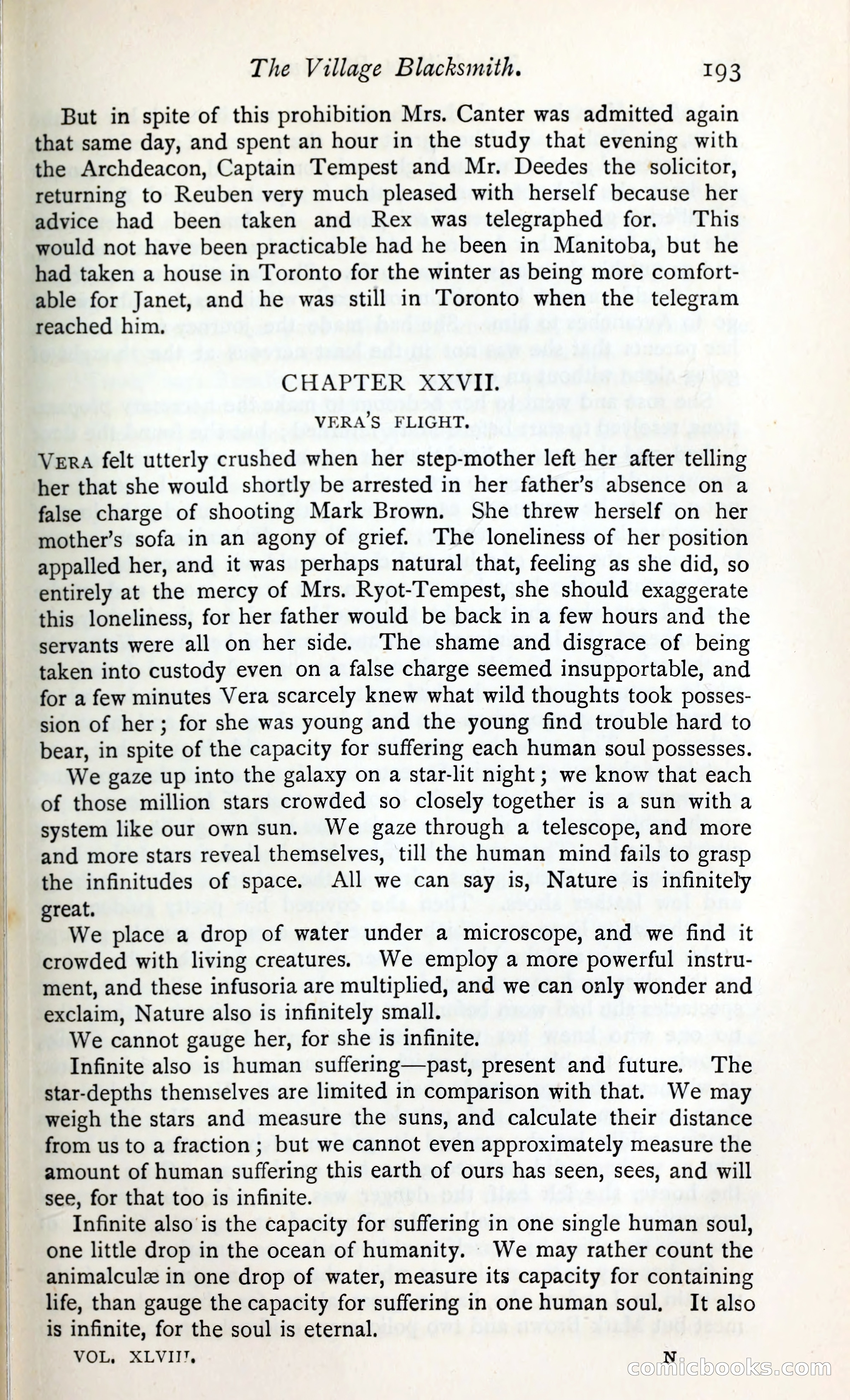
A restored page from Pulp Fiction, 1865. Page through the whole issue in the reader above.
📄 Transcribed text from this page (OCR, searchable)
Machine-transcribed from the original scan — historical spelling and the odd misread are preserved.
The Village Blacksmith. 193 But in spite of this prohibition Mrs. Canter was admitted again that same day, and spent an hour in the study that evening with the Archdeacon, Captain Tempest and Mr. Deedes the solicitor, returning to Reuben very much pleased with herself because her advice had been taken and Rex was telegraphed for. This would not have been practicable had he been in Manitoba, but he had taken a house in Toronto for the winter as being more comfort- able for Janet, and he was still in Toronto when the telegram reached him. CHAPTER XXVIFE. VERA’S FLIGHT, Vera felt utterly crushed when her step-mother left her after telling her that she would shortly be arrested in her father’s absence on a false charge of shooting Mark Brown. She threw herself on her mother’s sofa in an agony of grief. The loneliness of her position appalled her, and it was perhaps natural that, feeling as she did, so entirely at the mercy of Mrs. Ryot-Tempest, she should exaggerate this loneliness, for her father would be back in a few hours and the servants were all on her side. The shame and disgrace of being taken into custody even on a false charge seemed insupportable, and for a few minutes Vera scarcely knew what wild thoughts took posses- sion of her; for she was young and the young find trouble hard to bear, in spite of the capacity for suffering each human soul possesses. We gaze up into the galaxy on a star-lit night; we know that each of those million stars crowded so closely together is a sun witha system like our own sun. We gaze through a telescope, and more and more stars reveal themselves, till the human mind fails to grasp the infinitudes of space. All we can say is, Nature is infinitely great. We place a drop of water under a microscope, and we find it crowded with living creatures. We employ a more powerful instru- ment, and these infusoria are multiplied, and we can only wonder and exclaim, Nature also is infinitely small. We cannot gauge her, for she is infinite. Infinite also is human suffering—past, present and future. The star-depths themselves are limited in comparison with that. We may weigh the stars and measure the suns, and calculate their distance from us to a fraction; but we cannot even approximately measure the amount of human suffering this earth of ours has seen, sees, and will see, for that too is infinite. Infinite also is the capacity for suffering in one single human soul, one little drop in the ocean of humanity. We may rather count the animalculz in one drop of water, measure its capacity for containing life, than gauge the capacity for suffering in one human soul, It also is infinite, for the soul is eternal. VOL, XLVII’. N (SO EloOOlkKS (SO) am