
Pulp Fiction, 1865 · page 184 of 399
The Argosy — page 184: what you’re looking at
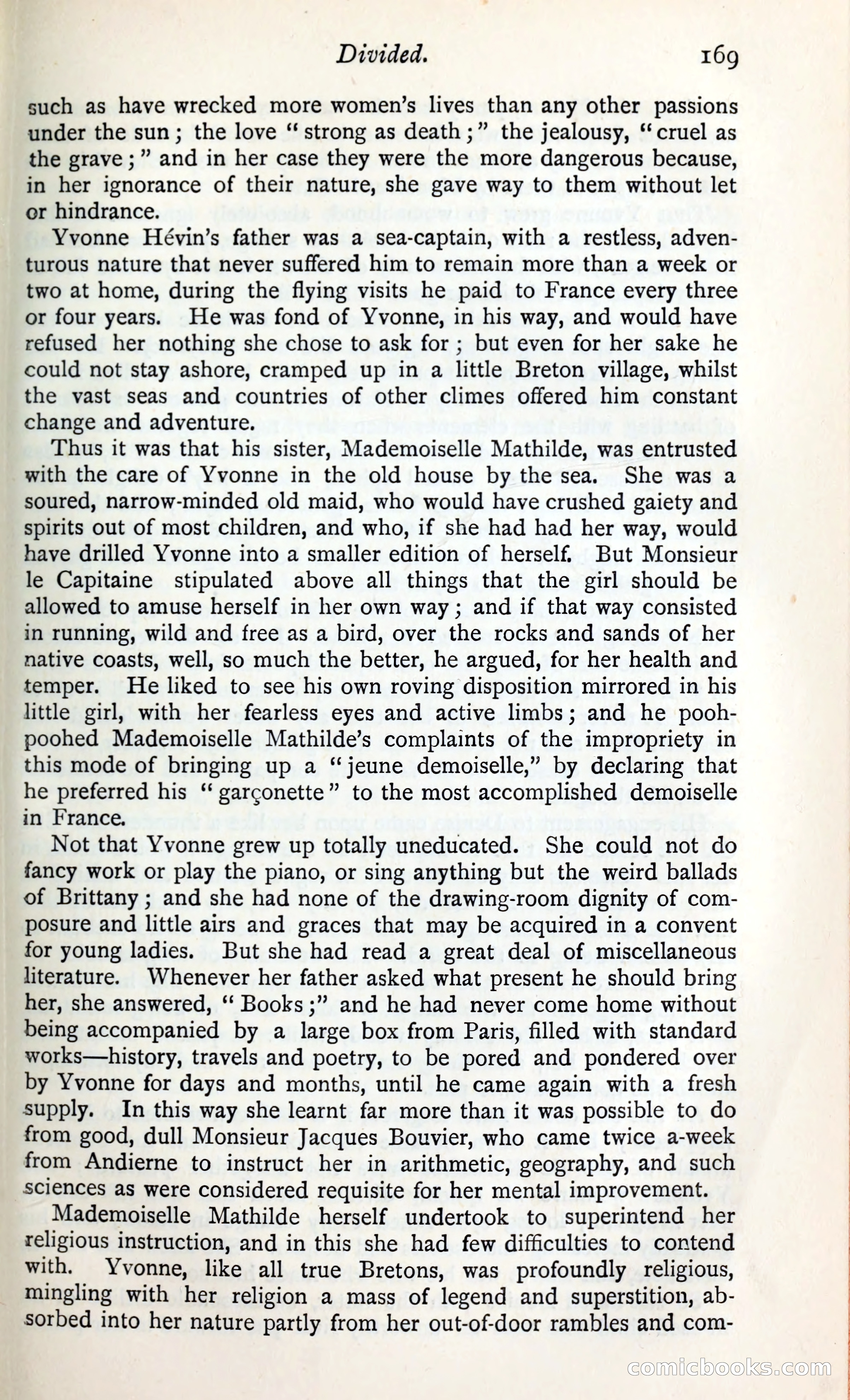
A restored page from Pulp Fiction, 1865. Page through the whole issue in the reader above.
📄 Transcribed text from this page (OCR, searchable)
Machine-transcribed from the original scan — historical spelling and the odd misread are preserved.
Divided. 169 such as have wrecked more women’s lives than any other passions under the sun; the love ‘‘ strong as death;” the jealousy, “cruel as the grave ;” and in her case they were the more dangerous because, in her ignorance of their nature, she gave way to them without let or hindrance. Yvonne Hévin’s father was a sea-captain, with a restless, adven- turous nature that never suffered him to remain more than a week or two at home, during the flying visits he paid to France every three or four years. He was fond of Yvonne, in his way, and would have refused her nothing she chose to ask for ; but even for her sake he could not stay ashore, cramped up in a little Breton village, whilst the vast seas and countries of other climes offered him constant change and adventure. Thus it was that his sister, Mademoiselle Mathilde, was entrusted with the care of Yvonne in the old house by the sea. She was a soured, narrow-minded old maid, who would have crushed gaiety and spirits out of most children, and who, if she had had her way, would have drilled Yvonne into a smaller edition of herself. But Monsieur le Capitaine stipulated above all things that the girl should be allowed to amuse herself in her own way; and if that way consisted in running, wild and free as a bird, over the rocks and sands of her native coasts, well, so much the better, he argued, for her health and temper. He liked to see his own roving disposition mirrored in his little girl, with her fearless eyes and active limbs; and he pooh- poohed Mademoiselle Mathilde’s complaints of the impropriety in this mode of bringing up a “jeune demoiselle,” by declaring that he preferred his “ garconette” to the most accomplished demoiselle in France. Not that Yvonne grew up totally uneducated. She could not do fancy work or play the piano, or sing anything but the weird ballads of Brittany ; and she had none of the drawing-room dignity of com- posure and little airs and graces that may be acquired in a convent for young ladies. But she had read a great deal of miscellaneous literature. Whenever her father asked what present he should bring her, she answered, ‘‘ Books ;” and he had never come home without being accompanied by a large box from Paris, filled with standard works—history, travels and poetry, to be pored and pondered over by Yvonne for days and months, until he came again with a fresh supply. In this way she learnt far more than it was possible to do from good, dull Monsieur Jacques Bouvier, who came twice a-week from Andierne to instruct her in arithmetic, geography, and such sciences as were considered requisite for her mental improvement. Mademoiselle Mathilde herself undertook to superintend her religious instruction, and in this she had few difficulties to contend with. Yvonne, like all true Bretons, was profoundly religious, mingling with her religion a mass of legend and superstition, ab- sorbed into her nature partly from her out-of-door rambles and com- GOMmiGc soo cS (CO) am