
Pulp Fiction, 1865 · page 179 of 399
The Argosy — page 179: what you’re looking at
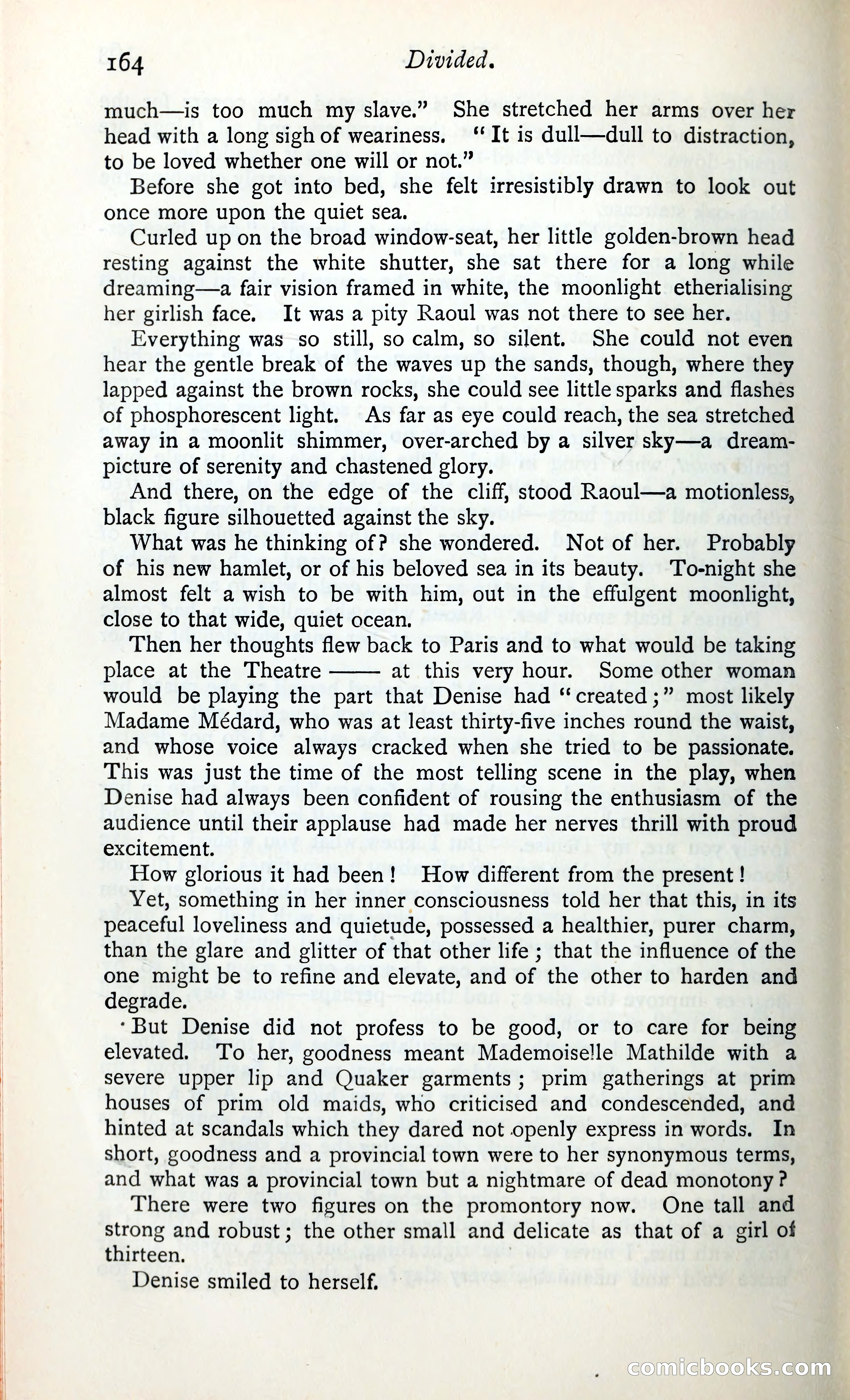
A restored page from Pulp Fiction, 1865. Page through the whole issue in the reader above.
📄 Transcribed text from this page (OCR, searchable)
Machine-transcribed from the original scan — historical spelling and the odd misread are preserved.
164 Divided. much—is too much my slave.” She stretched her arms over her head with a long sigh of weariness. ‘‘ It is dull—dull to distraction, to be loved whether one will or not.” Before she got into bed, she felt irresistibly drawn to look out once more upon the quiet sea. Curled up on the broad window-seat, her little golden-brown head resting against the white shutter, she sat there for a long while dreaming—a fair vision framed in white, the moonlight etherialising her girlish face. It was a pity Raoul was not there to see her. Everything was so still, so calm, so silent. She could not even hear the gentle break of the waves up the sands, though, where they lapped against the brown rocks, she could see little sparks and flashes of phosphorescent light. As far as eye could reach, the sea stretched away in a moonlit shimmer, over-arched by a silver skky—a dream- picture of serenity and chastened glory. And there, on the edge of the cliff, stood Raoul—a motionless, black figure silhouetted against the sky. What was he thinking of? she wondered. Not of her. Probably of his new hamlet, or of his beloved sea in its beauty. To-night she almost felt a wish to be with him, out in the effulgent moonlight, close to that wide, quiet ocean. Then her thoughts flew back to Paris and to what would be taking place at the Theatre at this very hour. Some other woman would be playing the part that Denise had ‘created ;” most likely Madame Médard, who was at least thirty-five inches round the waist, and whose voice always cracked when she tried to be passionate. This was just the time of the most telling scene in the play, when Denise had always been confident of rousing the enthusiasm of the audience until their applause had made her nerves thrill with proud excitement. How glorious it had been! How different from the present! Yet, something in her inner consciousness told her that this, in its peaceful loveliness and quietude, possessed a healthier, purer charm, than the glare and glitter of that other life ; that the influence of the one might be to refine and elevate, and of the other to harden and degrade. ‘But Denise did not profess to be good, or to care for being elevated. To her, goodness meant Mademoise!le Mathilde with a severe upper lip and Quaker garments; prim gatherings at prim houses of prim old maids, who criticised and condescended, and hinted at scandals which they dared not openly express in words. In short, goodness and a provincial town were to her synonymous terms, and what was a provincial town but a nightmare of dead monotony P There were two figures on the promontory now. One tall and strong and robust; the other small and delicate as that of a girl of thirteen. Denise smiled to herself. Gomilcbooks'.co