
Pulp Fiction, 1865 · page 157 of 399
The Argosy — page 157: what you’re looking at
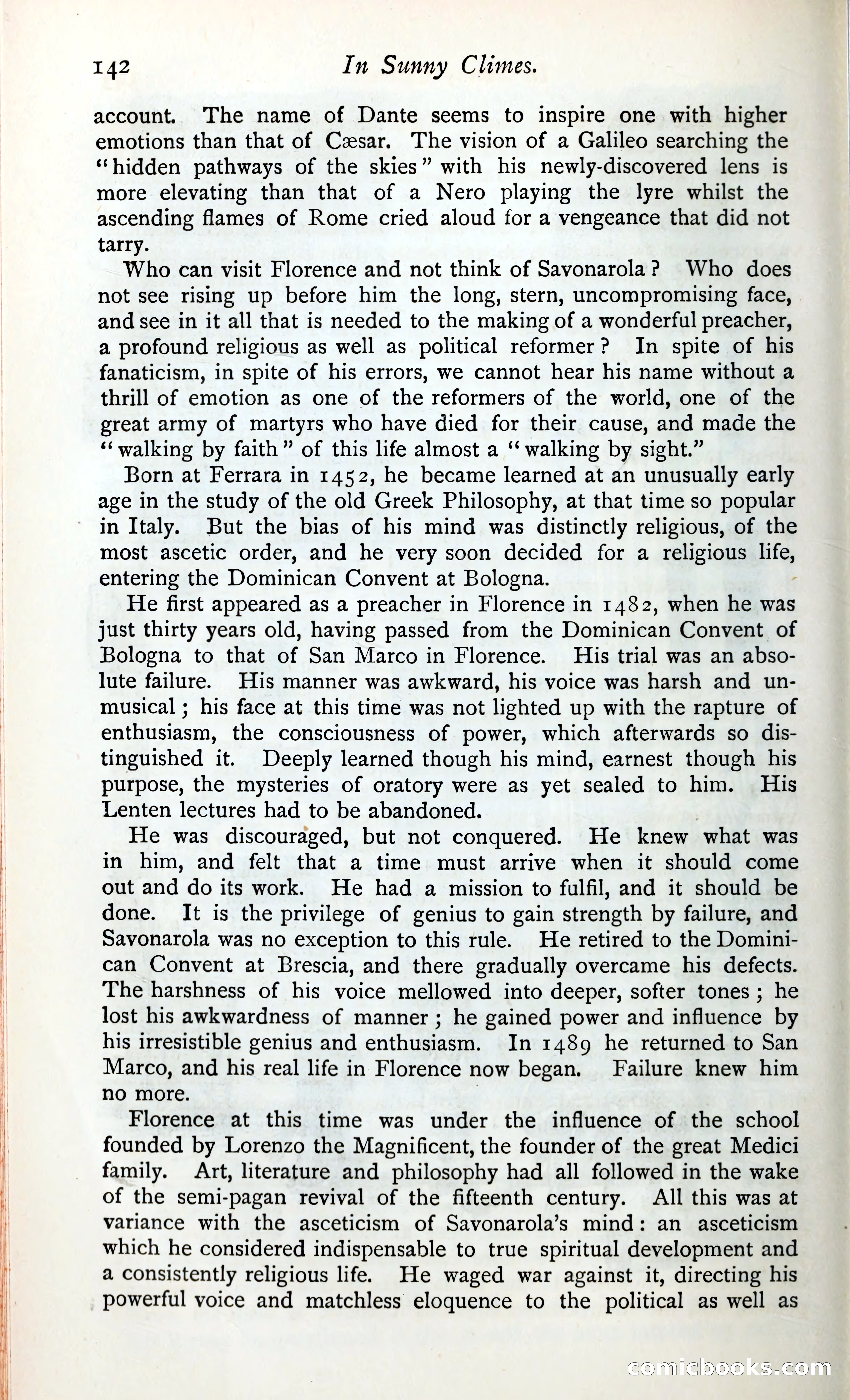
A restored page from Pulp Fiction, 1865. Page through the whole issue in the reader above.
📄 Transcribed text from this page (OCR, searchable)
Machine-transcribed from the original scan — historical spelling and the odd misread are preserved.
142 In Sunny Climes. account. The name of Dante seems to inspire one with higher emotions than that of Cesar. The vision of a Galileo searching the “hidden pathways of the skies” with his newly-discovered lens is more elevating than that of a Nero playing the lyre whilst the ascending flames of Rome cried aloud for a vengeance that did not tarry. Who can visit Florence and not think of Savonarola? Who does not see rising up before him the long, stern, uncompromising face, and see in it all that is needed to the making of a wonderful preacher, a profound religious as well as political reformer? In spite of his fanaticism, in spite of his errors, we cannot hear his name without a thrill of emotion as one of the reformers of the world, one of the great army of martyrs who have died for their cause, and made the ‘walking by faith” of this life almost a ‘‘ walking by sight.” Born at Ferrara in 1452, he became learned at an unusually early age in the study of the old Greek Philosophy, at that time so popular in Italy. But the bias of his mind was distinctly religious, of the most ascetic order, and he very soon decided for a religious ng entering the Dominican Convent at Bologna. He first appeared as a preacher in Florence in 1482, when he was just thirty years old, having passed from the Dominican Convent of Bologna to that of San Marco in Florence. His trial was an abso- lute failure. His manner was awkward, his voice was harsh and un- musical ; his face at this time was not lighted up with the rapture of enthusiasm, the consciousness of power, which afterwards so dis- tinguished it. Deeply learned though his mind, earnest though his purpose, the mysteries of oratory were as yet sealed to him. Huis Lenten lectures had to be abandoned. | He was discouraged, but not conquered. He knew what was in him, and felt that a time must arrive when it should come | out and do its work. He had a mission to fulfil, and it should be | done. It is the privilege of genius to gain strength by failure, and | Savonarola was no exception to this rule. He retired to the Domini- | can Convent at Brescia, and there gradually overcame his defects. | The harshness of his voice mellowed into deeper, softer tones ; he lost his awkwardness of manner ; he gained power and influence by his irresistible genius and enthusiasm. In 1489 he returned to San | Marco, and his real life in Florence now began. Failure knew him no more. | | Florence at this time was under the influence of the school founded by Lorenzo the Magnificent, the founder of the great Medici | family. Art, literature and philosophy had all followed in the wake of the semi-pagan revival of the fifteenth century. All this was at variance with the asceticism of Savonarola’s mind: an asceticism which he considered indispensable to true spiritual development and a consistently religious life. He waged war against it, directing his powerful voice and matchless eloquence to the political as well as NEN CONNIE OOOLKS5(€)