
Pulp Fiction, 1865 · page 121 of 399
The Argosy — page 121: what you’re looking at
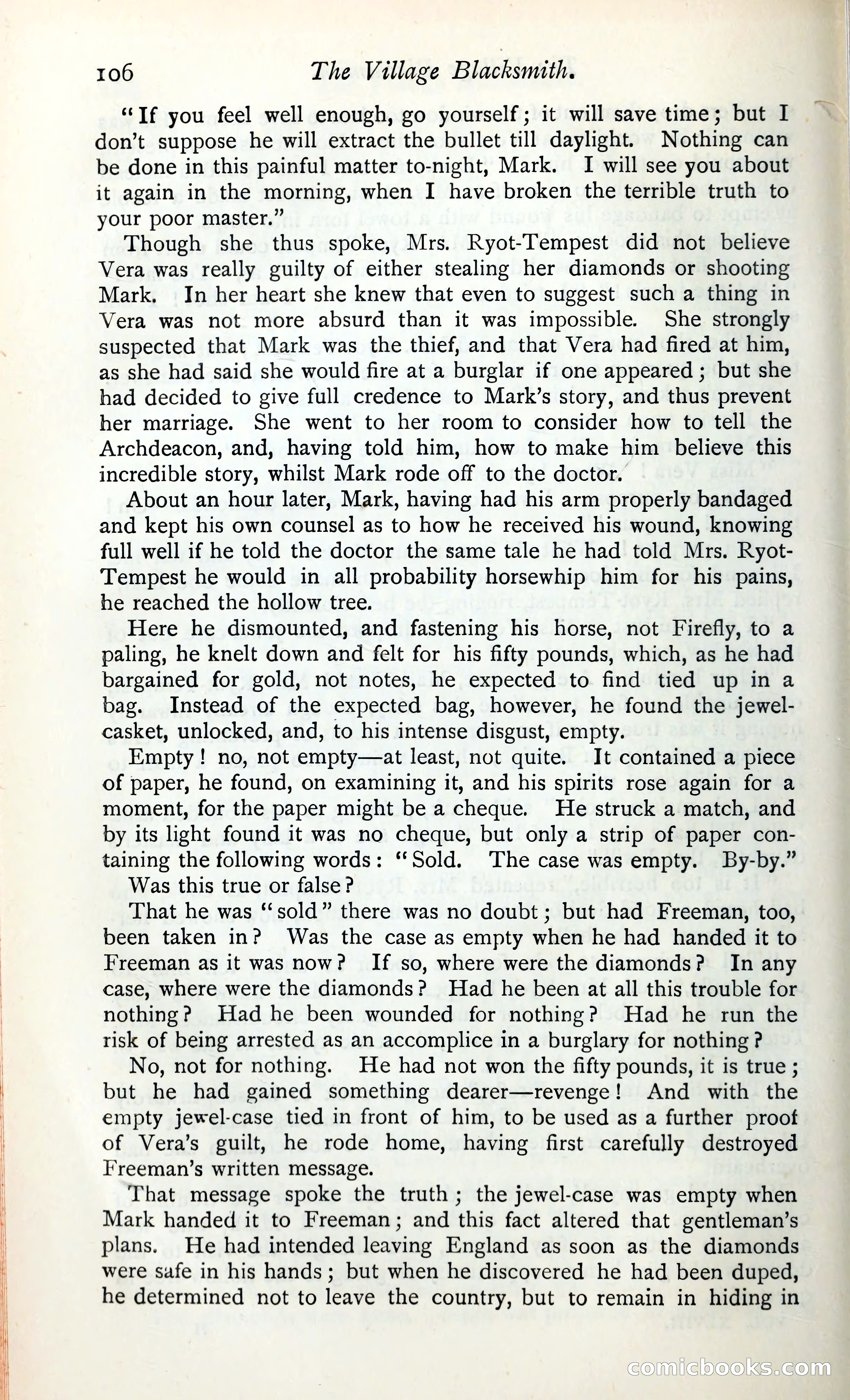
A restored page from Pulp Fiction, 1865. Page through the whole issue in the reader above.
📄 Transcribed text from this page (OCR, searchable)
Machine-transcribed from the original scan — historical spelling and the odd misread are preserved.
106 The Village Blacksmith. “Tf you feel well enough, go yourself; it will save time; but I don’t suppose he will extract the bullet till daylight. Nothing can be done in this painful matter to-night, Mark. I will see you about it again in the morning, when I have broken the terrible truth to your poor master.” Though she thus spoke, Mrs. Ryot-Tempest did not believe Vera was really guilty of either stealing her diamonds or shooting Mark. In her heart she knew that even to suggest such a thing in Vera was not more absurd than it was impossible. She strongly suspected that Mark was the thief, and that Vera had fired at him, as she had said she would fire at a burglar if one appeared ; but she had decided to give full credence to Mark’s story, and thus prevent her marriage. She went to her room to consider how to tell the Archdeacon, and, having told him, how to make him believe this incredible story, whilst Mark rode off to the doctor. About an hour later, Mark, having had his arm properly bandaged and kept his own counsel as to how he received his wound, knowing full well if he told the doctor the same tale he had told Mrs. Ryot- Tempest he would in all probability horsewhip him for his pains, he reached the hollow tree. Here he dismounted, and fastening his horse, not Firefly, to a paling, he knelt down and felt for his fifty pounds, which, as he had bargained for gold, not notes, he expected to find tied up in a bag. Instead of the expected bag, however, he found the jewel- casket, unlocked, and, to his intense disgust, empty. Empty! no, not empty—at least, not quite. It contained a piece of paper, he found, on examining it, and his spirits rose again for a moment, for the paper might be a cheque. He struck a match, and by its light found it was no cheque, but only a strip of paper con- taining the following words: ‘Sold. The case was empty. By-by.” Was this true or false P That he was ‘‘sold” there was no doubt; but had Freeman, too, been taken in? Was the case as empty when he had handed it to Freeman as it was now? If so, where were the diamonds? In any case, where were the diamonds? Had he been at all this trouble for nothing? Had he been wounded for nothing? Had he run the risk of being arrested as an accomplice in a burglary for nothing ? No, not for nothing. He had not won the fifty pounds, it is true ; but he had gained something dearer—revenge! And with the empty jewel-case tied in front of him, to be used as a further proof of Vera’s guilt, he rode home, having first carefully destroyed Freeman’s written message. That message spoke the truth; the jewel-case was empty when Mark handed it to Freeman; and this fact altered that gentleman’s plans. He had intended leaving England as soon as the diamonds were safe in his hands; but when he discovered he had been duped, he determined not to leave the country, but to remain in hiding in CONNIE OOOKS ne)