
Pulp Fiction, 1865 · page 276 of 400
The Argosy — page 276: what you’re looking at
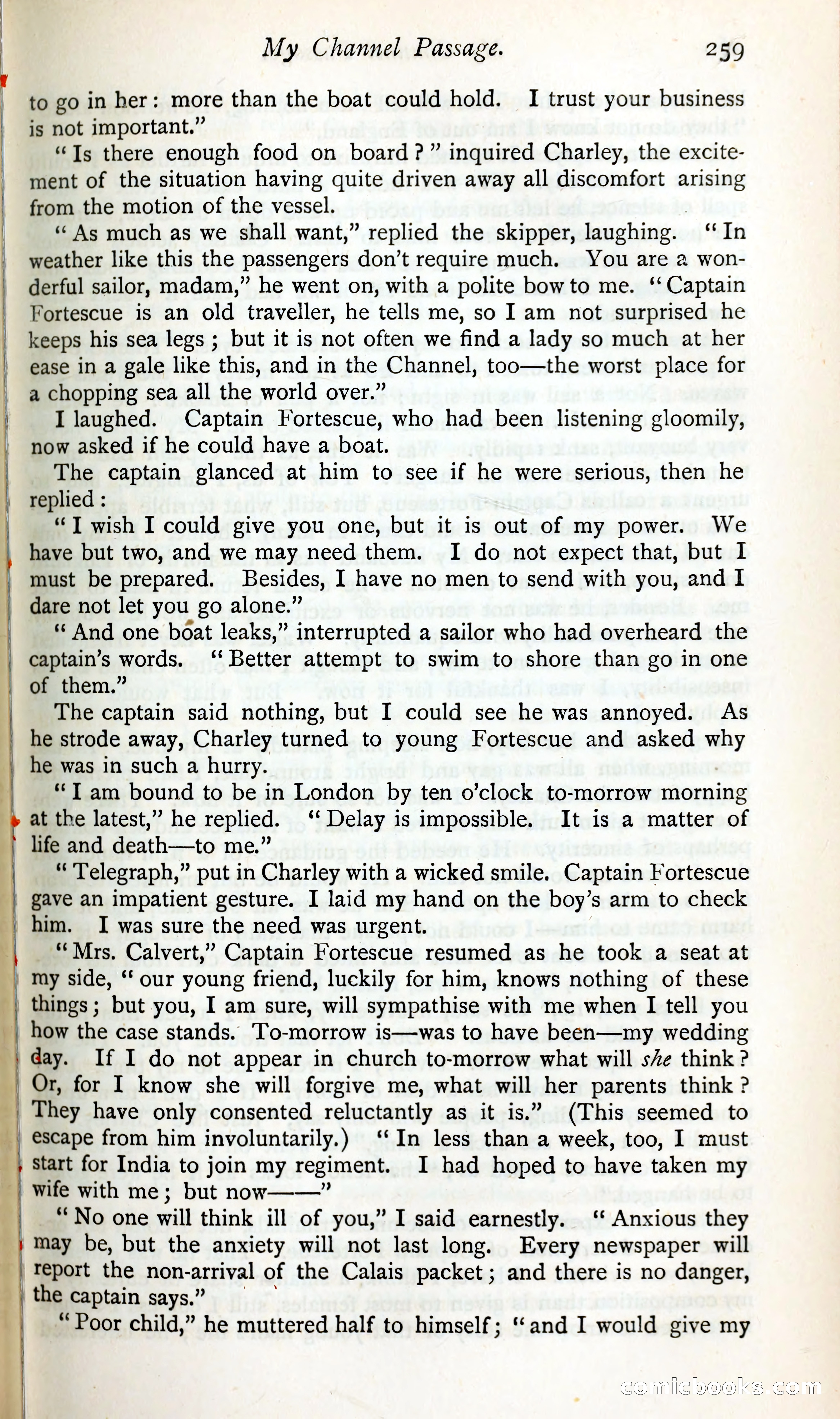
A restored page from Pulp Fiction, 1865. Page through the whole issue in the reader above.
📄 Transcribed text from this page (OCR, searchable)
Machine-transcribed from the original scan — historical spelling and the odd misread are preserved.
My Channel Passage. 259 to go in her: more than the boat could hold. I trust your business is not important.” “Ts there enough food on board?” inquired Charley, the excite- ment of the situation having quite driven away all discomfort sme ri from the motion of the vessel. ‘As much as we shall want,” replied the skipper, laughing. ‘In ' weather like this the passengers don’t require much. You are a won- _ derful sailor, madam,” he went on, with a polite bowto me. ‘‘ Captain Fortescue is an old traveller, he tells me, so I am not surprised he keeps his sea legs ; but it is not often we find a lady so much at her ease in a gale like this, and in the Channel, too—the worst place for _ a chopping sea all the world over.” | I laughed. Captain Fortescue, who had been listening gloomily, ) now asked if he could have a boat. | The captain glanced at him to see if he were serious, then he replied : “T wish I could give you one, but it is out of my power. We have but two, and we may need them. I do not expect that, but I must be prepared. Besides, I have no men to send with you, and 1 dare not let you go alone.” “ And one boat leaks,” interrupted a sailor who had overheard the captain’s words. ‘‘ Better attempt to swim to shore than go in one of them.” The captain said nothing, but I could see he was annoyed. As he strode away, Charley turned to young Fortescue and asked why he was in such a hurry. “I am bound to be in London by ten o’clock to-morrow morning at the latest,” he replied. ‘‘ Delay is impossible. It 1s a matter of life and death—to me.” Telegraph,” put in Charley with a wicked smile. Captain Fortescue gave an impatient gesture. I laid my hand on the boy’ s arm to check him. I was sure the need was urgent. “Mrs. Calvert,” Captain Fortescue resumed as he took a seat at my side, ‘‘ our young friend, luckily for him, knows nothing of these things ; but you, I am sure, will sympathise with me when I tell you _) how the case stands. To-morrow is—was to have been—my wedding -) day. If I do not appear in church to-morrow what will she think ? Or, for I know she will forgive me, what will her parents think ? They have only consented reluctantly as it is.” (This seemed to escape from him involuntarily.) ‘‘In less than a week, too, I must _; Start for India to join my regiment. I had hoped to have taken my | Wife with me; but now——” _ “No one will think ill of you,” I said earnestly. ‘‘ Anxious they rH may be, but the anxiety will not last long. Every newspaper will | Teport the non-arrival of the Calais packet; and there is no danger, the captain says.” “Poor child,” he muttered half to himself; ‘and I would give my VS 3 ae —— — | = ——— = “ * —— — —_—__ —— SS — EOMIIGIOOKS (©) im