
Pulp Fiction, 1865 · page 270 of 400
The Argosy — page 270: what you’re looking at
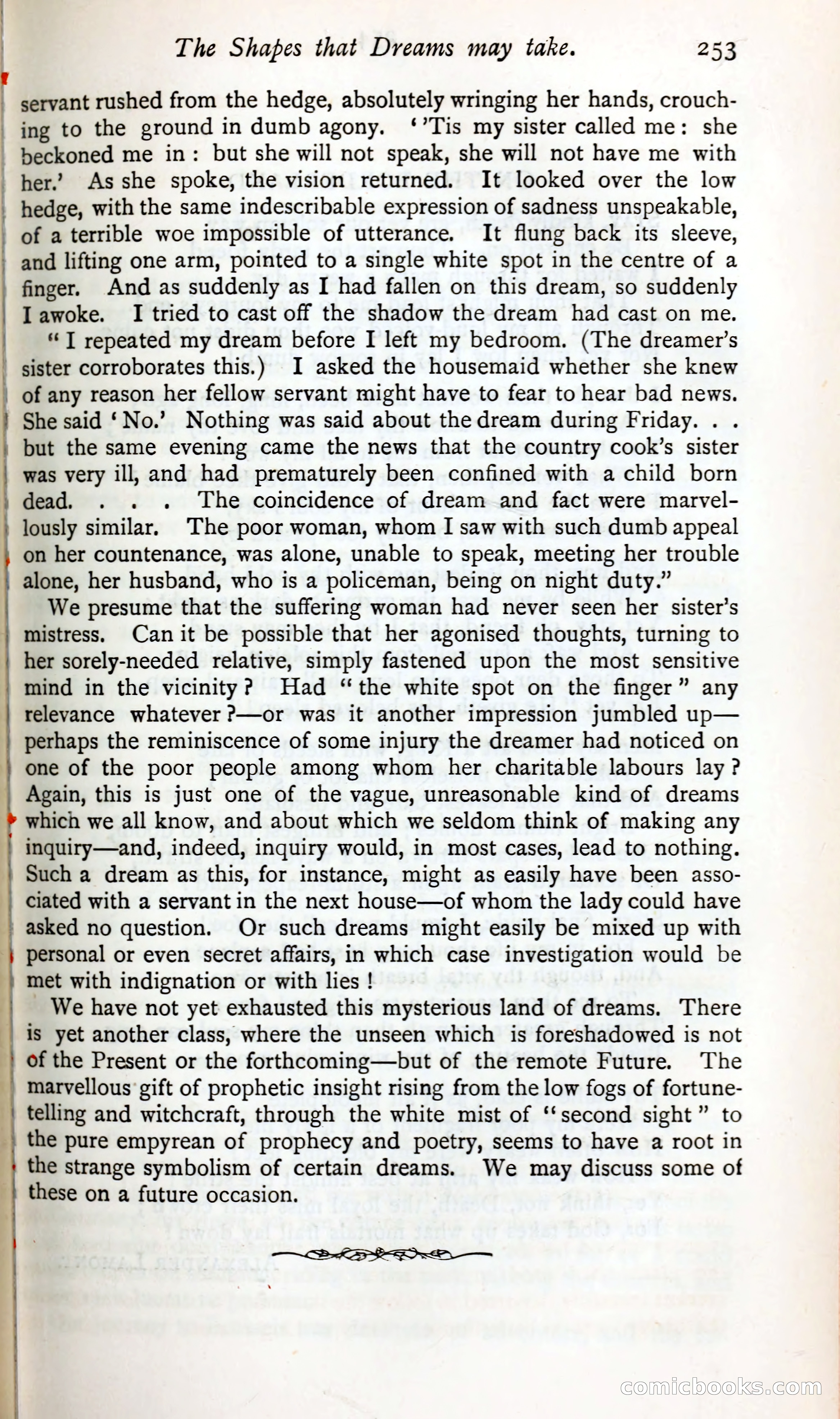
A restored page from Pulp Fiction, 1865. Page through the whole issue in the reader above.
📄 Transcribed text from this page (OCR, searchable)
Machine-transcribed from the original scan — historical spelling and the odd misread are preserved.
The Shapes that Dreams may take. 253 servant rushed from the hedge, absolutely wringing her hands, crouch- ing to the ground in dumb agony. ‘’Tis my sister called me: she beckoned me in: but she will not speak, she will not have me with her. As she spoke, the vision returned. It looked over the low hedge, with the same indescribable expression of sadness unspeakable, of a terrible woe impossible of utterance. It flung back its sleeve, and lifting one arm, pointed to a single white spot in the centre of a finger. And as suddenly as I had fallen on this dream, so suddenly Lawoke. I tried to cast off the shadow the dream had cast on me. “T repeated my dream before I left my bedroom. (The dreamer’s sister corroborates this.) I asked the housemaid whether she knew | of any reason her fellow servant might have to fear to hear bad news. She said ‘No.’ Nothing was said about the dream during Friday. . . | but the same evening came the news that the country cook’s sister was very ill, and had prematurely been confined with a child born \ dead. . . . The coincidence of dream and fact were marvel- Oe ia tem _ lously similar. ‘The poor woman, whom I saw with such dumb appeal on her countenance, was alone, unable to speak, meeting her trouble alone, her husband, who is a policeman, being on night duty.” We presume that the suffering woman had never seen her sister’s mistress. Canit be possible that her agonised thoughts, turning to her sorely-needed relative, simply fastened upon the most sensitive mind in the vicinity? Had “the white spot on the finger” any relevance whatever P—or was it another impression jumbled up— perhaps the reminiscence of some injury the dreamer had noticed on one of the poor people among whom her charitable labours lay? | Again, this is just one of the vague, unreasonable kind of dreams » which we all know, and about which we seldom think of making any } inquiry—and, indeed, inquiry would, in most cases, lead to nothing. | | | | . Such a dream as this, for instance, might as easily have been asso- ciated with a servant in the next house—of whom the lady could have asked no question. Or such dreams might easily be mixed up with personal or even secret affairs, in which case investigation would be met with indignation or with lies! _ We have not yet exhausted this mysterious land of dreams. There is yet another class, where the unseen which is foreshadowed is not of the Present or the forthcoming—but of the remote Future. The marvellous gift of prophetic insight rising from the low fogs of fortune- telling and witchcraft, through the white mist of ‘‘second sight” to the pure empyrean of prophecy and poetry, seems to have a root in the strange symbolism of certain dreams. We may discuss some of these on a future occasion. OEP EOS COMIC OOO SS (SO) im