
Pulp Fiction, 1865 · page 264 of 400
The Argosy — page 264: what you’re looking at
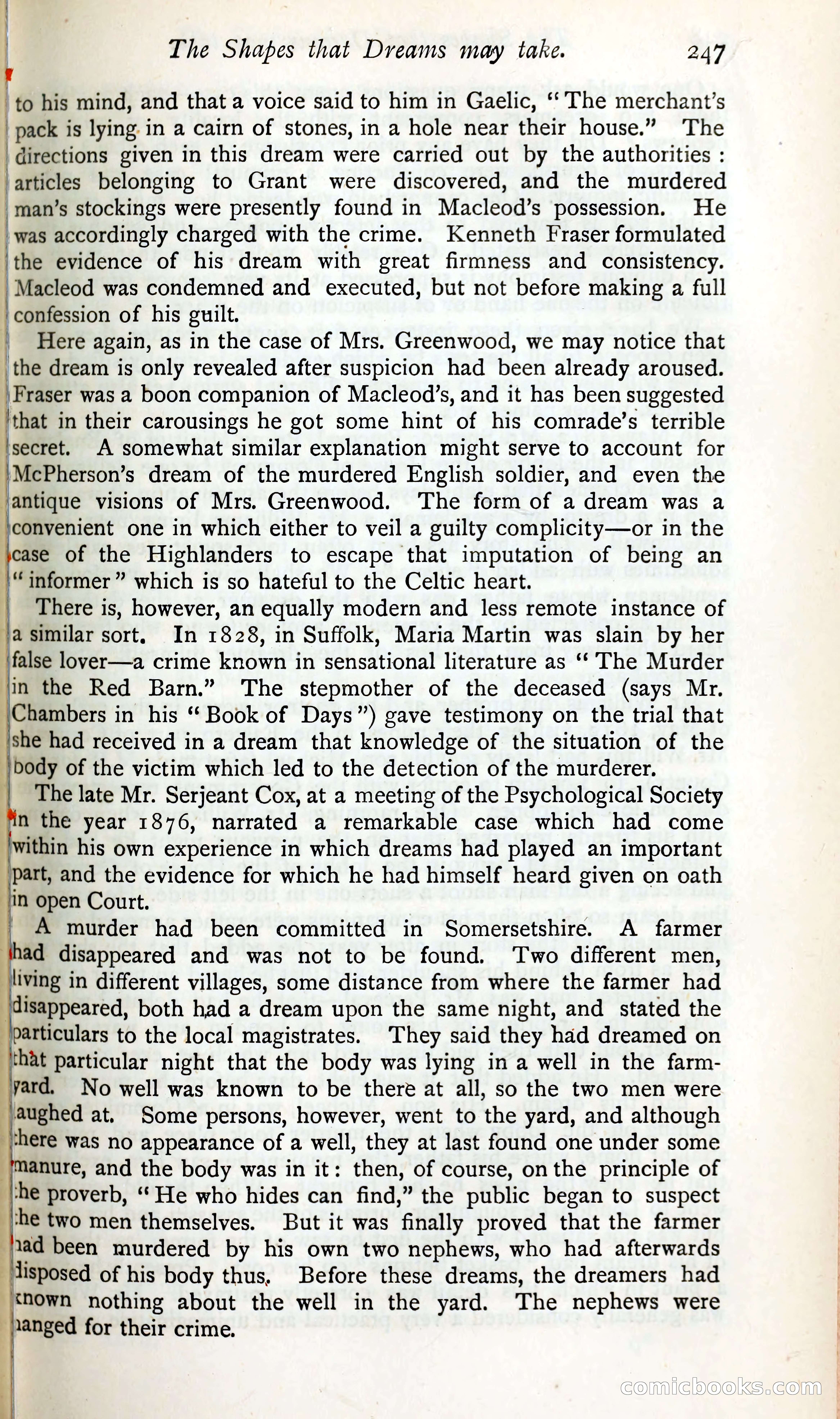
A restored page from Pulp Fiction, 1865. Page through the whole issue in the reader above.
📄 Transcribed text from this page (OCR, searchable)
Machine-transcribed from the original scan — historical spelling and the odd misread are preserved.
The Shapes that Dreams may take. 247 | to his mind, and that a voice said to him in Gaelic, “The merchant’s pack is lying in a cairn of stones, in a hole near their house.” ‘The | directions given in this dream were carried out by the authorities : articles belonging to Grant were discovered, and the murdered _man’s stockings were presently found in Macleod’s possession. He | was accordingly charged with the crime. Kenneth Fraser formulated ‘the evidence of his dream with great firmness and consistency. Macleod was condemned and executed, but not before making a full confession of his guilt. | Here again, as in the case of Mrs. Greenwood, we may notice that the dream is only revealed after suspicion had been already aroused. |Fraser was a boon companion of Macleod’s, and it has been suggested ‘that in their carousings he got some hint of his comrade’s terrible ‘secret. A somewhat similar explanation might serve to account for McPherson’s dream of the murdered English soldier, and even the antique visions of Mrs. Greenwood. The form of a dream was a jconyenient one in which either to veil a guilty complicity—or in the scase of the Highlanders to escape that imputation of being an )“informer ” which is so hateful to the Celtic heart. _ There is, however, an equally modern and less remote instance of jasimilar sort, In 1828, in Suffolk, Maria Martin was slain by her ifalse lover—a crime known in sensational literature as ‘* The Murder pe the Red Barn.” The stepmother of the deceased (says Mr. |Chambers in his “ Book of Days”) gave testimony on the trial that ‘she had received in a dream that knowledge of the situation of the body of the victim which led to the detection of the murderer. _ The late Mr. Serjeant Cox, at a meeting of the Psychological Society i n the year 1876, narrated a remarkable case which had come ‘within his own experience in which dreams had played an important ‘part, and the evidence for which he had himself heard given on oath —— a d jin open Court. : A murder had been committed in Somersetshire. A farmer | lad disappeared and was not to be found. Two different men, living in different villages, some distance from where the farmer had Misappeared, both had a dream upon the same night, and stated the particulars to the local magistrates. They said they had dreamed on that particular night that the body was lying in a well in the farm- yard. No well was known to be there at all, so the two men were aughed at. Some persons, however, went to the yard, and although there was no appearance of a well, they at last found one under some anure, and the body was in it: then, of course, on the principle of tthe proverb, “He who hides can find,” the public began to suspect }he two men themselves. But it was finally proved that the farmer nad been murdered by his own two nephews, who had afterwards disposed of his body thus, Before these dreams, the dreamers had nown nothing about the well in the yard. The nephews were ; langed for their crime. SS (CO) COMIC OOO