
Pulp Fiction, 1865 · page 253 of 400
The Argosy — page 253: what you’re looking at
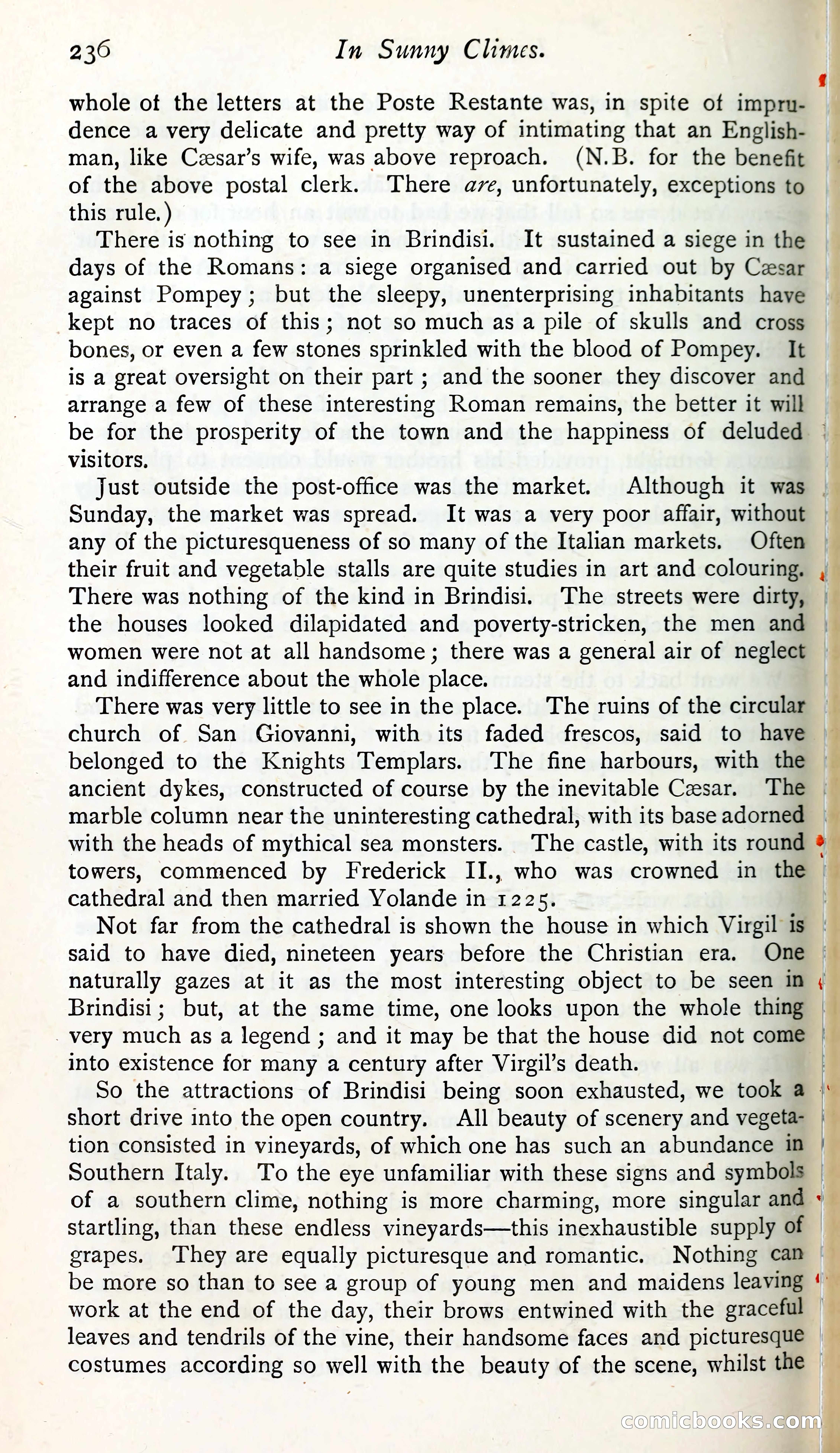
A restored page from Pulp Fiction, 1865. Page through the whole issue in the reader above.
📄 Transcribed text from this page (OCR, searchable)
Machine-transcribed from the original scan — historical spelling and the odd misread are preserved.
2.30 In Sunny Chimes. whole of the letters at the Poste Restante was, in spite of impru- dence a very delicate and pretty way of intimating that an English- man, like Czesar’s wife, was above reproach. (N.B. for the benefit of the above postal clerk. There ave, unfortunately, exceptions to this rule. ) There is nothing to see in Brindisi. It sustained a siege in the days of the Romans: a siege organised and carried out by Cesar against Pompey; but the sleepy, unenterprising inhabitants have kept no traces of this; not so much asa pile of skulls and cross bones, or even a few stones sprinkled with the blood of Pompey. It is a great oversight on their part ; and the sooner they discover and arrange a few of these interesting Roman remains, the better it will : be for the prosperity of the town and the happiness of deluded | visitors. Just outside the post-office was the market. Although it was | Sunday, the market was spread. It was a very poor affair, without any of the picturesqueness of so many of the Italian markets. Often their fruit and vegetable stalls are quite studies in art and colouring. There was nothing of the kind in Brindisi. ‘The streets were dirty, the houses looked dilapidated and poverty-stricken, the men and women were not at all handsome; there was a general air of neglect and indifference about the whole place. There was very little to see in the place. The ruins of the circular church of San Giovanni, with its faded frescos, said to have belonged to the Knights Templars. The fine harbours, with the ancient dykes, constructed of course by the inevitable Czesar. The © marble column near the uninteresting cathedral, with its base adorned with the heads of mythical sea monsters. The castle, with its round towers, commenced by Frederick II., who was crowned in the | cathedral and then married Yolande in 1225. Not far from the cathedral is shown the house in which Virgil is said to have died, nineteen years before the Christian era. One naturally gazes at it as the most interesting object to be seen in Brindisi; but, at the same time, one looks upon the whole thing _ very much as a legend ; and it may be that the house did not come into existence for many a century after Virgil’s death. So the attractions of Brindisi being soon exhausted, we took a short drive into the open country. All beauty of scenery and vegeta- tion consisted in vineyards, of which one has such an abundance in Southern Italy. To the eye unfamiliar with these signs and symbols of a southern clime, nothing is more charming, more singular and startling, than these endless vineyards—this inexhaustible supply of grapes. ‘They are equally picturesque and romantic. Nothing can be more so than to see a group of young men and maidens leaving work at the end of the day, their brows entwined with the graceful leaves and tendrils of the vine, their handsome faces and picturesque — costumes according so well with the beauty of the scene, whilst the CORnnIELOOKS areola a) al A —. » —— — ar a , “a —ae— = mmm, ee in a ae a en Sn