
Pulp Fiction, 1865 · page 199 of 400
The Argosy — page 199: what you’re looking at
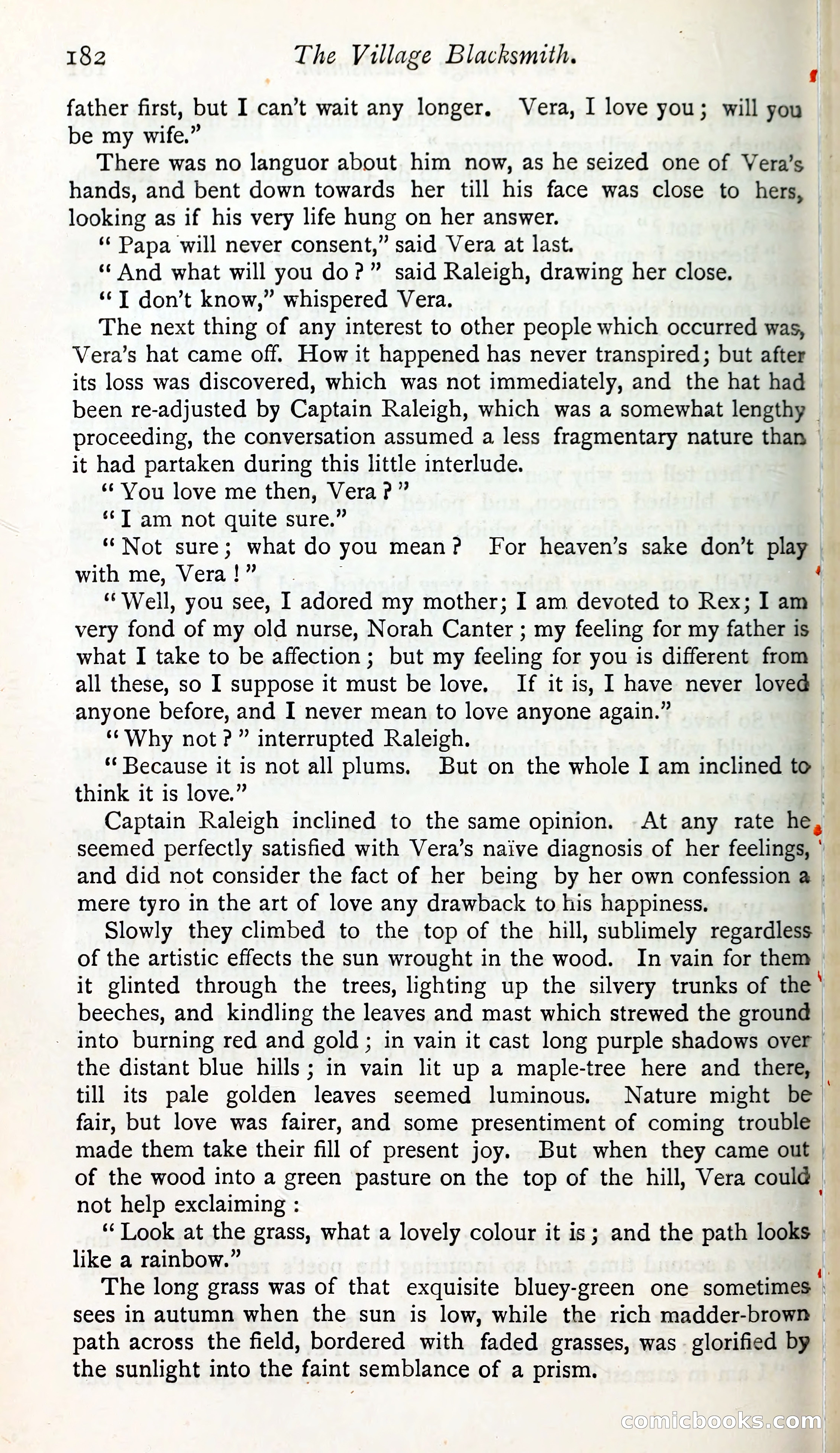
A restored page from Pulp Fiction, 1865. Page through the whole issue in the reader above.
📄 Transcribed text from this page (OCR, searchable)
Machine-transcribed from the original scan — historical spelling and the odd misread are preserved.
182 The Village Blacksmith. father first, but I can’t wait any longer. Vera, I love you; will you be my wife.” There was no languor about him now, as he seized one of Vera’s hands, and bent down towards her till his face was close to hers, looking as if his very life hung on her answer. ‘* Papa will never consent,” said Vera at last. ‘ And what will you do?” said Raleigh, drawing her close. ‘¢T don’t know,” whispered Vera. The next thing of any interest to other people which occurred was, Vera’s hat came off. How it happened has never transpired; but after its loss was discovered, which was not immediately, and the hat had been re-adjusted by Captain Raleigh, which was a somewhat lengthy © proceeding, the conversation assumed a less fragmentary nature than — it had partaken during this little interlude. ‘¢ You love me then, Vera a4 ‘*T am not quite sure.’ “Not sure; what do you mean? For heaven’s sake don’t play with me, Vera!” + Well, you see, I adored my mother; I am devoted to Rex; I am very fond of my old nurse, Norah Canter ; my feeling for my father is what I take to be affection; but my feeling for you is different from all these, so I suppose it must be love. If it is, I have never loved anyone before, and I never mean to love anyone again.” : ‘Why not?” interrupted Raleigh. ‘Because it is not all plums. But on the whole I am inclined to think it is love.” . Captain Raleigh inclined to the same opinion. At any rate he, seemed perfectly satisfied with Vera’s naive diagnosis of her feelings, ° and did not consider the fact of her being by her own confession a mere tyro in the art of love any drawback to his happiness. Slowly they climbed to the top of the hill, sublimely recardlaa of the artistic effects the sun wrought in the wood. In vain for them | it glinted through the trees, lighting up the silvery trunks of the’ beeches, and kindling the leaves and mast which strewed the ground | _ into burning red and gold; in vain it cast long purple shadows over | the distant blue hills; in vain lit up a maple-tree here and there, | till its pale golden leaves seemed luminous. Nature might be > fair, but love was fairer, and some presentiment of coming trouble made them take their fill of present joy. But when they came out | of the wood into a green pasture on the top of the hill, Vera coul@ | not help exclaiming : “ Look at the grass, what a lovely colour it is; and the path looks | like a rainbow.” I The long grass was of that exquisite bluey-green one sometimes sees in autumn when the sun is low, while the rich madder-brown | path across the field, bordered with faded grasses, was glorified by the sunlight into the faint semblance of a prism. Gomicsdooks.com