
Pulp Fiction, 1865 · page 173 of 400
The Argosy — page 173: what you’re looking at
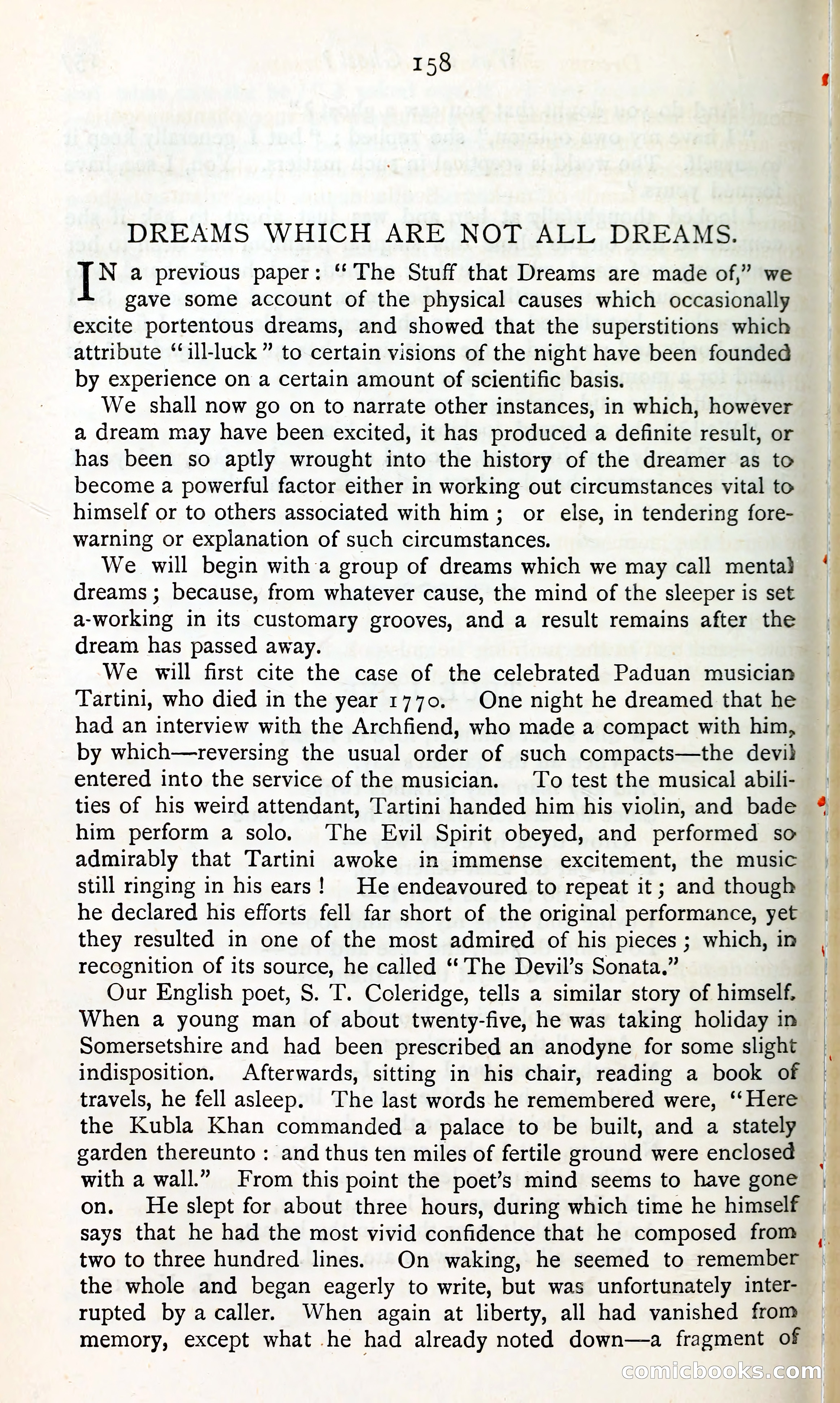
A restored page from Pulp Fiction, 1865. Page through the whole issue in the reader above.
📄 Transcribed text from this page (OCR, searchable)
Machine-transcribed from the original scan — historical spelling and the odd misread are preserved.
158 DREAMS WHICH ARE NOT ALL DREAMS. he a previous paper: ‘‘ The Stuff that Dreams are made of,” we gave some account of the physical causes which occasionally excite portentous dreams, and showed that the superstitions which attribute ‘‘ill-luck” to certain visions of the night have been founded by experience on a certain amount of scientific basis. We shall now go on to narrate other instances, in which, however a dream may have been excited, it has produced a definite result, or has been so aptly wrought into the history of the dreamer as to become a powerful factor either in working out circumstances vital to himself or to others associated with him; or else, in tendering fore- warning or explanation of such circumstances. We will begin witha group of dreams which we may call mental dreams ; because, from whatever cause, the mind of the sleeper is set a-working in its customary grooves, and a result remains after the dream has passed away. We will first cite the case of the celebrated Paduan musician Tartini, who died in the year 1770. One night he dreamed that he had an interview with the Archfiend, who made a compact with him, by which—reversing the usual order of such compacts—the devil entered into the service of the musician. To test the musical abili- ties of his weird attendant, Tartini handed him his violin, and bade him perform a solo. The Evil Spirit obeyed, and performed so admirably that Tartini awoke in immense excitement, the music still ringing in his ears! He endeavoured to repeat it; and though he declared his efforts fell far short of the original performance, yet they resulted in one of the most admired of his pieces ; which, in recognition of its source, he called “‘ The Devil’s Sonata.” Our English poet, S. T. Coleridge, tells a similar story of himself. When a young man of about twenty-five, he was taking holiday in Somersetshire and had been prescribed an anodyne for some slight indisposition. Afterwards, sitting in his chair, reading a book of travels, he fell asleep. The last words he remembered were, ‘‘ Here the Kubla Khan commanded a palace to be built, and a stately garden thereunto: and thus ten miles of fertile ground were enclosed with a wall.” From this point the poet’s mind seems to have gone on. He slept for about three hours, during which time he himself says that he had the most vivid confidence that he composed from two to three hundred lines. On waking, he seemed to remember the whole and began eagerly to write, but was unfortunately inter- rupted by a caller. When again at liberty, all had vanished from memory, except what he had already noted down—a fragment of -& ee ee a ee a a a, COMIC OOOMKS pe) 7 tt x