
Pulp Fiction, 1865 · page 119 of 400
The Argosy — page 119: what you’re looking at
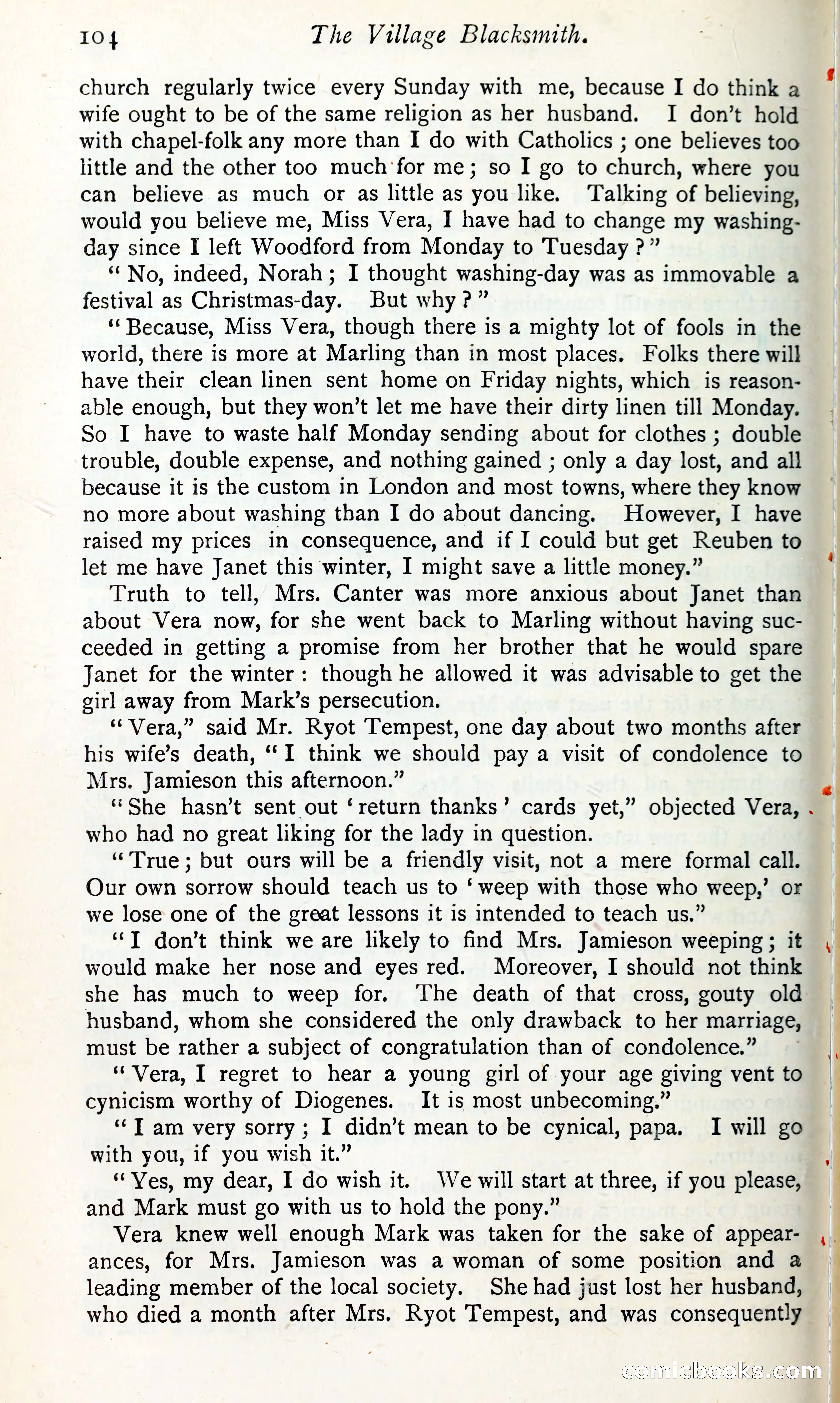
A restored page from Pulp Fiction, 1865. Page through the whole issue in the reader above.
📄 Transcribed text from this page (OCR, searchable)
Machine-transcribed from the original scan — historical spelling and the odd misread are preserved.
IO4 The Village Blacksmith. church regularly twice every Sunday with me, because I do think a wife ought to be of the same religion as her husband. I don’t hold with chapel-folk any more than I do with Catholics ; one believes too little and the other too much'for me; so I go to church, where you can believe as much or as little as you like. Talking of believing, would you believe me, Miss Vera, I have had to change my washing- day since I left Woodford from Monday to Tuesday ?” ‘No, indeed, Norah; I thought washing-day was as immovable a festival as Christmas-day. But why?” ‘Because, Miss Vera, though there is a mighty lot of fools in the world, there is more at Marling than in most places. Folks there will have their clean linen sent home on Friday nights, which is reason- able enough, but they won’t let me have their dirty linen till Monday. So I have to waste half Monday sending about for clothes ; double trouble, double expense, and nothing gained ; only a day lost, and all because it is the custom in London and most towns, where they know no more about washing than I do about dancing. However, I have raised my prices in consequence, and if I could but get Reuben to let me have Janet this winter, I might save a little money.” Truth to tell, Mrs. Canter was more anxious about Janet than about Vera now, for she went back to Marling without having suc- ceeded in getting a promise from her brother that he would spare Janet for the winter: though he allowed it was advisable to get the girl away from Mark’s persecution. Vera,” said Mr. Ryot Tempest, one day about two months after his wife’s death, ‘I think we should pay a visit of condolence to Mrs. Jamieson this afternoon.” ~~ ee —E—— — ‘She hasn’t sent out ‘return thanks’ cards yet,” objected Vera, . who had no great liking for the lady in question. “True; but ours will be a friendly visit, not a mere formal call. Our own sorrow should teach us to ‘weep with those who weep,’ or we lose one of the great lessons it is intended to teach us.” ‘‘T don’t think we are hkely to find Mrs. Jamieson weeping; it would make her nose and eyes red. Moreover, I should not think she has much to weep for. ‘The death of that cross, gouty old husband, whom she considered the only drawback to her marriage, must be rather a subject of congratulation than of condolence.” ‘ Vera, I regret to hear a young girl of your age giving vent to cynicism worthy of Diogenes. It is most unbecoming.” ‘¢T am very sorry ; I didn’t mean to be cynical, papa. I will go with you, if you wish it.” ‘Ves, my dear, I do wish it. We will start at three, if you please, and Mark must go with us to hold the pony.” Vera knew well enough Mark was taken for the sake of appear- ances, for Mrs. Jamieson was a woman of some position and 2 leading member of the local society. She had just lost her husband, who died a month after Mrs. Ryot Tempest, and was consequently CONNICLOOKS.E)