
Pulp Fiction, 1865 · page 113 of 400
The Argosy — page 113: what you’re looking at
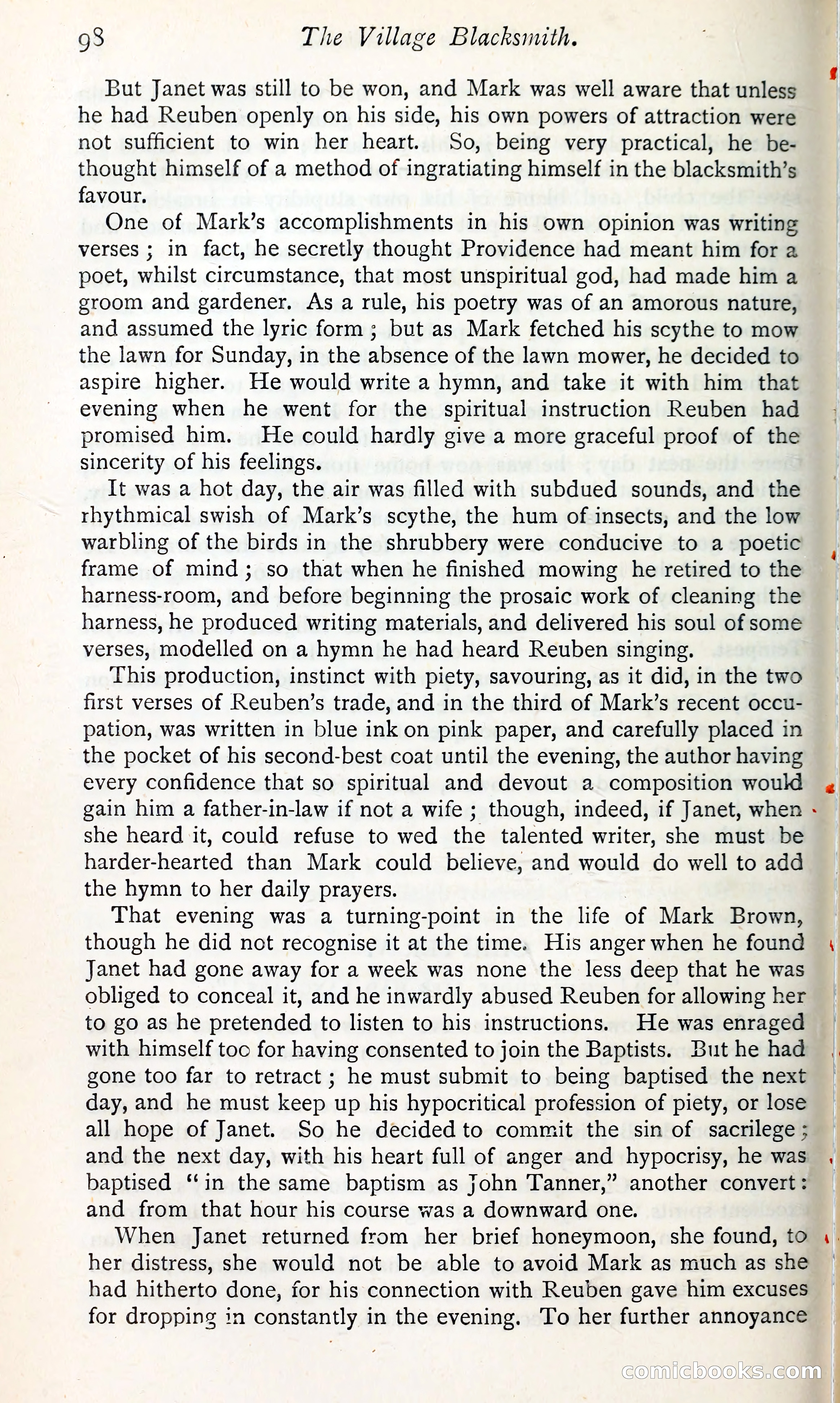
A restored page from Pulp Fiction, 1865. Page through the whole issue in the reader above.
📄 Transcribed text from this page (OCR, searchable)
Machine-transcribed from the original scan — historical spelling and the odd misread are preserved.
93 The Village Blacksmith. But Janet was still to be won, and Mark was well aware that unless he had Reuben openly on his side, his own powers of attraction were not sufficient to win her heart. So, being very practical, he be- thought himself of a method of ingratiating himself in the blacksmith’s favour. One of Mark’s accomplishments in his own opinion was writing verses ; in fact, he secretly thought Providence had meant him for a poet, whilst circumstance, that most unspiritual god, had made him a groom and gardener. As a rule, his poetry was of an amorous nature, and assumed the lyric form; but as Mark fetched his scythe to mow the lawn for Sunday, in the absence of the lawn mower, he decided to aspire higher. He would write a hymn, and take it with him that evening when he went for the spiritual instruction Reuben had promised him. He could hardly give a more graceful proof of the sincerity of his feelings. It was a hot day, the air was filled with subdued sounds, and the rhythmical swish of Mark’s scythe, the hum of insects, and the low warbling of the birds in the shrubbery were conducive to a poetic frame of mind; so that when he finished mowing he retired to the harness-room, and before beginning the prosaic work of cleaning the harness, he produced writing materials, and delivered his soul of some verses, modelled on a hymn he had heard Reuben singing. This production, instinct with piety, savouring, as it did, in the two first verses of Reuben’s trade, and in the third of Mark’s recent occu- pation, was written in blue ink on pink paper, and carefully placed in the pocket of his second-best coat until the evening, the author having every confidence that so spiritual and devout a composition would gain him a father-in-law if not a wife ; though, indeed, if Janet, when - she heard it, could refuse to wed the talented writer, she must be harder-hearted than Mark could believe, and would do well to add the hymn to her daily prayers. That evening was a turning- point in the life of Mark Brown, though he did not recognise it at the time. His anger when he found Janet had gone away for a week was none the less deep that he was obliged to conceal it, and he inwardly abused Reuben for allowing her to go as he pretended to listen to his instructions. He was enraged with himself too for having consented to join the Baptists. But he had gone too far to retract ; he must submit to being baptised the next day, and he must keep up his hypocritical profession of piety, or lose all hope of Janet. So he decided to commit the sin of sacrilege ; and the next day, with his heart full of anger and hypocrisy, he was baptised ‘fin the same baptism as john Tanner,” another convert: and from that hour his course was a downward one. When Janet returned from her brief honeymoon, she found, to her distress, she would not be able to avoid Mark as much as she had hitherto done, for his connection with Reuben gave him excuses for dropping in constantly in the evening. To her further annoyance COMIC OOOKS. COarg