
Pulp Fiction, 1865 · page 99 of 400
The Argosy — page 99: what you’re looking at
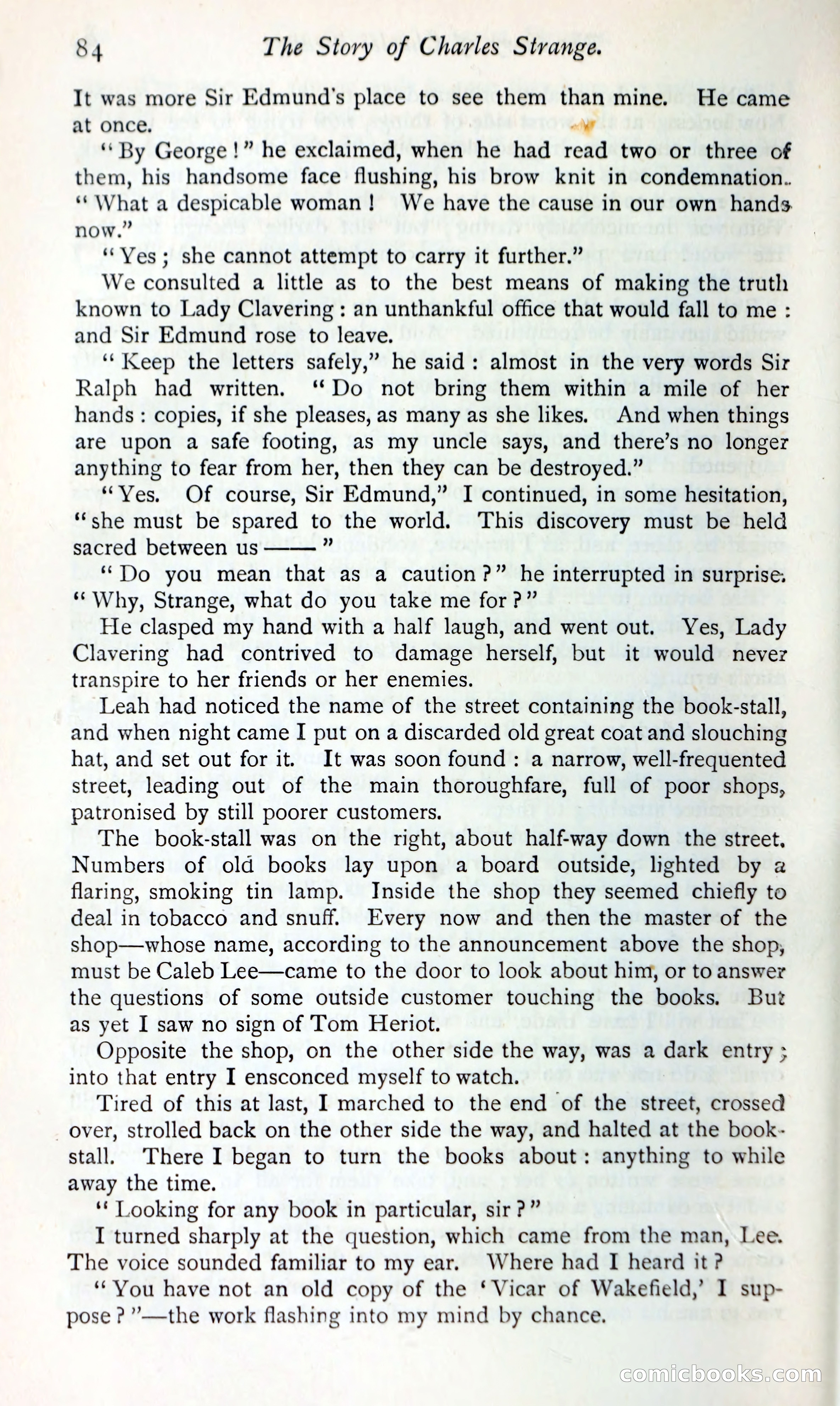
A restored page from Pulp Fiction, 1865. Page through the whole issue in the reader above.
📄 Transcribed text from this page (OCR, searchable)
Machine-transcribed from the original scan — historical spelling and the odd misread are preserved.
8 4 The Story of Charles Strange. It was more Sir Edmund's place to see them than mine. He came at once. oN ‘By George!” he exclaimed, when he had read two or three of them, his handsome face flushing, his brow knit in condemnation. ‘“ What a despicable woman! We have the cause in our own hands. now.” “Yes; she cannot attempt to carry it further.” We consulted a little as to the best means of making the truth known to Lady Clavering : an unthankful office that would fall to me : and Sir Edmund rose to leave. ‘‘ Keep the letters safely,” he said: almost in the very words Sir Ralph had written. ‘Do not bring them within a mile of her hands: copies, if she pleases, as many as she likes. And when things are upon a safe footing, as my uncle says, and there’s no longer anything to fear from her, then they can be destroyed.” “Ves. Of course, Sir Edmund,” I continued, in some hesitation, ‘she must be spared to the world. This discovery must be held sacred between us ” ‘Do you mean that as a caution?” he interrupted in surprise. ‘Why, Strange, what do you take me for?” He clasped my hand with a half laugh, and went out. Yes, Lady Clavering had contrived to damage herself, but it would never transpire to her friends or her enemies. Leah had noticed the name of the street containing the book-stall, and when night came I put on a discarded old great coat and slouching hat, and set out for it. It was soon found: a narrow, well-frequented street, leading out of the main thoroughfare, full of poor shops, patronised by still poorer customers. The book-stall was on the right, about half-way down the street, Numbers of old books lay upon a board outside, lighted by 2 flaring, smoking tin lamp. Inside the shop they seemed chiefly to deal in tobacco and snuff. Every now and then the master of the shop—whose name, according to the announcement above the shop, must be Caleb Lee—came to the door to look about him, or to answer the questions of some outside customer touching the books. But as yet I saw no sign of Tom Heriot. Opposite the shop, on the other side the way, was a dark entry ; into that entry I ensconced myself to watch. Tired of this at last, I marched to the end of the street, crossed over, strolled back on the other side the way, and halted at the book- stall. There I began to turn the books about: anything to while away the time. ‘* Looking for any book in particular, sir ?” I turned sharply at the question, which came from the man, Lee. The voice sounded familiar to my ear. Where had I heard it? ‘You have not an old copy of the ‘Vicar of Wakefield,’ I sup- pose ?”’—the work flashing into my mind by chance. COMMICLOOOKS.E© m