
Pulp Fiction, 1865 · page 89 of 400
The Argosy — page 89: what you’re looking at
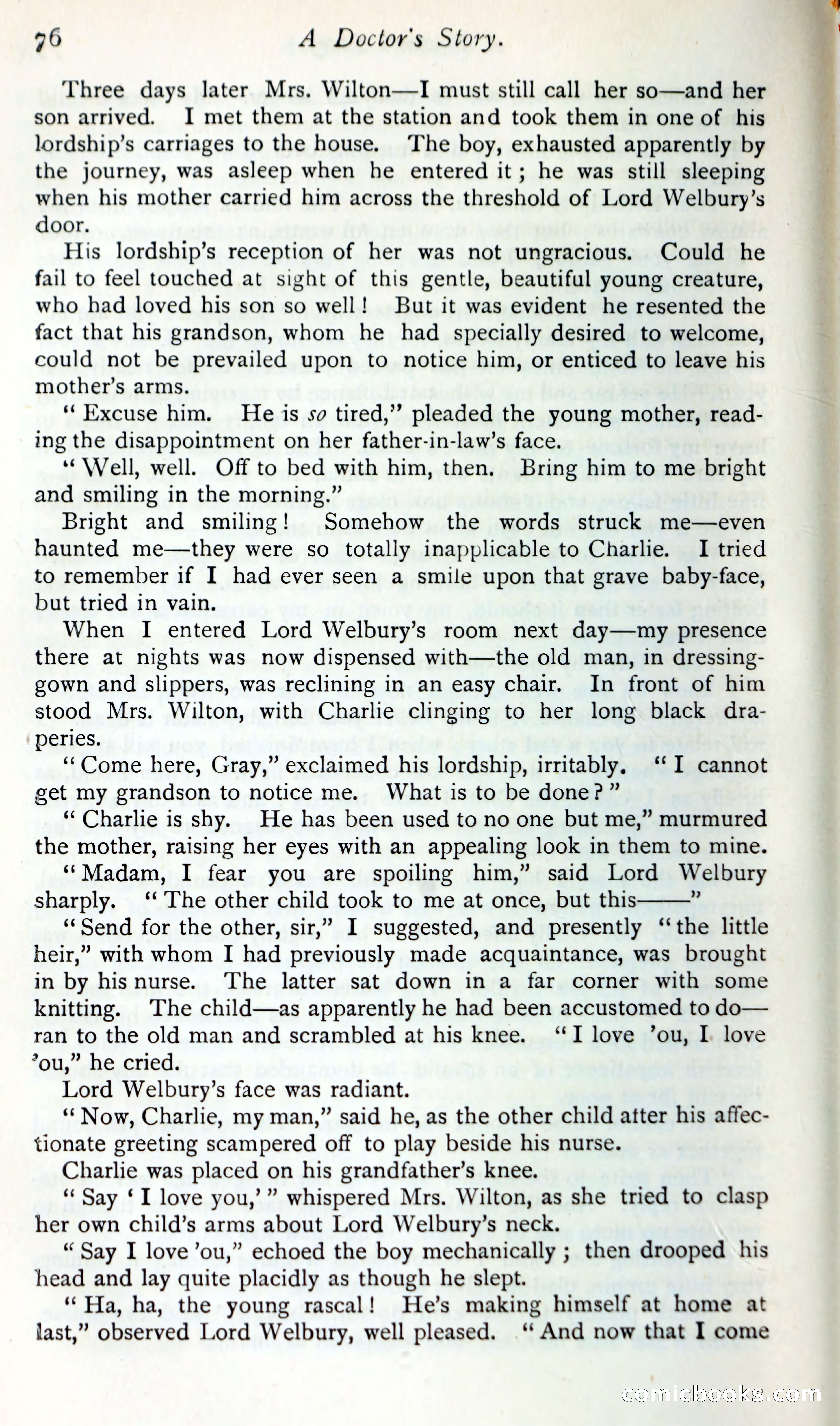
A restored page from Pulp Fiction, 1865. Page through the whole issue in the reader above.
📄 Transcribed text from this page (OCR, searchable)
Machine-transcribed from the original scan — historical spelling and the odd misread are preserved.
76 A Doctor's Story. Three days later Mrs. Wilton—I must still call her so—and her son arrived. I met them at the station and took them in one of his lordship’s carriages to the house. ‘The boy, exhausted apparently by the journey, was asleep when he entered it; he was still sleeping when his mother carried him across the threshold of Lord Welbury’s door. His lordship’s reception of her was not ungracious. Could he fail to feel touched at sight of this gentle, beautiful young creature, who had loved his son so well! But it was evident he resented the fact that his grandson, whom he had specially desired to welcome, could not be prevailed upon to notice him, or enticed to leave his mother’s arms. “Excuse him. He is so tired,’’ pleaded the young mother, read- ing the disappointment on her father-in-law’s face. “Well, well. Off to bed with him, then. Bring him to me bright and smiling in the morning.” Bright and smiling! Somehow the words struck me—even haunted me—they were so totally inapplicable to Charlie. I tried to remember if I had ever seen a smile upon that grave baby-face, but tried in vain. When I entered Lord Welbury’s room next day—my presence there at nights was now dispensed with—the old man, in dressing- gown and slippers, was reclining in an easy chair. In front of him stood Mrs. Wilton, with Charlie clinging to her long black dra- peries. ‘“‘Come here, Gray,” exclaimed his lordship, irritably. ‘‘ I cannot get my grandson to notice me. What is to be done?” ‘Charlie is shy. He has been used to no one but me,” murmured the mother, raising her eyes with an appealing look in them to mine. ‘Madam, I fear you are spoiling him,” said Lord Welbury sharply. ‘‘ The other child took to me at once, but this + ‘Send for the other, sir,” I suggested, and presently ‘‘the little heir,” with whom I had previously made acquaintance, was brought in by hisnurse. ‘The latter sat down in a far corner with some knitting. The child—as apparently he had been accustomed to do— ran to the old man and scrambled at his knee. ‘‘I love ’ou, I love *ou,” he cried. Lord Welbury’s face was radiant. ‘‘ Now, Charlie, my man,” said he, as the other child atter his affec- tionate greeting scampered off to play beside his nurse. Charlie was placed on his grandfather’s knee. ‘‘ Say ‘I love you,’” whispered Mrs. Wilton, as she tried to clasp her own child’s arms about Lord Welbury’s neck. “ Say I love ’ou,” echoed the boy mechanically ; then drooped his head and lay quite placidly as though he slept. ‘Ha, ha, the young rascal! He’s making himself at home at last,” observed Lord Welbury, well pleased. “ And now that I come CORNICE OOOKS (EO)